Hybrid
Plants & Bulbs
Abutilon pictum
SKU: ABUT-PICT-01G
Two things the common names get wrong: it is not Chinese, and it is not a maple. Abutilon pictum comes from the warm river country of southern Brazil and its neighbors, Argentina, Paraguay, and Uruguay, and the maple lives only in the leaves, which are lobed and toothed enough to
Combine varieties in one inquiry
About this variety
Two things the common names get wrong: it is not Chinese, and it is not a maple. Abutilon pictum comes from the warm river country of southern Brazil and its neighbors, Argentina, Paraguay, and Uruguay, and the maple lives only in the leaves, which are lobed and toothed enough to have fooled people into "flowering maple." It belongs instead to the mallow family, in good company with hibiscus, hollyhock, okra, and cotton, and it carries that resemblance in every five-petaled bloom.
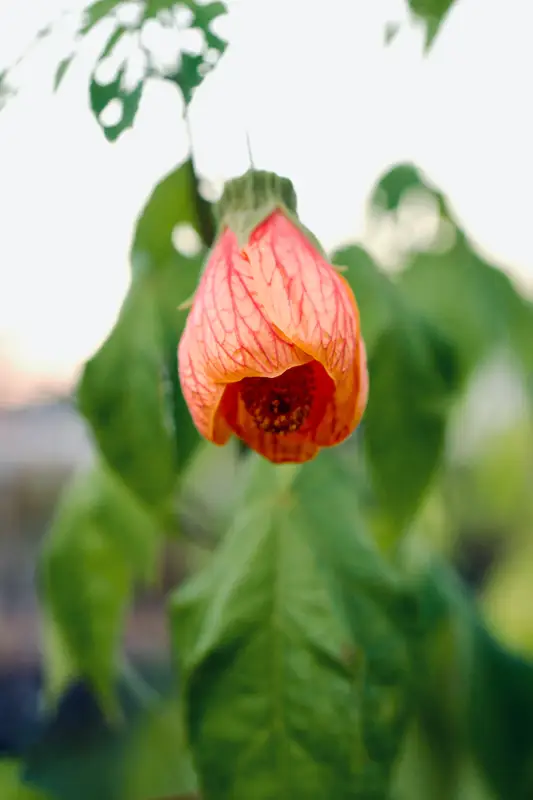
pictum means painted, and the painting is in the veins: bell-shaped flowers of warm orange, each petal overlaid with fine crimson lines, hung on long thin stalks like lanterns strung along the branch. They open from spring well into fall, are sweet enough to eat, and hummingbirds find them without being told. The Victorians kept this as a parlour plant, a tender thing for the conservatory shelf, and a century and a half on it still has that faintly old-fashioned, hothouse charm. One confession from the family album: several of its speckle-leaved cousins owe their gold-dusted foliage to a virus, kept on purpose and passed plant to plant. This one stays honestly green.
In zone 8 they behave as a dieback shrub, cut hard after the first frost, mounded against the cold, rising again with the heat to hang lanterns from May clear through October. A sheltered corner and a little sun are the whole of the asking. For all the misnamings, it is still one of the surest ways to keep a hummingbird returning to the same warm wall, summer after summer.
Standing on: It is native to southern Brazil, Argentina, Paraguay, and Uruguay, in the family Malvaceae; "Chinese-lantern" and "flowering maple" are common names, and pictum means "painted." The flowers attract bees and hummingbirds and are edible with a sweet flavor; A. striatum/'Thompsonii'-type relatives develop prized variegated foliage from Abutilon mosaic virus, while A. pictum itself does not. It is in the mallow family alongside hibiscus and is grown as a greenhouse or conservatory plant in cooler climates.
You may also like
View all
Hybrid
Hybrid
Hybrid