
21 of the Best Plants to Grow on a Septic Discharge Field
Let’s face it: a septic drainage field can be an eyesore. Most people just cover theirs up with some lawn and call it a day. When something goes wrong, these spaces can turn into a muddy, mucky mess, but even when they’re working as they should, they’re nothing to write home about. But it doesn’t.
Let’s face it: a septic drainage field can be an eyesore. Most people just cover theirs up with some lawn and call it a day.
When something goes wrong, these spaces can turn into a muddy, mucky mess, but even when they’re working as they should, they’re nothing to write home about.
But it doesn’t have to be like that. You can turn a drainage field into a gorgeous garden, so long as you pick the right plants.
While you shouldn’t plant a vegetable garden or woody shrubs over your drainage area, herbaceous plants are just fine.
Better than fine, actually – whereas compacted soil can lead to drainage failure, the roots can help to aerate the soil so your septic system functions as it should.
Which plants will work? There are plenty of options. Here are the top picks we’ll be discussing:
21 of the Best Plants for Septic Fields
1. Agapanthus
2. Blue Fescue
3. Butterfly Weed
4. Cast-Iron Plant
5. Columbine
6. Crocus
7. Daffodil
8. Dahlia
9. Foxglove
10. Gladiolus
11. Grape Hyacinth
12. Hellebore
13. Iris
14. Lady’s Mantle
15. Lily
16. Oatgrass
17. Sedge
18. Trillium
19. Tulip
20. Violet
21. Yarrow
Before we jump in, let’s quickly talk about how septic systems work. Say you flush your toilet.
The water, excrement, and toilet paper heads down the drain and into the tank, which holds everything. The solids are kept in the tank while the wastewater exits into the drainfield.
The field filters the wastewater through the soil, along with some help from beneficial bacteria in the soil.
Septic drain fields won’t typically be wet on the surface unless there is an issue with the drainage.
But you should use plants that can tolerate some moisture, since clogging and other failures aren’t terribly uncommon.
If you plant a bunch of cacti and your field floods, you’re going to be replacing a lot of plants.
Ideally, discuss your planting plan with the septic installers if this will be a new system so they can keep everything in mind when preparing the layout.
Ready to decide what to plant? You won’t see any trees on this list.
That’s because trees usually have large root systems, and the last thing you want is for these roots to intrude, infiltrating your septic system.
Speaking of intruding, don’t dig too deep when cultivating the soil. Some drain and supply lines may be right below the soil surface, so never till the ground as you dig in your plants.
Do it by hand, so you can feel what you’re working with and stop if you hit something that should be avoided.
Septic systems need to breathe, believe it or not, so you don’t want to plant dense ground covers or plants that will capture debris either.
1. Agapanthus
Whether you call them lilies of the nile, African lilies, or agapanthus, the flowering plants in the Agapanthus genus are easy to love.
Their clusters of trumpet-shaped flowers steal the show all summer and fall. And even when the flowers aren’t around, the strappy, grass-like foliage is appealing all on its own.
Agapanthus
If you live in Zones 6 to 11, you can fill your leach field with these deer-resistant beauties.
For the classic blue-purple options, grab three, six, or nine bare roots at .
Learn how to grow your own agapanthus here.
2. Blue Fescue
If you need a little evergreen, or semi-evergreen, depending on your location, color in your septic field, check out blue fescue (Festuca glauca).
This quick-growing grass grows in foot-tall clumps in Zones 4 to 8.
Blue Fescue Grass
Use it in clusters for a carpet-like appearance, as an accent, or as a border for taller plants.
3. Butterfly Weed
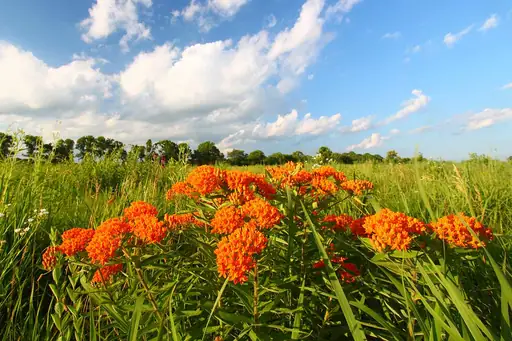
If you want to attract butterflies to your garden, you can’t go wrong with butterfly weed (Asclepias tuberosa).
Hardy in Zones 3 to 9, the orange-yellow flowers that pop up in the summer attract pollinators and add vibrant color to your septic field.
Butterfly Weed
Learn more about growing butterfly weed and other types of milkweeds.
4. Cast-Iron Plant
Aspidistra elatior is a fantastically tough plant for those who live in Zones 8 to 10.
Many people know cast-iron plant as a houseplant, but this fantastic foliage plant makes an excellent outdoor specimen, hedge, or grouping plant for warmer climates.
The leaves come in an exciting range of colors and patterns, with some featuring stars, stripes, and splotches of light green, yellow, or white.
They also produce small, strange flowers that only outdoor gardeners will be able to grow easily.
Cast-Iron Plant
And don’t worry one bit about flooding. If your field runneth over, these plants will be just fine. Same thing with drought and general neglect – they can handle it.
5. Columbine
A self-seeding, short-lived perennial, columbine (Aquilegia spp.) is just perfect if your septic field receives a bit of shade.
The red, orange, yellow, purple, blue, violet, white, or pink flowers will bloom nicely in a partial shade exposure, and this hummingbird favorite will bloom for up to a month.
Columbine Origami Mix
Can’t commit to just one color?
‘McKana Giants’
Or, grab about 130 seeds of ‘McKana Giants’ in a blend of colors from .
Find cultivation tips in our guide to growing columbine.
5. Crocus
Crocuses (Crocus spp.) are famous for their early spring color, but some types bloom in fall and winter.
Grow a mixture for some long-lasting interest, or mix spring bloomers with something different that will offer up summer color, like daylilies.
With over 80 species and tons of hybrids available there are lots of crocuses to choose from, and you’ll find options suitable for Zones 3 to 8.
Crocus Large Flowering Mix
Bring home a mix of yellow, white, and violet spring-blooming jumbo crocuses (C. vernus) in 25, 50, and 100 counts from .
Read our guide to learn more about growing crocuses at home.
7. Daffodil
Daffodils (Narcissus spp.) are always a welcome sight in the spring.
The bright yellow – or white, pink, or orange – blossoms rise up like little bits of sunshine, and you can use them to shine up blah spots like a septic field.
You can find cultivars that will grow in Zones 4 to 8, and they’ll return reliably year after year with hardly any work from you.
Daffodils have come a long way if you haven’t grown them in a while.
‘Replete’ Daffodils
‘Replete’ is pink at its ruffled center, surrounded by creamy white outer petals. It’s drought-tolerant, tall, and attention-grabbing.
You can make 10, 20, 50, or 100 ‘Replete’ bulbs yours by visiting .
‘Tahiti’ is a unique double daffodil with pale yellow petals surrounded by smaller, ruffled petals in vibrant red-orange.
‘Tahiti’ Daffodils
Grab 10, 20, 50, or 100 bulbs of this vigorous, tough daffodil at .
Learn more about growing daffodils here.
8. Dahlia
It’s pretty obvious why dahlias (Dahlia spp.) have garnered such a loyal following of ardent fans. They’re stunning. A massive dinnerplate dahlia is truly impossible to compete with.
Thanks to their shallow root systems, they’re perfect for septic areas, so long as you live in Zones 8 to 10 or you’re willing to dig up and protect the tubers during the winter.
‘Labyrinth’ is a stunner, with cupped petals that have a pink and peach hue.
‘Labyrinth’ Dahlia
Pick up two, four, or eight of these dinnerplate type tubers at .
A stand of these alone would be incredible enough, but they’d be even prettier mixed with something like the semi-cactus type ‘Black Narcissus,’ which has thin, deep red, almost black petals.
‘Black Narcissus’ Dahlia
It’s also available at in two-, four-, or eight-packs.
Read our guide to learn all about growing dahlias.
9. Foxglove
Fabulous foxgloves (Digitalis purpurea) are instantly eye-catching. The tall spires of tubular blossoms are painted in vibrant colors with playful speckles in their throats.
As a biennial, foxglove only flowers in its second year. But let it self-seed away and you’ll have a steady supply of blooms – provided you live in Zones 4 to 10.
Purple and White Foxgloves
Need foxglove growing tips? Our guide will show you how!
10. Gladiolus
Gorgeous gladioli (Gladiolus spp.) are forgiving plants that will tolerate less-than-ideal conditions, all while still putting on their colorful show.
You don’t have to worry about intrusive roots with these plants either. If you’ve ever planted a corm, you know they don’t go too deep.
These plants will return year after year in Zones 8 to 10, and you can grow them in colder areas as annuals or you can lift and overwinter the corms. Hardy glads are perennial in Zones 5 to 8.
Gladiolus ‘Mon Amour’
Imagine the rosy pink, pale yellow, and cream spires of ‘Mon Amour,’ available at in 10-, 50-, and 100-bulb packages.
Or what about the dark wine red pillars of ‘Black Star,’ also available at , standing tall at the back of your field.
Gladiolus ‘Black Star’
It would be a pretty incredible addition to a space that is usually a bit of a bore.
Find our guide to growing gladiolus here.
11. Grape Hyacinth
Grape hyacinth (Muscari spp.) is a reliable, sweet-smelling little cutie that looks like a cluster of grapes.
It has a bad reputation for invading lawns, but I say these plants can make a welcome addition to an area that is usually totally homogenous.
If you have grass covering your leach field, add some grape hyacinths for color and fragrance. Otherwise, grow them in big clusters with other spring-blooming bulbs.
These tough little plants grow well in Zones 3 to 9.
Purple Muscari
I love the traditional purple, and you can grab packages of 16 bulbs from if you’re craving a classic. But there are some pretty beautiful alternatives out there.
Read our guide for grape hyacinth growing advice.
12. Hellebore
Hellebore (Helleborus spp.) is such a welcome relief to the winter blahs in shady corners. And in Zones 3 to 9, you can enjoy Christmas roses in all their glory.
These plants can use a little assistance during the summer, since they stop blooming and fade by the fall.
Plant something else as well that provides late-season interest, like coleus or hydrangea.
Lenten roses don’t need to offer anything more than their beautiful flowers and attractive foliage to be worth having around, but some will even give you changing colors.
Gold Collection®
For example, the Gold Collection® hybrid starts out ballet pink, but as the blooms age, they take on a dark cranberry hue.
Sound like just the thing?
Learn more about growing hellebores.
13. Iris
Irises (Iris spp.) are perennial favorites because you can rely on them to give you intense garden color year after year. They’re also extremely tolerant of wet, poorly drained soils.
Depending on the species, irises will grow in Zones 3 to 9. Consider planting them with other species, like dahlias or daylilies, that will bloom later in the summer for a continual show.
‘Silver Edge’ Iris
I’m a particular fan of ‘Silver Edge,’ a Siberian iris with bright blue petals edged in silver, with yellow throats.
carries sets of two, four, or 10 bare roots if you’d like to grow this pretty plant.
Find tips for growing irises here.
14. Lady’s Mantle
Fast-growing, viridescent, and tough as nails, lady’s mantle (Alchemilla mollis) might not be your first thought when it comes to ornamentals, but it should be.
The plant forms clumps of scalloped leaves topped with chartreuse flowers in the spring, and while the flowers aren’t the draw, they’re awfully sweet.
Just beware that this plant is considered invasive in some areas, so determine whether it’s allowed in your neck of the woods before planting.
If it is, you’ll have a robust self-seeder that will happily fill your entire septic field if you want.
‘Thriller’ Lady’s Mantle
‘Thriller’ is a delightful cultivar with larger leaves than the species plant.
Our guide explains best practices for growing lady’s mantle.
15. Lily
There are lots of plants in the Lilium genus, each prettier than the last, and each perfect for planting in a drain field.
Just imagine turning an ugly functional area into a beautiful garden filled with flowering lilies from summer into fall.
If you live in Zones 4 to 9, mix summer-flowering lilies with spring-blooming bulbs like tulips or grape hyacinth for multi-season interest.
‘Stargazer’ Lilies
Visit to grab three, six, or nine ‘Stargazer’ bulbs.
The hot pink petals are edged with white, with spots in the center.
Read our guide to growing lilies for more info.
16. Oatgrass
Plants in the Danthonia genus play nicely with septic systems.
California oatgrass (D. californica) is a popular option in western North America, and it makes an excellent lawn-like option without all the negatives that come with planting non-native grass lawns.
It’s nearly evergreen, doesn’t mind foot traffic, and does just fine in drought or wet conditions.
You can find oatgrass species that will grow in Zones 3 to 8. Check local nurseries for recommended options.
17. Sedge
Most sedges (Carex spp.) will do well in septic fields. Look for those that tolerate wet soil.
In addition to being tolerant of wet earth, many are also happy growing in shady areas. So that’s two tough spots to fill that you can tackle with one plant.
Sedges grow best in Zones 5 to 9. Do you live within that range? Then you’re lucky enough to be able to grow C. morrowii ‘Ice Dance.’
‘Ice Dance’ Sedge
Golden sedge (C. aurea) is another good choice. The golden-green, strappy leaves will add color and texture to the area.
Read our guide to growing sedges now.
18. Trillium
With their three-petaled flowers and trio of large, oval or egg-shaped leaves, they’ll give you colorful interest in shady areas of your drainage field.
There are many beautiful native types that the local wildlife in Zones 4 to 9 will love.
If you live in the eastern part of North America, T. erectum, commonly known as red trillium, is native to your region.
Our growing guide sheds more light on trillium care.
19. Tulip
Nothing says “hello, spring” like tulips (Tulipa spp.).
Whether you grow them in patches combined with other species for a cottage garden look, or you intend to fill up your entire field with these popular bulbs, the result is going to be stunning.
Grow these reliable plants in Zones 3 to 7, or 8 and above with some special care, which involves lifting and storing the bulbs.
Don’t worry, it’s easy. The hardest part of growing tulips is picking just one or two types to plant.
If you like something showy and dramatic, ‘Double Bllizz’ is the way to go.
‘Double Blizz’ Tulips
It has massive, double blossoms, with varying degrees of striping and speckling. For 10, 25, or 100 bulbs, head to .
We cover all things tulip care in this guide.
20. Violet
Vivacious violets (Viola spp.) will form a carpet of color when allowed to reseed naturally.
You can find ones that will bloom everywhere from Zone 2 to 10, and you can buy native species that will attract pollinators. Plus, they’re fabulous for filling in a shady area.
For something a little different, try Corsican violets (V. corsica). They have large, bright purple blossoms that will happily reseed around your drainage field.
Read our guide to learn all about growing violets.
21. Yarrow
Achillea millefolium, commonly known as yarrow, is a trouble-free herb with lacy green leaves and bright white, yellow, pink, purple, or red flowers.
It’s so able to care for itself that it can become pretty aggressive in certain conditions – that’s why you’ll see it naturalized in disturbed areas.
But this is perfect if you want to fill in a septic field in full sun in Zones 3 to 9.
A cluster of one color would be striking, but a patch of red, rose, pink, yellow, and white blooms would be pretty lovely, too.
Colorado Blend Yarrow
Grab 50 milligrams of seeds from and watch this ‘Colorado’ blend fill your space.
Our guide to growing yarrow is available here if you need any assistance!
Make It Pretty
Septic fields are a necessary part of life sometimes. But leaving the space they occupy as a bland patch of lawn isn’t.
Turn that eyesore into an attention-getter by adding a few of the plants mentioned above.
Which of these species is destined for your garden? Did we miss something that you love that works well for this purpose? Share the details with us in the comments.
Looking for other ways to add some interesting garden design to your space? We have a few more guides that might help you along your way:
- How to Create a Fragrant Garden Plan
- How to Design an Old-Fashioned Cottage Garden
- Grow Your Own Cut Flower Garden
- Facebook60
- X




Fragen und Diskussion