
How to Care for Phalaenopsis Orchids After Flowering
Your moth orchid (Phalaenopsis spp.) has been blooming for weeks, with tall stalks of gorgeous flowers. But they’re starting to fade and you know the end of the colorful display is nigh. Now what? Some indoor gardeners simply toss the moth orchid in the garbage when the blooms fade, but your orchid.
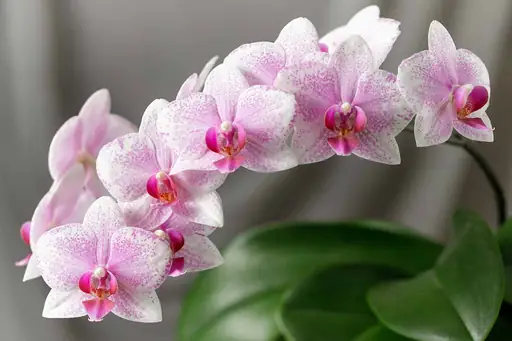
Your moth orchid (Phalaenopsis spp.) has been blooming for weeks, with tall stalks of gorgeous flowers.
But they’re starting to fade and you know the end of the colorful display is nigh. Now what?
Some indoor gardeners simply toss the moth orchid in the garbage when the blooms fade, but your orchid has so much more to give if you provide it with the proper aftercare!
In our guide to growing moth orchids, we discuss how to cultivate these beautiful plants in your home.
And after the flowers have faded, a few maintenance tasks will keep your moth orchid healthy until the next time it’s ready to bloom.
If you’re committed to keeping yours instead of throwing it in the trash, let’s talk about post-bloom care to set you up for success.
Preparation is the key to any successful project so let’s start with that:
Tools and Preparation
While you can technically do the work with any sharp object, I’d advise you to use a razor, craft knife, or scalpel.
That way, you can make a precise cut right where you want it.
Scissors or pruners can end up crushing the stem as they cut through, and they don’t let you get as close to the base of the stem as you can with something like a razor.
Make sure to clean whatever tool you choose to use with hot, soapy water or isopropyl alcohol. And be careful! You don’t want to cut yourself, so consider wearing a good pair of gloves.
Encourage More Blooms on the Same Stalk
Before you cut off the stem with the spent blooms, it’s worth a try to encourage the same stalk to produce more blooms.
Give the moth orchid just a smidge more light and water than you are currently, and it may flower again on the same stem. It can even flower multiple times on the same stalk.
The subsequent blooms will typically be smaller and less numerous and that’s the reason you might want to cut the stalk off and let the plant form a new one.
Note that not all Phalaenopsis species or hybrids will rebloom on the same stalk. Some simply don’t have the genetic capability to do so.
So how do you know if yours will? If your orchid is the type that produces branched flower stalks, it’s highly likely it won’t rebloom on the same stalk.
Young or undernourished plants might not rebloom, either. If you don’t see any buds within four months, give that stalk the chop.
I generally prefer to remove the flower stalk because the plant will typically produce better blooms on a fresh stalk and you don’t have to wait for months hoping that the bare stalk will rebloom.
Learn more about encouraging orchids to rebloom in our guide.
Removing the Flower Stem
Once the orchid is done flowering, the stem that held the blossoms can be removed if you find it unsightly and if you want to encourage the plant to produce a new flowering stem.
How do you go about this?
If you ask 100 experts and avid phalaenopsis growers any question about their care, you’ll get 100 different answers, and how and when to cut the flower stem is no different.
Some experts insist you need to leave a node or two on the stem. Others say to cut it right off at the main stalk. Still others insist that you should never remove anything that is green from your orchid. I say do whatever you want.
If you decide to leave some of the stalk, cut it just in front of a node, leaving two or three nodes intact. The node is the ridge on the stalk where the buds develop.
Otherwise, cut it off as close to the stem as you can, leaving maybe an eighth of an inch in place.
Then, continue to care for your plant while you wait for it to produce a new flowering stem!
Keep the Party Going
In the wild, moth orchids will bloom over and over, because that’s how they reproduce.
In our homes, the conditions are a little different than in their natural habitat and we need to provide a little bit of care to help them produce new flowers.
Now you know exactly what this entails – not much, really!
Which method are you going with? Will you be trying to promote blossoms on the existing stem or will you be snipping the whole thing off and starting fresh? Let us know in the comments section below!
On top of dealing with the flower stalks, there are lots of other aspects to orchid care you need to know to keep these unique plants happy.
We have a few guides to help out with that. Add these to your reading list next:
- 23 Types of Orchids to Grow as Houseplants
- 13 Common Orchid Problems and How to Solve Them
- Orchids 101: How to Grow and Care for Orchids
- X




Fragen und Diskussion