
How to Prune Blooming Plants in Spring
Spring-blooming perennials brighten up the landscape, providing much-needed color after the bleak winter winter months. And to keep your plants healthy and vigorous, these shrubs will need proper pruning. But how does a gardener do that properly when bloom time coincides with when you need to trim.
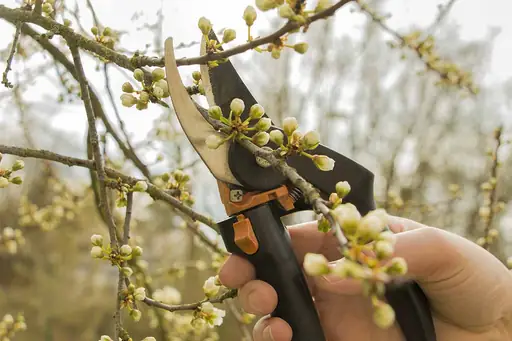
Spring-blooming perennials brighten up the landscape, providing much-needed color after the bleak winter winter months. And to keep your plants healthy and vigorous, these shrubs will need proper pruning.
But how does a gardener do that properly when bloom time coincides with when you need to trim your plant?
Pruning your springtime bloomers comes with many benefits, whether it’s improved health of the plant, aesthetics, or to encourage abundant flowering.
But there’s more to the process than simply giving your plants a haircut. You’ll need precision, proper timing, and the right equipment.
Because it’s quite the dilemma, really: you’ve got pretty flowers on branches that need to be removed.
In a way, it’s a lot like getting pieces of chewed-up bubble gum stuck in an awesome hairdo. Whether you cut those magnificent locks away or leave the Dubble Bubble be, you lose.
Okay, not my best analogy. But you get it – it’s an either/or situation.
Or is it?
Thankfully, horticulture differs quite a bit from hair. In this scenario, you can have your cake and eat it too. It just takes a bit of know-how.
That’s where this guide comes in. I’ll cover everything you need to know about pruning blooming plants in spring.
Here’s what I’ll cover:
What You’ll Learn
Why Prune Blooming Plants?
What You’ll Need
When to Prune
How to Make Your Cuts
Why Prune Blooming Plants?
If you’re gonna take sharp blades to a beautiful bloomer’s branches, it’s worth knowing the reasons why it is beneficial.
Aesthetics
Even if a plant doesn’t have any damaged or diseased branches to get rid of, it may still need some cutting back if it doesn’t have the desired shape.
That’s where strategic pruning can be a huge help.
By removing select branches from critical spots, you can drastically change a plant’s form. It often takes less cutting than you’d think!
Health
Along with appearance, health can also be improved via pruning.
All those damaged, dead, and diseased branches? They’re not just eyesores – they’re vulnerabilities.
And it’s through these weak spots that pathogens and pests can enter the plant and cause even more harm.
Additionally, by removing the branches that aren’t pulling their weight, the plant can direct its energy towards new, healthy growth.
Vigor
But how does this energy redirection work? Well, plants love to keep their roots and shoots in relative proportion.
And once shoots are removed, the root mass is now greater than the shoot mass.
To bring these structures back into balance, the tree will grow its shoots back quicker by increasing its vigor, or its rate of plant growth.
The result? A more vibrant and lush specimen!
What You’ll Need
Unless you’re naturally endowed with bone claws like Wolverine, you’ll need some external tools for all this cutting.
Personal Protective Equipment
Keeping with the Wolverine references… I’m guessing you also don’t have an enhanced healing factor that instantly heals all your wounds. Therefore, you’ll need stuff to prevent said wounds.
For the home gardener, the two most important pieces of PPE are safety glasses and puncture-proof gloves.
The former keeps wood shavings and sharp points out of your eyeballs, while the latter might help to protect your delicate digits from chance cuts.
3M Safety Glasses
Want glasses that go over the spectacles you already wear?
Puncture-Proof Gloves
For green puncture-proof gloves that come in medium, large, and extra-large sizes, head on over to Garrett Wade.
Read more about some of our favorite gardening gloves here.
Hand Pruners
Often worn at the hip like a trusty lawman’s Colt .45, hand pruners are a popular tool for cutting small branches less than an inch thick.
Specifically, you’ll want bypass pruners, which make clean cuts while also prolonging blade sharpness.
Bypass Pruners
Want a primo set of bypass pruners with swanky green handles?
Loppers
Consisting of short, durable blades and long, strong handles, loppers use the power of physics to make difficult cuts on branches up to a couple inches thick.
For removing live branches in spring, go with bypass rather than anvil loppers, as the latter are better for cutting deadwood.
Bypass Loppers
Need some heavy-duty bypass loppers with extendable handles? Go visit Garrett Wade.
Pruning Saw
When you run into branches too thick for loppers, that’s where a pruning saw comes in handy.
Longer and thinner than the wood saws you used in shop class, pruning saws are perfect for fitting through a densely-packed bunch of branches.
And as long as the blade is longer than the limb is thick, these tools can handle any cut size.
Pruning Saw
Isopropyl Alcohol
As you make your cuts, pathogens can easily hitch a ride on your blades and spread from plant to plant… unless you sterilize your tools in between specimens.
And isopropyl alcohol is the perfect germ-killer.
Use a 70 to 99 percent alcohol concentration, with water making up the remainder of the solution.
To sterilize blades, you can either dip them straight into the solution, or use an old spray bottle to spritz them. Wipe the blades down with a clean rag, and they’re ready to go.
Rubbing Alcohol
When to Prune
For most plants, pruning just before bud break in spring is the perfect time to trigger a burst of vegetative growth for the growing season.
However, if it’s the blooms that you’re trying to enhance, then “just before bud break in spring” isn’t always the best time. So when is?
For a plant to have optimal flowering, the best pruning time depends on its bloom window.
For a plant that blooms before mid-June, or the start of summer, you’ll want to hold off on cutting back until after it has flowered.
This allows for a beautiful floral display that’s unadulterated by the stress of losing its mass.
If a plant puts out flowers in summer or later, then you’ll want to prune it in late winter to early spring, before bud break. This gives the specimen enough time to recover before it flowers.
How to Make Your Cuts
Different plants have different forms and shapes, so the exact recommendations will vary from species to species.
But in general, here’s your order of operations for pruning, ranked from most to least important.
- If your plant is a woody shrub or tree, promptly remove damaged, dead, or diseased branches. These can be removed year-round, whenever you happen to notice them. If your plant is in bloom, remove any spent flowers and their stalks, along with any damaged, dead, or diseased leaves.
- If your plant needs a central leader established, choose the strongest, most centered, and most vertical leader to keep. Remove away competing leaders as needed.
- Remove crossing or rubbing branches – these will eventually lead to plant injury. Keep the branch with the branch-to-trunk angle that’s closest to 90 degrees, and cut away the other one.
- Remove any branches angled sharply upwards or downwards, or those that otherwise throw off the plant shape you’re going for.
- If any branches grow faster than the rest of the plant in a visually distracting way, remove them.
- To prevent moisture from collecting on cut stumps, make your cuts parallel to the trunk whenever possible.
For any heavy branches, utilize the three-cut method to avoid a gnarly peeling of trunk bark as the branch falls.
The three-cut method, illustrated. Photo by Joe Butler.And no matter what plant you’re pruning, don’t remove more than a third of its aboveground mass in one go. Any more, and it’ll be very stressful on the organism.
Have cut branches and stems that need disposal? Sounds like you’ve got some fuel for the compost pile!
Spring Has Sprung…
You know what else has sprung? You, into action, after you’ve read this guide! Thank you, thank you, I’ll be here all week.
Cringe-inducing jokes aside, hopefully you now have a game plan come springtime. As the years pass and you gain experience, it’ll become more and more routine.
Still have questions? Wisdom of your own to share? Check out the comments section below!
Need more pruning know-how? These guides should do the trick:
- The Basics of Pruning Shrubs and Woody Plants
- When to Prune Old vs New Wood and How to Tell the Difference
- Your Guide to Fall and Spring Perennial Cutbacks and Pruning
- Facebook44
- X




Fragen und Diskussion