
How Does Color Impact Tomato Flavor?
Tomatoes come in an astonishing range of colors, shapes, and sizes. Gone are the days when you might only expect to find a choice of small, medium, and large red types at the grocery store. And along with that color variation comes a huge range of flavors. Tomatoes can be smoky and complex, or.
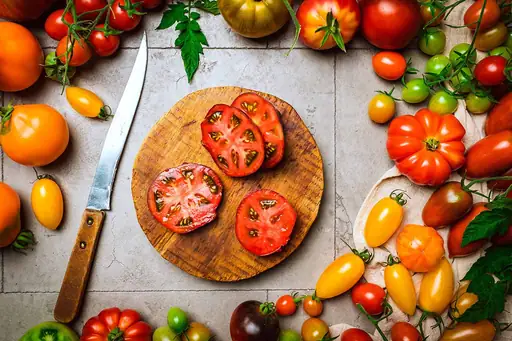
Tomatoes come in an astonishing range of colors, shapes, and sizes.
Gone are the days when you might only expect to find a choice of small, medium, and large red types at the grocery store. And along with that color variation comes a huge range of flavors.
Tomatoes can be smoky and complex, or bright and acidic.
Pluck a sun-warmed yellow baby off the vine, and you’re eating nature’s candy. Or, roast a thick-skinned Roma, and you’re tasting a totally different thing altogether.
Short of taking a bite out of every tomato you see at the farmers market (and I’m totally for that idea, by the way…), how do you know if you’re going to taste something sugary sweet or tart and tangy?
The color of the skin offers you a clue. That’s because the same stuff that makes up the color of the fruit also determines the taste you’ll experience.
Coming up, we’re going to discuss the general flavor profile of each color and a few of the best options for each one. Here’s what you can expect:
What You’ll Learn
- How We Perceive Flavor
- The Basic Flavor Elements in Tomatoes
- Red
- Black and Purple
- Pink
- Orange
- Yellow
- Bicolored or Striped
- Green
- White
Before we take a bite out of the various flavors and colors, let’s have a quick lesson on how flavor works to help us better understand what’s going on in our mouths when we tuck into a caprese salad.
How We Perceive Flavor
Welcome to our super quick primer on taste. Our taste buds tell us whether something is salty, sour, bitter, umami (or savory), or sweet.
By the way, spiciness like what you might experience after biting into a chili pepper isn’t technically a flavor, but rather, a sensation of heat in the mouth.
Our taste buds (papillae) have teeny-tiny hairs on them called microvilli. These hairs send signals to your brain about the chemicals in the food, and our brain interprets that as flavor.
In addition to the five flavors, our brains are highly attuned to oils in food, since fat is an important source of energy for humans. We can also sense metallic and alkaline flavors.
Most of us also know that our noses provide additional “coloring” to our perception of flavor.
Try plugging your nose and determining how something tastes. If you get any sense at all, it’s quite flat. Or, think about how you might gag just from smelling something rotten. The nose is key in providing extra detail about how something tastes.
In addition to the five taste elements described above, the temperature and texture of a food can influence flavor.
You will perceive the flavor of an icy cold tomato differently than one that is still warm from the sun.
The Basic Flavor Elements in Tomatoes
The flavor of tomatoes is made up primarily of sweetness from fructose and glucose, and acidic flavors from citric and malic acids.
Then, there are dozens of volatile organic compounds (VOCs) in the oils of the fruit that hit the nose and contribute to the taste that we experience when we take a bite and crush the skin and flesh, exposing them to the air.
For the most part, the combination of flavors is determined by genetics, but there is a small degree of flavor that is influenced by how much sun, water, and food the plant receives as it’s developing the fruits.
As someone who is growing tomatoes in a mild, cool climate, I can attest to the difference between these and the same types grown in a hot, dry location in the past.
The “classic” tomato flavor is nearly balanced between acidic and sweet. A full-flavored tomato has lots of volatile organic compounds that provide a good balance of sweetness and acid.
A tart tomato has some sweetness and lots of acid, while a sweet one is mostly sugar with little acid. One with little acid or sugar is bland.
In addition to the balance of flavors, the texture can also influence how we perceive the taste. Those with tougher skins have a different concentration of flavors than those with thin, delicate skins.
Size has an impact on flavor, as well. The smaller tomatoes tend to have more concentrated sugar, so they’re sweeter. Imagine the flavor of a petite ‘Sun Sugar’ versus that of a big old beefsteak.
Researchers from the University of Tsukuba in Japan looked at the pigment profiles of various tomatoes so they could determine if it was possible to influence the flavor and published their findings in the journal Metabolites in 2021.
Basically, they found that the same pigment that determines the color of the fruit is also responsible for the flavor.
These pigments come from carotenoids and chlorophyll, which impact the accumulation of sugars, acids, and volatile organic compounds.
As the color of the tomato changes, the concentration of these pigments changes, and so does the flavor.
That’s why an unripe tomato has a significantly different flavor from a ripe one.
Red
We’ll start with red because these tend to have the “classic” tomato flavor. Those old-reliable red tomatoes are often a bit sweeter than they are acidic, but they’re balanced overall.
Typically the most acidic types, they’re moderately complex, though this varies dramatically from one red type to another.
Of the red tomatoes, hybrid varieties rather than heirlooms tend to be the most acidic of all, with the petite cherries and plums being the sweetest of the reds.
‘Celebrity,’ ‘Rutgers,’ and ‘Long Keeper’ are more acidic.
If you want something sweet, ‘Supernova Cherry’ has more sugar, packed in a gorgeous marbled skin.
‘Supernova Cherry’
High Mowing Seeds carries this superstar in various packet sizes.
For that “classic” tomato flavor, pick something like ‘Carmello’ or ‘Brandywine,’ both of which are juicy, balanced, fruity, and mildly grassy.
‘Oregon Spring’ is also balanced, in addition to being extremely early, which makes it ideal for cooler regions or those with short summers.
‘Oregon Spring’
Or, for a larger fruit, ‘Marianna’s Peace’ has a fantastic classic flavor on an heirloom plant.
‘Marianna’s Peace’
Black and Purple
The coloring in black tomatoes appears when green and red pigments are combined, and the flavor reflects this color mixture.
These types have a balanced blend of sweet and sour and a high number of volatile organic compounds, resulting in a complex flavor.
These also tend to have just a hint of saltiness with slightly less acid than red ones.
If you’re looking for a tomato to eat raw, either on its own or in a salad, black types are the way to go. Their complex flavor is just perfect as the main ingredient in a dish.
If you’ve never dipped your toe into the black category, ‘Cherokee Purple’ is the perfect place to start.
‘Cherokee Purple’ looks redder than some black types, depending on the growing conditions, but the flavor is all black and purple. It has somewhat smoky notes with a sweet, complex base.
‘Cherokee Purple’
It’s clear why this beefsteak type is extremely popular. Add it to your garden by nabbing a small packet or ounce of seeds from .
‘Black Prince’ has a nice, round shape, and with one bite, you’ll be treated to a mosaic of flavors on your tongue and enticing aromas.
‘Carbon’ is one of my favorites, and not just because the extra dark skin is visually appealing.
All that dark pigment makes it extremely flavorful, as if you’ve taken all the great stuff about black tomatoes and concentrated it.
‘Black Krim’ is particularly salty in a pleasant way.
It’s hard to find a prettier tomato than ‘Indigo,’ if you ask me. The skin is beautifully mottled red and black with that intriguing black tomato flavor
‘Indigo’
You can bring home 10 seeds of this exceptional heirloom from High Mowing Seeds.
‘Midnight Snack’
Or, if you want a sweet snack with the complexity of a black type, visit to grab a live plant or 10 seeds of ‘Midnight Snack.’
Pink
Pinks are often grouped with reds in terms of flavor, but they’re notably less acidic, while they still feature more acid than the other colors on this list.
They’re a bit milder with fewer VOCs than reds. They also have a bit more sugar.
‘Pink Brandywine’ has all the best of a pink type with huge fruits that weigh up to a pound each.
‘Pink Brandywine’
‘Arkansas Traveler’ isn’t as bothered by drought and extreme heat as some tomatoes, with the classic pink flavor. ‘Mortgage Lifter’ is legendary, with large, one-pound fruits with a sweet, rich flavor.
Then there’s ‘German Johnson,’ which was bred from ‘Mortgage Lifter.’ It’s meaty, pretty much seedless, and seemingly custom-made for slicing and serving in sandwiches or burgers.
‘German Johnson’
has packets of 30 seeds available if you’re dreaming of this juicy wonder.
Orange
Orange tomatoes are fruity, with mild to moderate acidity.
They’re usually some of the sweeter types, though not quite as sweet as yellows. They lack the complexity of red and black types, with lower concentrations of VOCs.
That makes them perfect for things like salads or popping in your mouth fresh, since they’re fruity, bright, and sweet.
‘Juane Flamme’ is a perfect example of what the orange types can taste like. It’s fruity, light, and nicely balanced between sweetness and acid, with just enough tartness to make it not candy sweet.
‘Persimmon’ is beautiful, with one-pound, peachy-colored fruits with pale green shoulders. It’s not just a pretty face, though. It has a rich, fruity flavor and few seeds to get in the way of enjoying it.
‘Sweet Tangerine’ has a classic orange flavor on early-ripening, disease-resistant plants. Sound like one you want to try?
‘Sweet Tangerine’
has packets of 30 seeds available.
Yellow
They may look like they’d be acidic with their lemon-yellow coloring, but in general, yellows are mild and extremely sweet.
You won’t get much acidity from these. They’re sweet enough that you might think you’re eating candy.
‘Yellow Pear’ is an heirloom with a marvelous flavor. It’s somewhat mild, so you won’t be overwhelmed by the sugar, but it still has oodles of oomph.
‘Yellow Currant’ is itty-bitty, with half-inch fruits that are sweet with just enough tartness to make them stand out among the cherry yellow types.
‘Yellow Currant’
Visit to grab 25 seeds to add to your salsa garden.
‘GinFiz’ is disease resistant, with a perfect balance of sweetness and acid.
When you slice into this early type, you’ll find an intriguing blend of red swirls in the orange flesh, reflecting the faint red stripes on the skin.
‘GinFiz’
High Mowing Organic Seeds has packets of 10 seeds available if this variety sounds right for you.
Bicolored or Striped
As you might imagine, tomatoes with stripes or patches of secondary colors have characteristics of both colors in terms of flavor.
In general, these lack the intense acidity of reds and have a ton of sweetness.
But of course, it all depends on the specific coloration. A black-speckled yellow cultivar like ‘Indigo Kumquat’ is sweet and tart with a hint of smoky complexity.
‘Mr. Stripey,’ on the other hand, with its orange and red stripes, is mainly sweet with hardly any acidity.
By the way, if you’ve never tried ‘Mr. Stripey,’ you should. It’s a classic for a good reason.
‘Mr. Stripey’
carries small packets or one-ounce containers of seeds.
‘Striped German’ is marbled yellow and red with a bright, fruity flavor.
‘Green Zebra’ is incredibly sweet with a subtle tang. It’s worth growing it just for the flavor, but the sharp contrast between the green and yellow coloring makes it a striking addition to a salad.
Slice it, drizzle it with olive oil, sprinkle some feta cheese on top, and you have a stunning dish that looks like it took a lot more work to create than it actually did.
‘Green Zebra’
Find ‘Green Zebra’ seed for your garden from in small packets or one-ounce packages.
Then there’s the marvelous ‘Two Tasty’ tomato, with bright red and purple to black coloring.
‘Two Tasty’
, which carries this option as a live plant or in packets of 20 seeds, says their garden interns voted for this cultivar as one their favorites out of hundreds of options.
It has the balanced flavor of a red variety with the savory complexity of a black tomato in a petite two-inch package.
carries another exceptional option called ‘Shimmer.’
‘Shimmer’
It’s gorgeous, with green and red stripes and flecks of golden yellow that give it its name.
This primarily sweet plum-sized fruit is ideal for salads and sandwiches.
Green
When we talk about green varieties, we don’t mean unripe tomatoes.
Unripe tomatoes can be delicious when prepared well, but right now, we’re referring to those that ripen to a green color.
These have what can be perceived as a spicy bite, and they have more sweetness and less acidity than reds. Unripe fruits, on the other hand, lack sweetness and are extremely tart and acidic.
‘Aunt Ruby’s German Green’ has a luscious green hue, though it will take on a bit of blush if you leave it on the vine to become overripe.
The massive fruits can weigh a pound or more, but you don’t sacrifice size for flavor. It’s a sweet and fruity cultivar.
‘Cherokee Green’ is fun because these look like they’re unripe and you expect the firm texture and tang of an unripe fruit, but when you take a bite, you’re treated to a rich, sweet flavor with a touch more acid than other greens.
‘Cherokee Green’
Widely regarded as one of the best-tasting green types out there, has small packets or 250-count packages of seed available so you can bring ‘Cherokee Green’ home.
‘Green Envy’ looks more like a gem than a tomato, with deep emerald coloring that can sometimes take on a shimmery blush hue.
‘Green Envy’
The one-inch fruits are incredibly sweet. Buy a live plant or packets of 40 seeds from .
White
White tomatoes are low in acidity and extremely sweet.
Without much pigment to them, they don’t have much complexity either. If you want something straightforwardly sweet, this is it.
‘Moonbeam’ is a bright yellow and white cultivar with a constellation of speckles and sparkles on the skin.
‘Moonbeam’
Snag seeds in a variety of package sizes at High Mowing Seeds.
‘Cherry White’
They have 250-milligram, quarter-ounce, one-ounce, four-ounce, and one-pound options.
Taste the Rainbow
Knowing how the various pigments influence the flavor of tomatoes means you can pick the perfect option for your dinner without having to steal bites of the fruit while you’re standing in the supermarket.
That said, I encourage you to try samples next time you’re at the farmers market to really get to know all the different flavors.
It’s one thing to read about how something tastes, but it’s a lot more fun to learn by doing.
Did we miss any of your favorites here? What color do you tend to lean toward? Share with us in the comments.
Hopefully, next time you head to the store or market, or when you’re planning your garden for the coming year and selecting seeds to purchase, you’ll feel prepared to make a more informed choice.
Ready to continue on your journey? If so, we have a few other guides to growing the best tomatoes that might be helpful:
- How to Grow and Care for Tomatoes in Your Garden
- How to Grow Tomatoes in Containers
- Can You Freeze Fresh Tomatoes? Tips for Freezing Your Homegrown Crop
- Facebook62
- X
Fragen und Diskussion