

Diese Seite wird in ihrer Originalsprache angezeigt. Eine Übersetzung ist noch nicht verfügbar.
Die Seedsun-Auswahl
Castanea pumila
Artikelnummer: CAST-PUMI-01G
Castanea pumila, the American chinquapin or Allegheny chinkapin, is a deciduous large shrub or small tree native to the eastern and southeastern United States. Long admired by rural foragers and old-time orchardists, this relatively rare native once flourished across the South, where children.
Fordern Sie ein individuelles Angebot an
Preise, Packungsgrößen und Verfügbarkeit werden in Ihrem persönlichen Angebot bestätigt. Mit dem Absenden einer Anfrage wird noch keine Bestellung aufgegeben.
Erkundigen Sie sich nach Eignung, Aussaat- und Anbaubedingungen.
Bitte prüfen Sie die Lieferoptionen und die benötigten Dokumente in Ihrem Angebot.
Über diese Sorte
Castanea pumila, the American chinquapin or Allegheny chinkapin, is a deciduous large shrub or small tree native to the eastern and southeastern United States. Long admired by rural foragers and old-time orchardists, this relatively rare native once flourished across the South, where children filled their pockets with the spiny burrs and the sweet, nutty treasure inside.
Resembling the better-known cousin, the American chestnut (Castanea dentata), the chinquapin bears elongated, serrated, oval leaves and, from late summer into fall, small edible nuts about the size of a hazelnut, each wrapped in a prickly burr that splits when ripe. The nuts are rich, sweet, and highly prized, eaten raw, roasted, or worked into the old recipes from a time when the forest fed the family.
What sets the chinquapin apart is blight resistance. Not immune to the chestnut blight that decimated the American chestnut in the early twentieth century, C. pumila is notably more resilient, often surviving and regenerating thanks to a multi-stemmed, shrubby habit. In the right setting, on well-drained sandy to loamy soil in sun to part shade, the plant may reach small-tree stature.
Now scattered and increasingly uncommon in the wild, this native nut-bearer is both a botanical treasure and a restoration opportunity, an ideal choice for edible landscapes, native plant gardens, woodland edges, and wildlife plantings.
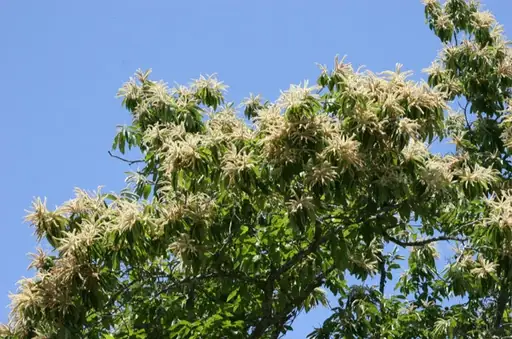
Photo courtesy of Carolyn Fannon.
Es gibt noch mehr zu entdecken



Fragen und Diskussion