

Diese Seite wird in ihrer Originalsprache angezeigt. Eine Übersetzung ist noch nicht verfügbar.
Die Seedsun-Auswahl
Cleyera japonica 'Fortunei'
Artikelnummer: CLEY-JAPO-FORT-01G
Cleyera japonica was for generations placed in the tea family, the Theaceae, alongside camellia and tea themselves, and the resemblance still reads in the glossy, leathery, deep green leaves. Later molecular study moved the genus out of that family and into the Pentaphylacaceae, so the old.
Fordern Sie ein individuelles Angebot an
Preise, Packungsgrößen und Verfügbarkeit werden in Ihrem persönlichen Angebot bestätigt. Mit dem Absenden einer Anfrage wird noch keine Bestellung aufgegeben.
Erkundigen Sie sich nach Eignung, Aussaat- und Anbaubedingungen.
Bitte prüfen Sie die Lieferoptionen und die benötigten Dokumente in Ihrem Angebot.
Über diese Sorte
Cleyera japonica was for generations placed in the tea family, the Theaceae, alongside camellia and tea themselves, and the resemblance still reads in the glossy, leathery, deep green leaves. Later molecular study moved the genus out of that family and into the Pentaphylacaceae, so the old tea-family listing has since been dropped, though the kinship of appearance remains. In the plant's native Japan the species carries a sacred weight few garden shrubs can claim: this is the sakaki, written with a character that fuses the signs for tree and for god, and the branches are cut for tamagushi, the leafy wands offered at Shinto shrines for blessing and purification. Small, sweetly scented cream flowers open in early summer, followed by berries that ripen from red to black.
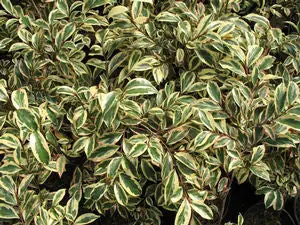
'Fortunei' is the old variegated form, long cultivated in Japan and known only in this dress, the narrow leaves edged in a clean creamy white that lifts the whole shrub in shade. Grow in well-drained, fertile soil with ample moisture, in sun or semi-shade. One word of caution repays repeating: this is a true Cleyera, not the different Asian shrub Ternstroemia gymnanthera that nurseries so often sell under the Cleyera name, a plant now sharing the same family, Pentaphylacaceae, but never the same genus.
Use 'Fortunei' as a refined evergreen for a shaded or part-shaded border, a woodland edge, or a courtyard where the variegated foliage and quiet red-to-black berries carry the year. The slow, upright habit suits an informal screen or a specimen near a path where the leaf edges can be read at close range. Pair with darker broadleaf evergreens and shade companions that throw the cream margins forward.
Photos courtesy of and John Grimshaw.
Es gibt noch mehr zu entdecken



Fragen und Diskussion