

Diese Seite wird in ihrer Originalsprache angezeigt. Eine Übersetzung ist noch nicht verfügbar.
Die Seedsun-Auswahl
Danae racemosa
Artikelnummer: DANA-RACE-01Q
Few plants carry their history as plainly as Danae racemosa. The name reaches back to Greek myth, to Danae, daughter of the king of Argos, and the foliage carries a heavier classical freight than almost anything else you can grow in shade: Roman poet laureates are said to have worn the sprays as.
Fordern Sie ein individuelles Angebot an
Preise, Packungsgrößen und Verfügbarkeit werden in Ihrem persönlichen Angebot bestätigt. Mit dem Absenden einer Anfrage wird noch keine Bestellung aufgegeben.
Erkundigen Sie sich nach Eignung, Aussaat- und Anbaubedingungen.
Bitte prüfen Sie die Lieferoptionen und die benötigten Dokumente in Ihrem Angebot.
Über diese Sorte
Few plants carry their history as plainly as Danae racemosa. The name reaches back to Greek myth, to Danae, daughter of the king of Argos, and the foliage carries a heavier classical freight than almost anything else you can grow in shade: Roman poet laureates are said to have worn the sprays as their wreath, and Alexander the Great may have taken his victory crowns from the same hills where he was fighting. Hence the two common names that have followed the plant for centuries, poet's laurel and Alexandrian laurel. Danae is, for the record, no true laurel at all.
What Danae is, botanically, is stranger and better. Danae is a monotypic genus, the only one of the kind, a monocot long filed among the lilies and now placed with the asparagus. The glossy, tapered leaves are not leaves but phylloclades, flattened stems doing a convincing impression of foliage. In spring the new growth comes up like asparagus or young bamboo, vertical canes rising from the crown that arch over as they lengthen into a soft, weeping fountain two to three feet tall and a little wider. The effect is fine-textured and deep green and holds every month of the year, which is rare enough in deep shade to feel like a small miracle.
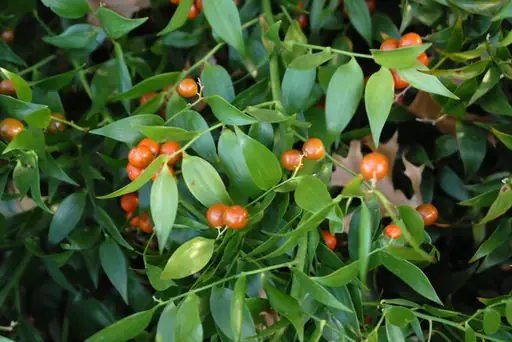
The flowers are negligible by design, tiny and greenish, the kind you have to be told to look for. The fruit is the payoff: come autumn, the plants set bright red-orange berries that sit among the dark foliage and hold through winter, the whole reason florists have prized the cut stems for generations. Most of the commercial greenery, in fact, is grown in Italy and flown out weekly, which has saddled this Iranian native with the third name of Italian ruscus.
There is a reason you do not see them at every nursery. Danae grows slowly and resists propagation, taking five to seven years from seed to a plant worth selling, which is precisely how they became a treasured Southern pass-along, begged from a neighbor rather than bought. Give them shade, even deep shade, and ordinary well-drained soil; they ask for moisture to establish but shrug off drought once settled, and the deer leave them alone. Native to the woodlands of northern Iran and Asia Minor, hardy through roughly Zone 7, they bring a refinement to the dark corners of a garden that almost nothing else will, and a pedigree no other shade plant can touch.
Es gibt noch mehr zu entdecken



Fragen und Diskussion