

Diese Seite wird in ihrer Originalsprache angezeigt. Eine Übersetzung ist noch nicht verfügbar.
Die Seedsun-Auswahl
Dryopteris x australis
Artikelnummer: DRYO-AUST-01Q
Dryopteris ×australis is a fern that cannot, strictly speaking, reproduce, and is all the more vigorous for the lack. This is a natural hybrid, thrown wherever two Southern wood ferns grow within a spore’s reach of one another: the log fern, Dryopteris celsa, and the southern wood fern, Dryopteris.
Fordern Sie ein individuelles Angebot an
Preise, Packungsgrößen und Verfügbarkeit werden in Ihrem persönlichen Angebot bestätigt. Mit dem Absenden einer Anfrage wird noch keine Bestellung aufgegeben.
Erkundigen Sie sich nach Eignung, Aussaat- und Anbaubedingungen.
Bitte prüfen Sie die Lieferoptionen und die benötigten Dokumente in Ihrem Angebot.
Über diese Sorte
Dryopteris ×australis is a fern that cannot, strictly speaking, reproduce, and is all the more vigorous for the lack. This is a natural hybrid, thrown wherever two Southern wood ferns grow within a spore’s reach of one another: the log fern, Dryopteris celsa, and the southern wood fern, Dryopteris ludoviciana. The cross comes out sterile, setting spores that never amount to anything, so the fern cannot seed itself across a bed the way a large fern usually will. Every plant in cultivation traces back by division to a wild clump found somewhere between Virginia and Louisiana, the greatest number of them in Alabama.
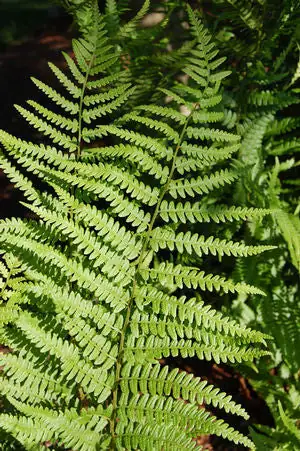
The pedigree is better than it has any right to be. The log fern parent is itself a hybrid, a fertile cross of that same ludoviciana with the northern Goldie’s wood fern, Dryopteris goldieana, which puts ludoviciana in the family tree twice and tucks a cold-country fern into the third corner. Whatever the arithmetic is doing, the result is the largest fern native to eastern North America. They grow rather as a Christmas fern might, scaled up and stood on end: lance-shaped, lustrous dark green fronds, finely cut and twice-divided, held bolt upright in a dense vase four to five feet tall and half as wide. There is nothing floppy in them. The fronds rise and stay risen, which is uncommon at this size, and the effect in a shaded bed is frankly architectural, a green exclamation where most ferns manage a comma.
Southern by birth, the fern is unbothered by cold. The fern man John Mickel, who knew the genus as well as anyone, counted this among the great garden ferns and grew them strongly in New York, and they hold reliably from zone 5 through 9. Give them part to full shade and the rich, moist, humusy ground their parents keep along streams and in swampy hammocks. Once established they will take the dry, rooty shade under a canopy without complaint, but a damp footing is where they show off. The one real caution is wind, since fronds this tall can tatter in the open, so site them somewhere sheltered. Semi-evergreen, glossy and green through a mild winter, bronzing and falling after a hard freeze, best cut back before the new fiddleheads climb. Sterile, so they stay precisely where you put them, and increased only by dividing the short creeping rhizome.
A sterile giant with a borrowed pedigree, too well-bred to spread and too handsome to overlook. The tallest native fern in the East, standing at attention in the shade while everything around leans.
Es gibt noch mehr zu entdecken



Fragen und Diskussion