

Diese Seite wird in ihrer Originalsprache angezeigt. Eine Übersetzung ist noch nicht verfügbar.
Die Seedsun-Auswahl
Eriobotrya japonica
Artikelnummer: ERIO-JAPO-01G
The loquat, Eriobotrya japonica, is a handsome broadleaved evergreen of the rose family, kin to apples, pears, and hawthorns, grown for the bold foliage and the early, unusual fruit. Native to the warm-temperate hills of central China and cultivated in Japan for more than a thousand years, the.
Fordern Sie ein individuelles Angebot an
Preise, Packungsgrößen und Verfügbarkeit werden in Ihrem persönlichen Angebot bestätigt. Mit dem Absenden einer Anfrage wird noch keine Bestellung aufgegeben.
Erkundigen Sie sich nach Eignung, Aussaat- und Anbaubedingungen.
Bitte prüfen Sie die Lieferoptionen und die benötigten Dokumente in Ihrem Angebot.
Über diese Sorte
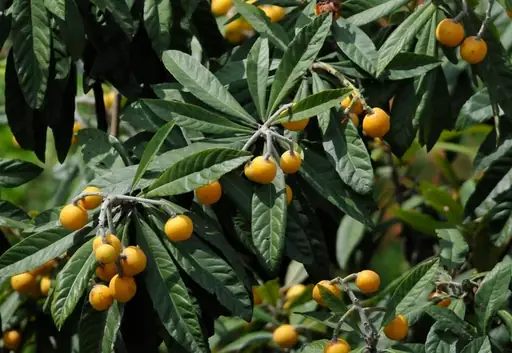
The loquat, Eriobotrya japonica, is a handsome broadleaved evergreen of the rose family, kin to apples, pears, and hawthorns, grown for the bold foliage and the early, unusual fruit. Native to the warm-temperate hills of central China and cultivated in Japan for more than a thousand years, the loquat has traveled with settlers throughout the mild-winter world, from the Mediterranean to the American South, where old dooryard trees are a familiar sight. The large, leathery leaves, deeply veined and toothed along the edges, give the tree a lush, almost tropical presence year round.
The loquat keeps an upside-down calendar. Where most fruit trees bloom in spring, the loquat opens clusters of small, fragrant, cream-white flowers in late fall and early winter, filling cold air with a soft, sweet scent and feeding bees when little else is in flower. From those winter blooms come the fruits: small, oval, yellow to orange, with sweet-tart, honeyed flesh around a few large brown seeds, ripening in spring, months ahead of any other tree fruit. Whether a given year sets a heavy crop depends entirely on winter cold, since a hard freeze at or after flowering will take the blossoms and the fruit with them.
In the landscape the loquat pulls double duty as ornament and orchard. Left to grow, the tree makes a rounded, densely leafy small tree or large shrub, fifteen feet or more, excellent as an evergreen screen, a patio shade tree, or a bold-textured specimen against a wall. The fruit is best fresh off the branch but also makes fine jelly, jam, and preserves, and the trees carry a heavy crop where winters are kind. Give the loquat room, since the broad canopy and big leaves want space to look their best.
Loquats are easy in the right climate. Hardy in USDA zones 7 through 10, the tree wants full sun to part shade and fertile, well-drained soil, tolerates a range of ground so long as drainage is good, and shrugs off heat once established, though young trees and open flowers need protection from hard frost. Beyond the kitchen, loquat leaves have a long life in traditional Chinese and Japanese medicine, where they are known as pipa ye and brewed against coughs and chest complaints, an old use that modern research on the leaf's triterpenes continues to explore. Few small trees give so much: evergreen structure, winter fragrance, spring fruit, and a deep well of history.
Es gibt noch mehr zu entdecken



Fragen und Diskussion