

Diese Seite wird in ihrer Originalsprache angezeigt. Eine Übersetzung ist noch nicht verfügbar.
Die Seedsun-Auswahl
Heteropterys glabra
Artikelnummer: HETE-GLAB-01G
Redwing is grown less for the flowers than for what follows them. Through the warm months this fast, twining, semi-woody climber carries loose clusters of small clear-yellow flowers along the stems, pretty enough in passing, but the real event comes after, when each pollinated bloom ripens into a.
Fordern Sie ein individuelles Angebot an
Preise, Packungsgrößen und Verfügbarkeit werden in Ihrem persönlichen Angebot bestätigt. Mit dem Absenden einer Anfrage wird noch keine Bestellung aufgegeben.
Erkundigen Sie sich nach Eignung, Aussaat- und Anbaubedingungen.
Bitte prüfen Sie die Lieferoptionen und die benötigten Dokumente in Ihrem Angebot.
Über diese Sorte
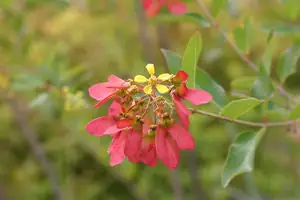
Redwing is grown less for the flowers than for what follows them. Through the warm months this fast, twining, semi-woody climber carries loose clusters of small clear-yellow flowers along the stems, pretty enough in passing, but the real event comes after, when each pollinated bloom ripens into a bright red winged fruit, a samara built exactly like the spinning key of a maple. In quantity the red keys smother the vine and glow against the small, neat foliage, an unexpected and long-lasting display that few visitors can name.
The resemblance to maple is pure coincidence. Redwing belongs to the Malpighiaceae, the tropical family of the acerola or Barbados cherry, and comes by the winged fruit through an entirely separate line: the genus name Heteropterys, from the Greek for different wings, marks the unequal wings on the samara, while glabra notes the smooth, hairless leaves. Native to South America, the vine brings a touch of the subtropics to a warm-temperate garden and remains genuinely uncommon in cultivation, a plant for the collector and the curious.
As a garden plant, redwing is easygoing and quick. The long, flexible stems climb and scramble readily, so give the vine a sturdy support to clothe: an arbor, a pergola, a fence, or a large trellis in full sun to part shade. Growth is fast once established, the small leaves cast light, dappled shade, and the plant asks only for reasonable drainage and warmth. Where winters bite, the top may die back and return, or a plant can be grown in a large pot and wintered under cover.
In the garden, treat redwing as a warm-season screen or a conversation piece where the red-keyed fruit can be seen at close range: along a rail, over a gateway, or against a wall where the color reads. Pair with other subtropical climbers and hot-border plants, and site where late-summer sun can light the ripening samaras. Nothing else in the garden will look quite like the vine hung with red maple keys that never came from a maple.
Es gibt noch mehr zu entdecken



Fragen und Diskussion