

Diese Seite wird in ihrer Originalsprache angezeigt. Eine Übersetzung ist noch nicht verfügbar.
Die Seedsun-Auswahl
Ilex cassine (female)
Artikelnummer: ILE-CASS-FEMA-01G
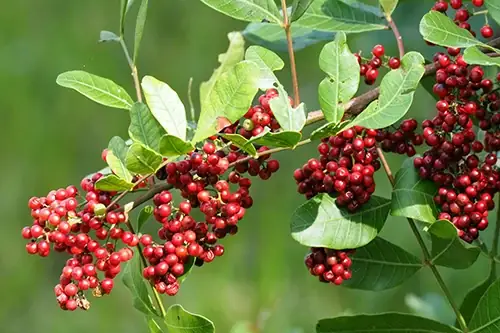
Ilex cassine, the dahoon holly, is an elegant evergreen native of the southern wetlands, and this is a fruiting female, the sex that carries the crop of small, glossy red berries. Unlike the fiercely spined American holly, dahoon holds narrow, smooth-edged, bright green leaves that are a pleasure.
Fordern Sie ein individuelles Angebot an
Preise, Packungsgrößen und Verfügbarkeit werden in Ihrem persönlichen Angebot bestätigt. Mit dem Absenden einer Anfrage wird noch keine Bestellung aufgegeben.
Erkundigen Sie sich nach Eignung, Aussaat- und Anbaubedingungen.
Bitte prüfen Sie die Lieferoptionen und die benötigten Dokumente in Ihrem Angebot.
Über diese Sorte
Ilex cassine, the dahoon holly, is an elegant evergreen native of the southern wetlands, and this is a fruiting female, the sex that carries the crop of small, glossy red berries. Unlike the fiercely spined American holly, dahoon holds narrow, smooth-edged, bright green leaves that are a pleasure to plant near a path, and in fall and winter the branches string themselves with scarlet fruit against that clean green. Grown as a large shrub or a small tree, dahoon is one of the most useful evergreen hollies for the South.
A word every holly buyer should hear: this is a dioecious plant, with male and female flowers on separate plants, so a female like this one will only set berries when a male dahoon, or another compatible holly blooming at the same time, grows within reach of the bees. Plant a male somewhere nearby and the reward is heavy, reliable fruit; plant a female alone and the berries will not come. The small greenish-white spring flowers feed bees, and the winter berries feed the birds.
The name is a two-hundred-year-old mistake nobody has managed to undo. Spanish colonists in sixteenth-century Florida heard the Timucua word for the celebrated black drink, wrote it down as cacina, and Linnaeus attached that beverage-word to this holly in 1753. The plant actually brewed for the black drink was yaupon, Ilex vomitoria, which Aiton named properly in 1789. So dahoon carries the name of the drink without the chemistry to match: a 2019 survey of the genus found the stimulant alkaloids in yaupon, yerba mate and guayusa, and specifically failed to corroborate older reports of caffeine in Ilex cassine. The common name is no clearer. Thomas Walter published Ilex dahoon in 1788 and the origin of the word has never been established.
Dahoon is a plant of swamps, pond edges, and wet flatwoods along the coastal plain from the Carolinas to Texas, and takes happily to wet ground, standing water, and heavy rain where many evergreens sulk. In the garden the plant is more forgiving still, thriving on ordinary moist, acid soil in full sun or part shade, asking mainly that the roots not bake dry. Growth is steady rather than fast, building over the years into a dense, glossy screen. Where dahoon and American holly meet in the wild they cross, and a hybrid found in Florida in 1924 became Ilex × attenuata, the parent of ‘East Palatka’ and of the Foster hollies, which is a larger contribution to American gardens than the species is usually given credit for.
Use Ilex cassine as an evergreen screen or hedge, a berrying specimen, or a small tree for a rain garden, a pond margin, or any low, wet spot that needs a handsome, non-prickly evergreen. The persistent red fruit brings birds through the winter, and the smooth foliage makes the plant safe and pleasant beside walks and seating. One honest caution comes with the crop: hollies are mildly toxic to people and to dogs and cats, so the fruit is for admiring and for the waxwings, not for eating.
Es gibt noch mehr zu entdecken



Fragen und Diskussion