

Diese Seite wird in ihrer Originalsprache angezeigt. Eine Übersetzung ist noch nicht verfügbar.
Die Seedsun-Auswahl
Lantana camara 'Hybrida'
Artikelnummer: LANT-CAMA-HYBR-01G
Few tender shrubs work as hard for as long as the lantanas, and Lantana camara 'Hybrida' distills the whole genus down to a single clear note of yellow. The species belongs to the verbena family, Verbenaceae, and hails from the West Indies and the warm reaches of Mexico south through tropical.
Fordern Sie ein individuelles Angebot an
Preise, Packungsgrößen und Verfügbarkeit werden in Ihrem persönlichen Angebot bestätigt. Mit dem Absenden einer Anfrage wird noch keine Bestellung aufgegeben.
Erkundigen Sie sich nach Eignung, Aussaat- und Anbaubedingungen.
Bitte prüfen Sie die Lieferoptionen und die benötigten Dokumente in Ihrem Angebot.
Über diese Sorte
Few tender shrubs work as hard for as long as the lantanas, and Lantana camara 'Hybrida' distills the whole genus down to a single clear note of yellow. The species belongs to the verbena family, Verbenaceae, and hails from the West Indies and the warm reaches of Mexico south through tropical America, where the plant scrambles along roadsides and clearings in a haze of nectar and butterflies. The genus name is a borrowed one: Renaissance botanists lifted 'Lantana' from an old Latin name for the wayfaring tree, Viburnum lantana, whose domed flower clusters the lantana blooms happen to echo. The epithet camara is murkier, glossed variously as a vaulted chamber or a small boat, the true meaning long since lost to the record.
Carried out of the Americas by early plant collectors, the species spread so freely across the world's tropics that Lantana camara now grows wild on every warm continent, beloved and reviled in equal measure. Where the plant naturalized, people put the aromatic foliage to use: leaves were steeped, poulticed, and burned as a fumigant in folk traditions from the Caribbean to South Asia, and the ripe purple-black drupes were carried off by birds who scattered the seed far and wide. That same vigor carries a warning. The leaves and the green, unripe berries hold compounds called lantadenes, and grazing livestock that eat them can suffer liver damage and photosensitivity, so gardeners with stock or curious children should site the shrub thoughtfully and keep the fallen fruit picked up.
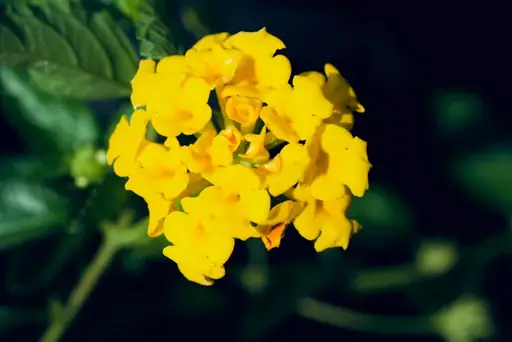
'Hybrida' is the sunny-tempered member of the clan, a selection grown for flowerheads of pure, unmixed yellow rather than the hot orange-and-pink medleys the species usually offers. Each bloom is really a tight posy of tiny tubular florets packed into a flat disk barely an inch across, opening in relays from the outside in so the shrub stays freckled with color from late spring until frost cuts the show short. Brush past the mid-green, sandpaper-textured leaves and they release the pungent, faintly medicinal scent that tells you at once this is a lantana; butterflies read the perfume differently, and swallowtails, sulphurs, and skippers work the flowers from morning to dusk.
In the garden 'Hybrida' asks for the least hospitable spot and pays the favor back in flowers: a baking south slope, a gravel hellstrip, the lip of a tall container where the low, mounding growth can spill and trail. Give the plant full sun and lean, sharply drained soil and the lantana shrugs off heat and drought that would flatten softer perennials. Yellow reads well against almost anything, so plant a drift alongside blue plumbago, mealycup sage, or the airy gold of coreopsis for a pollinator border that hums straight through the dog days. In the frost-free Deep South the shrub stays evergreen and woody; farther north, treat the lantana as a root-hardy perennial, mulch the crown, and cut the winter-killed top to the ground in early spring, when fresh shoots return from the base.
Es gibt noch mehr zu entdecken



Fragen und Diskussion