

Diese Seite wird in ihrer Originalsprache angezeigt. Eine Übersetzung ist noch nicht verfügbar.
Die Seedsun-Auswahl
Lonicera sempervirens 'Leo'
Artikelnummer: LONI-SEMP-LEO-01G
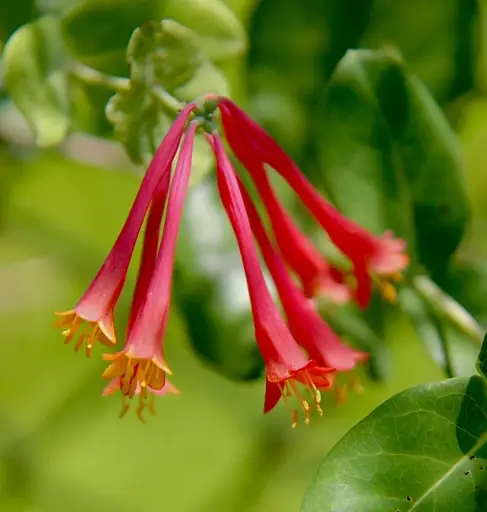
Lonicera sempervirens 'Leo' is the coral honeysuckle at its free-flowering best, a selection of the native red honeysuckle that covers itself in bright red, yellow-throated trumpets over an unusually long season. The tubular flowers pour nectar for ruby-throated hummingbirds, which find the vine as.
Fordern Sie ein individuelles Angebot an
Preise, Packungsgrößen und Verfügbarkeit werden in Ihrem persönlichen Angebot bestätigt. Mit dem Absenden einer Anfrage wird noch keine Bestellung aufgegeben.
Erkundigen Sie sich nach Eignung, Aussaat- und Anbaubedingungen.
Bitte prüfen Sie die Lieferoptionen und die benötigten Dokumente in Ihrem Angebot.
Über diese Sorte
Lonicera sempervirens 'Leo' is the coral honeysuckle at its free-flowering best, a selection of the native red honeysuckle that covers itself in bright red, yellow-throated trumpets over an unusually long season. The tubular flowers pour nectar for ruby-throated hummingbirds, which find the vine as irresistible as gardeners do, and the blue-green leaves, some fused right around the stem, make a cool foil for all that heat.
Honesty compels a small confession: the record does not show who first introduced and named 'Leo'. What is certain is the quality, a clone that flowers more heavily and more continuously than ordinary seedlings, which is reason enough to keep the selection in circulation. That free-blooming habit is why 'Leo' has become one of our best sellers.
Coral honeysuckle belongs to the family Caprifoliaceae, and the genus Lonicera honors the sixteenth-century German herbalist Adam Lonitzer. Native across the eastern and midwestern United States, this is the well-mannered honeysuckle, not the invasive Japanese kind that swallows fencerows, so 'Leo' can be planted with a clear conscience. Red berries follow the flowers and feed songbirds, carrying the vine's value past the growing season.
Coral honeysuckle is the classic vine for a mailbox post, but 'Leo' suits almost any sunny, well-drained spot with a fence, trellis, or arbor to twine upon. Full sun brings the heaviest bloom, and once established the vine shrugs off drought and asks little beyond a light trim to shape, since flowers come on new growth. Semi-evergreen in mild winters and hardy well to the north, this is a native vine that earns the best-seller badge honestly. Photo credit to cpf1.
Es gibt noch mehr zu entdecken



Fragen und Diskussion