

Diese Seite wird in ihrer Originalsprache angezeigt. Eine Übersetzung ist noch nicht verfügbar.
Die Seedsun-Auswahl
Callerya reticulata
Artikelnummer: MILL-RETI-01G
Callerya reticulata, the evergreen wisteria, is one of the most graceful vines for the Southern garden, and one of the most refined. Once known to botanists as Millettia reticulata and Wisteria reticulata, this evergreen climber is not a true wisteria, though the cascading habit and aristocratic.
Fordern Sie ein individuelles Angebot an
Preise, Packungsgrößen und Verfügbarkeit werden in Ihrem persönlichen Angebot bestätigt. Mit dem Absenden einer Anfrage wird noch keine Bestellung aufgegeben.
Erkundigen Sie sich nach Eignung, Aussaat- und Anbaubedingungen.
Bitte prüfen Sie die Lieferoptionen und die benötigten Dokumente in Ihrem Angebot.
Über diese Sorte
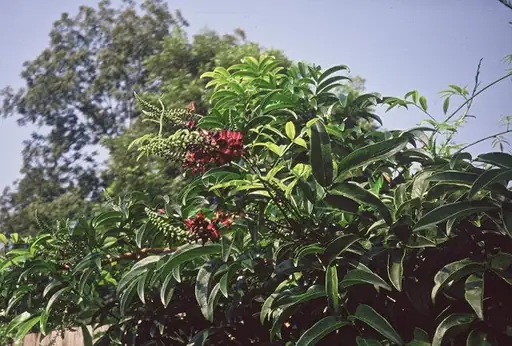
Callerya reticulata, the evergreen wisteria, is one of the most graceful vines for the Southern garden, and one of the most refined. Once known to botanists as Millettia reticulata and Wisteria reticulata, this evergreen climber is not a true wisteria, though the cascading habit and aristocratic bearing recall one. A vine for porches and pergolas, the evergreen wisteria prizes quiet bloom over brash spectacle, and carries both fragrance and folklore in the tendrils.
Native to the humid woodlands of China, Vietnam, and Taiwan, this member of the pea family wears dense, leathery, deep-green leaves, each compound leaf composed of seven to thirteen softly pointed leaflets whose netted veining gives the species the name reticulata, netted. In bloom, the evergreen wisteria is transformed: panicles of bluish-violet, pea-shaped flowers with golden centers hang like garlands of amethyst, scenting the air with a heady mix of cedar and camphor from the height of summer well into fall.
Far more manageable than the rampant true wisterias, the evergreen wisteria is a restrained, well-mannered climber for zones 8 to 10, happy in fertile, loamy, evenly moist soil in dappled to full sun. Prune faded flowers to prevent seeding and to spur fresh bloom, and at the cold edge of the range shelter the plant in a pot for winter. Pollinators work the flowers heavily, and with age the slender stems thicken into woody, twisting trunks like the old vines of courtyard walls.
There is a second life to this vine. In traditional Chinese medicine the dried stem, known as ji xue teng, has a long history as a remedy for the blood and circulation, and modern study has isolated genistein and flavonoids of interest. Grown here for the evergreen foliage and the fragrant amethyst bloom.
Photos courtesy of Jim Robbins.
Es gibt noch mehr zu entdecken



Fragen und Diskussion