

Diese Seite wird in ihrer Originalsprache angezeigt. Eine Übersetzung ist noch nicht verfügbar.
Die Seedsun-Auswahl
Oenothera fruticosa ssp. glauca (tetragona)
Artikelnummer: OENO-FRUT-GLAU-TETR-01Q
Sundrops make a gentle joke of their family. Oenothera fruticosa ssp. glauca belongs to the evening primroses, a tribe famous for opening at dusk and closing by mid-morning, yet the sundrops break ranks and bloom by day, holding cups of clear, satiny yellow wide open through the sunlit hours of.
Fordern Sie ein individuelles Angebot an
Preise, Packungsgrößen und Verfügbarkeit werden in Ihrem persönlichen Angebot bestätigt. Mit dem Absenden einer Anfrage wird noch keine Bestellung aufgegeben.
Erkundigen Sie sich nach Eignung, Aussaat- und Anbaubedingungen.
Bitte prüfen Sie die Lieferoptionen und die benötigten Dokumente in Ihrem Angebot.
Über diese Sorte
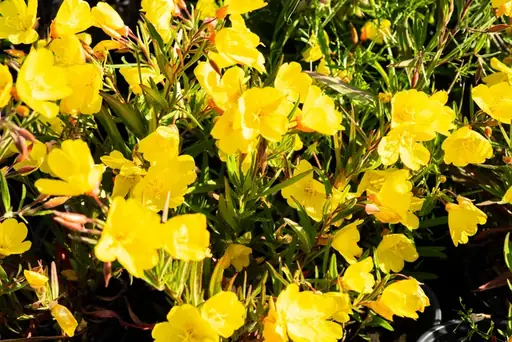
Sundrops make a gentle joke of their family. Oenothera fruticosa ssp. glauca belongs to the evening primroses, a tribe famous for opening at dusk and closing by mid-morning, yet the sundrops break ranks and bloom by day, holding cups of clear, satiny yellow wide open through the sunlit hours of late spring and early summer. The genus name comes from the Greek oinos, wine, and thera, to hunt or seek, an old and disputed reference to a European relative whose roots were once thought to give a taste for wine; the epithet fruticosa means shrubby, for the firm, upright stems, and glauca notes the blue-green bloom on the foliage.
Native across eastern North America, from Nova Scotia and Quebec south to Florida and west toward Manitoba and Louisiana, this narrowleaf sundrops forms a tidy, mounding clump that spreads gently into a colony where the ground is kept free of competition. The reddish buds and glaucous leaves are handsome in their own right, and a real bonus arrives in the cold months, when the plant holds a flat evergreen rosette that flushes purple and bronze and quietly smothers winter weeds while the border sleeps.
The evening primroses carry a long ethnobotanical record, and the famous evening primrose oil is pressed from the seeds of the biennial Oenothera biennis rather than from these day-blooming sundrops, a distinction worth keeping straight; grow this one for the flowers and the pollinators, not the pharmacy. Bees, butterflies, and moths work the open cups through the flush, and the four broad petals catch light like little dishes of butter set out along the stems.
Give the sundrops full sun for the heaviest bloom, a little afternoon shade where summers are fierce, and lean, sandy to loamy, well-drained ground; established plants shrug off drought and ask almost nothing. Use the clump at the front of a sunny border, in a rock garden, or as a low, colonizing groundcover through a meadow planting, and pair with coreopsis, salvia, and coneflower for a long, easy season. Deer tend to pass the foliage by, and a light shearing after bloom keeps the planting neat.
Es gibt noch mehr zu entdecken



Fragen und Diskussion