

Diese Seite wird in ihrer Originalsprache angezeigt. Eine Übersetzung ist noch nicht verfügbar.
Die Seedsun-Auswahl
Physostegia correllii
Artikelnummer: PHYS-CORR-01Q
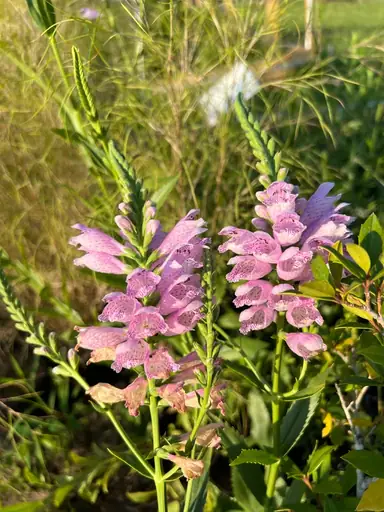
Physostegia correllii, Correll's obedient plant, is a rare and handsome member of the mint family, a robust, upright, somewhat succulent perennial rising from thick, spreading rhizomes. Among the false dragonheads the species stands out for unusually dark, glossy green leaves and cool purplish-pink.
Fordern Sie ein individuelles Angebot an
Preise, Packungsgrößen und Verfügbarkeit werden in Ihrem persönlichen Angebot bestätigt. Mit dem Absenden einer Anfrage wird noch keine Bestellung aufgegeben.
Erkundigen Sie sich nach Eignung, Aussaat- und Anbaubedingungen.
Bitte prüfen Sie die Lieferoptionen und die benötigten Dokumente in Ihrem Angebot.
Über diese Sorte
Physostegia correllii, Correll's obedient plant, is a rare and handsome member of the mint family, a robust, upright, somewhat succulent perennial rising from thick, spreading rhizomes. Among the false dragonheads the species stands out for unusually dark, glossy green leaves and cool purplish-pink flowers streaked and spotted with darker purple, an inch long and packed into dense terminal spikes.
The common name obedient plant comes from a small botanical trick shared across the genus: each flower sits on a hinged stalk and stays put when nudged left or right along the spike, holding whatever position a curious finger leaves behind. Bloom runs from midsummer into early fall, the flared lower lip of each tubular flower making a small landing platform for the bumblebees that work the spikes.
In the wild Correll's obedient plant is a streamside specialist, now reduced to a scattered handful of sites in Texas, Louisiana, and northern Mexico, where the plant grows in standing water or wet soil along streams and irrigation ditches. Growing a nursery-raised plant is a small act of conservation for an increasingly uncommon Southwestern native.
Give Correll's obedient plant a sunny spot with ample and reliable moisture, a pond or stream edge, a rain garden, a bog bed, or any bed that never dries, and room for the rhizomes to travel into a colony. Pair with other moisture-loving natives such as swamp milkweed, blue flag iris, and cardinal flower, and cut the frost-killed stems to the ground in late winter.
Es gibt noch mehr zu entdecken



Fragen und Diskussion