

Diese Seite wird in ihrer Originalsprache angezeigt. Eine Übersetzung ist noch nicht verfügbar.
Die Seedsun-Auswahl
Prunus incisa 'Kojo no mai'
Artikelnummer: PRUN-INCI-KOJO-NO-01G
'Kojo no mai' is a small cherry with a large personality, a dwarf Fuji cherry grown as much for the winter silhouette as for the spring flowers. The stiff, twiggy branches grow in sharp zig-zags, crooking this way and that into a dense, architectural little bush, and in early spring, before the.
Fordern Sie ein individuelles Angebot an
Preise, Packungsgrößen und Verfügbarkeit werden in Ihrem persönlichen Angebot bestätigt. Mit dem Absenden einer Anfrage wird noch keine Bestellung aufgegeben.
Erkundigen Sie sich nach Eignung, Aussaat- und Anbaubedingungen.
Bitte prüfen Sie die Lieferoptionen und die benötigten Dokumente in Ihrem Angebot.
Über diese Sorte
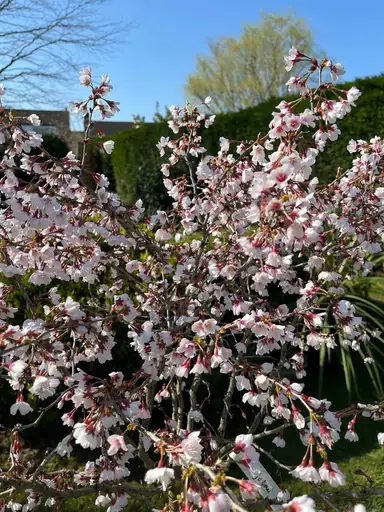
'Kojo no mai' is a small cherry with a large personality, a dwarf Fuji cherry grown as much for the winter silhouette as for the spring flowers. The stiff, twiggy branches grow in sharp zig-zags, crooking this way and that into a dense, architectural little bush, and in early spring, before the leaves, those bare zig-zag stems line themselves with single flowers, pink in bud and opening to white and blush. The Japanese name translates, fittingly, as flight of butterflies.
The parent species, Prunus incisa, is the Fuji cherry, a dainty early bloomer from the mountains around Mount Fuji, and the epithet incisa points to the deeply cut, doubly toothed leaves. 'Kojo no mai' keeps all the charm at a fraction of the size, slow and compact, reaching only four to eight feet after many years, and finishes the season with a fine show of orange, yellow, and red autumn color before the leaves drop.
Few flowering cherries suit a small garden so well. The dwarf scale and the sculptural zig-zag framework make 'Kojo no mai' a natural for a courtyard, a patio, a rock garden, or a large container, and the plant is a longtime favorite for bonsai, where the crooked branches and early bloom come into their own. Four seasons of interest come in a plant you can stand beside: winter structure, spring flower, summer leaf, autumn fire.
Grow 'Kojo no mai' in full sun to part shade in any decent, well-drained soil, hardy through USDA zones 5 to 8 and thoroughly cold-tough. Little pruning is needed beyond shaping, and when you do cut, do it in summer rather than winter, since the flowering cherries are prone to silver leaf and canker through wet dormant wounds. For the gardener short on space but long on appetite for a real ornamental, this is one of the best small trees going.
Photos courtesy of Insomniac Gardener and The Plant Pot.
Es gibt noch mehr zu entdecken



Fragen und Diskussion