

Diese Seite wird in ihrer Originalsprache angezeigt. Eine Übersetzung ist noch nicht verfügbar.
Die Seedsun-Auswahl
Quercus michauxii
Artikelnummer: QUER-MICH-BARE
Quercus michauxii is a big, generous bottomland oak that borrows the best of two better-known relatives: the pale, flaky, handsome bark of the white oak, and the large, coarsely toothed, chestnut-shaped leaves of the chestnut oak. The result is one of the noblest of the Southern hardwoods. In Coker.
Fordern Sie ein individuelles Angebot an
Preise, Packungsgrößen und Verfügbarkeit werden in Ihrem persönlichen Angebot bestätigt. Mit dem Absenden einer Anfrage wird noch keine Bestellung aufgegeben.
Erkundigen Sie sich nach Eignung, Aussaat- und Anbaubedingungen.
Bitte prüfen Sie die Lieferoptionen und die benötigten Dokumente in Ihrem Angebot.
Über diese Sorte
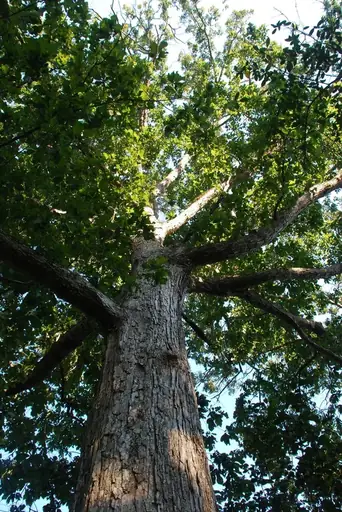
Quercus michauxii is a big, generous bottomland oak that borrows the best of two better-known relatives: the pale, flaky, handsome bark of the white oak, and the large, coarsely toothed, chestnut-shaped leaves of the chestnut oak. The result is one of the noblest of the Southern hardwoods. In Coker and Totten's Trees of the Southeastern States, a 1931 letter from James Henry Rice, Jr. of Colleton County, South Carolina, put it plainly: "It is a noble and beautiful tree and might be termed majestic with no violence to the language."
The swamp chestnut oak is a tree of the rich bottomlands, the floodplains and stream terraces of the Southern coastal plain, but the same deep, fertile ground that suits the wild tree makes for a superb shade or street tree on fertile upland sites as well. Given room, these trees build a broad, rounded crown of substantial dark foliage, silver-backed and striking in a breeze, and close the year in reddish-orange to deep burgundy, unusually good fall color for a white oak.
The acorns are the largest of any white oak, and among the sweetest: low enough in tannin that Native peoples of the Southeast ground and ate them with only minimal leaching, and palatable enough that livestock, and especially cattle, sought them out, which is how the tree earned the old country name cow oak. Deer, turkey, squirrels, and wood ducks take them just as eagerly, so a mature tree is a wildlife pantry every fall.
Plant swamp chestnut oak for the long view, on deep, moist, fertile, well-drained soil in full sun to part shade, as a specimen shade tree, a stately street or park tree, or an anchor for floodplain and bottomland restoration. The tree tolerates seasonal flooding but not permanent standing water, and takes moderate upland drought once established. Give room for a sixty- to eighty-foot tree with a broad crown, pair with other bottomland natives such as overcup oak and swamp tupelo on wet ground, and set the tree carefully, since a deep taproot makes a settled oak hard to move.
Es gibt noch mehr zu entdecken



Fragen und Diskussion