

Diese Seite wird in ihrer Originalsprache angezeigt. Eine Übersetzung ist noch nicht verfügbar.
Die Seedsun-Auswahl
Rhododendron arborescens
Artikelnummer: RHOD-ARBO-01G
Rhododendron arborescens, the sweet or smooth azalea, is one of the hardiest and most graceful of the native white azaleas, a tall, loosely branched deciduous shrub of the eastern mountains and piedmont. The common name smooth azalea points to the hairless, glossy twigs and leaves that set the.
Fordern Sie ein individuelles Angebot an
Preise, Packungsgrößen und Verfügbarkeit werden in Ihrem persönlichen Angebot bestätigt. Mit dem Absenden einer Anfrage wird noch keine Bestellung aufgegeben.
Erkundigen Sie sich nach Eignung, Aussaat- und Anbaubedingungen.
Bitte prüfen Sie die Lieferoptionen und die benötigten Dokumente in Ihrem Angebot.
Über diese Sorte
Rhododendron arborescens, the sweet or smooth azalea, is one of the hardiest and most graceful of the native white azaleas, a tall, loosely branched deciduous shrub of the eastern mountains and piedmont. The common name smooth azalea points to the hairless, glossy twigs and leaves that set the species apart from woollier kin, while sweet azalea speaks to the flowers, which pour out a rich heliotrope perfume. The species epithet arborescens is Latin for becoming tree-like, a fair description of an old plant that can reach ten to eighteen feet, and the genus name Rhododendron means rose tree in Greek.
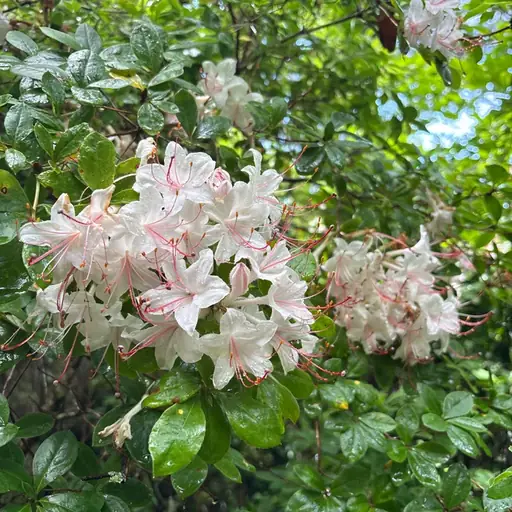
In late spring and on into summer, well after most native azaleas have finished, the shrub opens clusters of pure white to faintly pink flowers, each blossom shot through with five slender red stamens and a matching red style that arch far beyond the petals. The contrast of white corolla and red filaments is the plant's signature, and the fragrance carries across the garden on a warm evening. Glossy green summer leaves turn deep burgundy and red in autumn, so the shrub earns a second season of interest.
In the wild the sweet azalea haunts the banks of mountain streams, sloping woodlands, and the edges of high bogs from the Appalachians down through the Carolina piedmont, often leaning out over running water. Southern gardeners have long cherished the wild azaleas as bush honeysuckles for their scent, though the old country wisdom was always to admire and never to taste: like all Rhododendron, the leaves and nectar carry grayanotoxins and are not edible. The flowers reward a different guest, drawing swallowtail butterflies, hummingbirds, and native bees to the late-season nectar.
Because the sweet azalea blooms so late and grows so tall, the shrub fills a valuable niche in the shade garden, carrying fragrant white bloom into the quiet weeks after the spring rush and rising to the back of a woodland border or the middle story beneath high trees. Give moist, acidic, well-drained soil that never dries out, morning sun with afternoon shade, and a cool mulch over the shallow roots. Site the shrub near a streamside planting, a path, or a seating area where the heliotrope fragrance can be enjoyed, and pair with ferns, native phlox, and summersweet for a long, layered season.
Es gibt noch mehr zu entdecken



Fragen und Diskussion