

Diese Seite wird in ihrer Originalsprache angezeigt. Eine Übersetzung ist noch nicht verfügbar.
Die Seedsun-Auswahl
Rhodotypos scandens
Artikelnummer: RHOD-SCAN-01G
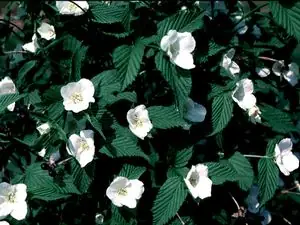
Jetbead is an old-fashioned, exceptionally tough deciduous shrub of the rose family, forming an open, multi-stemmed mound roughly three to six feet tall and four to nine feet wide on arching gray-brown stems. The opposite, sharply toothed leaves break very early in spring, and four-petaled white.
Fordern Sie ein individuelles Angebot an
Preise, Packungsgrößen und Verfügbarkeit werden in Ihrem persönlichen Angebot bestätigt. Mit dem Absenden einer Anfrage wird noch keine Bestellung aufgegeben.
Erkundigen Sie sich nach Eignung, Aussaat- und Anbaubedingungen.
Bitte prüfen Sie die Lieferoptionen und die benötigten Dokumente in Ihrem Angebot.
Über diese Sorte
Jetbead is an old-fashioned, exceptionally tough deciduous shrub of the rose family, forming an open, multi-stemmed mound roughly three to six feet tall and four to nine feet wide on arching gray-brown stems. The opposite, sharply toothed leaves break very early in spring, and four-petaled white flowers about two inches across open at the shoot tips in May and June. Clusters of three or four glossy black drupes follow in fall and hang on well into winter, the shining beads that give jetbead the common name.
Few shrubs are so adaptable. Jetbead grows in full sun to dense shade and takes average, well-drained soil in stride, along with clay, alkaline ground, urban pollution, drought, and road salt, and asks little maintenance once established. This durability, and a willingness to bloom in deep shade where few ornamentals will, earned the plant a long run as a background and border shrub in older gardens across the temperate world.
That same toughness carries a real caution. Across many eastern United States, jetbead escapes cultivation readily, birds spreading the seed into woodlands where the shrub forms dense understory thickets that crowd out native plants. Several state invasive-plant councils and arboreta advise strong control or recommend against planting near natural areas. Anyone who grows the shrub should deadhead the fruit promptly, watch for volunteer seedlings, and check local regulations first; in ecologically sensitive settings, well-behaved natives such as black chokeberry (Aronia melanocarpa) or mapleleaf viburnum (Viburnum acerifolium) make better choices.
A second caution belongs with the beauty: all parts, and the black fruit in particular, carry a high-severity poison rating, since the seeds hold amygdalin, which can release cyanide, so keep the plant well clear of children and pets and dispose of trimmings with household trash rather than compost. Where jetbead is legal and can be managed, grow the shrub as a rugged filler for deep, difficult shade, in a border, a mass, or a naturalistic planting, and enjoy the early white flowers and glossy winter beads in a spot where the spread can be kept in check.
Es gibt noch mehr zu entdecken



Fragen und Diskussion