

Diese Seite wird in ihrer Originalsprache angezeigt. Eine Übersetzung ist noch nicht verfügbar.
Die Seedsun-Auswahl
Rohdea japonica 'Claudia Phelps'
Artikelnummer: ROHD-JAPO-CLAU-PHEL-01G
Rohdea japonica, the sacred lily or Nippon lily, is a bold, slow, tufted evergreen perennial grown above all for foliage, and this selection carries the darkest leaves of all, an almost black, glossy green that anchors a shaded planting through the whole year and lights up a winter landscape when.
Fordern Sie ein individuelles Angebot an
Preise, Packungsgrößen und Verfügbarkeit werden in Ihrem persönlichen Angebot bestätigt. Mit dem Absenden einer Anfrage wird noch keine Bestellung aufgegeben.
Erkundigen Sie sich nach Eignung, Aussaat- und Anbaubedingungen.
Bitte prüfen Sie die Lieferoptionen und die benötigten Dokumente in Ihrem Angebot.
Über diese Sorte
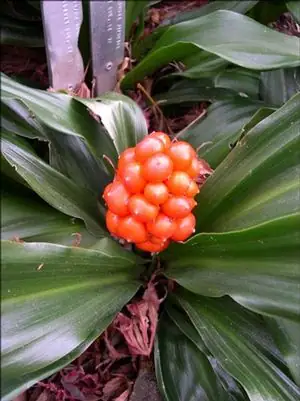
Rohdea japonica, the sacred lily or Nippon lily, is a bold, slow, tufted evergreen perennial grown above all for foliage, and this selection carries the darkest leaves of all, an almost black, glossy green that anchors a shaded planting through the whole year and lights up a winter landscape when little else holds. Rather sizeable red berries ripen in tight clusters, half-hidden at the base of the leaves, a quiet second season for anyone who looks closely.
Few plants carry so much cultural weight. Known in Japan as omoto, meaning evergreen, and prized for at least five hundred years as a symbol of long life and good fortune, Rohdea became the subject of a genuine craze: the sale of the plant was banned in 1852 to cool the speculation, and the Japan Rohdea Society today registers some six hundred named cultivars, the more dwarf, contorted, and variegated the more highly prized. As the old saying that is fond of repeating goes, in Japan old men devote their declining years to the culture of the various forms of this plant. The small, pale flowers, carried in a short dense spike among the leaves, are pollinated, remarkably, by snails.
In China the plant is wan nian qing, again evergreen, and the roots and leaves have a long place in traditional Chinese medicine as a cardiac and general tonic, a reminder that Rohdea, like foxglove and lily of the valley, carries potent cardiac glycosides and is poisonous if eaten. This particular clone has a home-ground story: the plant comes from Rosehill, the Aiken estate of the late Claudia Phelps, and was named for her by our friend Ted Stephens of Nurseries Caroliniana.
Grow 'Claudia Phelps' in shade to part shade, in rich, well-drained soil, as a bold evergreen groundcover, a foliage anchor at the front of a shaded border, or an accent in a courtyard or container where the near-black leaves can be read at close range. Slow and long-lived, deer-resistant, and drought-tolerant in shade once established, the plant pairs beautifully with ferns, hellebores, hostas, and other shade companions, and rewards the patient gardener with decades of quiet, sculptural presence.
Es gibt noch mehr zu entdecken



Fragen und Diskussion