

Diese Seite wird in ihrer Originalsprache angezeigt. Eine Übersetzung ist noch nicht verfügbar.
Die Seedsun-Auswahl
Shibataea kumasaca
Artikelnummer: SHIB-KUMA-01G
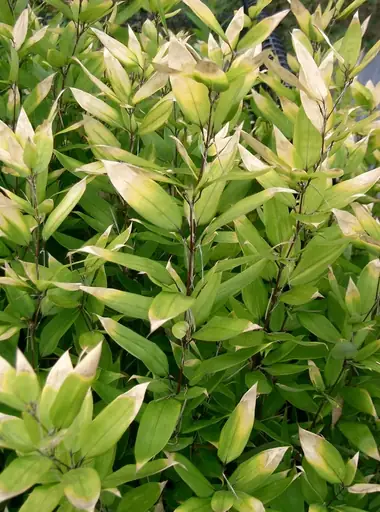
Shibataea kumasaca is the most civilized of bamboos, a low, dense, evergreen kind grown for tidy structure rather than height. The short, broad, oval leaves are unusual for a bamboo, closer to the foliage of ruscus or a small shrub than to the fine blades most bamboos wear, which is why the plant.
Fordern Sie ein individuelles Angebot an
Preise, Packungsgrößen und Verfügbarkeit werden in Ihrem persönlichen Angebot bestätigt. Mit dem Absenden einer Anfrage wird noch keine Bestellung aufgegeben.
Erkundigen Sie sich nach Eignung, Aussaat- und Anbaubedingungen.
Bitte prüfen Sie die Lieferoptionen und die benötigten Dokumente in Ihrem Angebot.
Über diese Sorte
Shibataea kumasaca is the most civilized of bamboos, a low, dense, evergreen kind grown for tidy structure rather than height. The short, broad, oval leaves are unusual for a bamboo, closer to the foliage of ruscus or a small shrub than to the fine blades most bamboos wear, which is why the plant goes by ruscus-leaf bamboo. Growing to about four or five feet, the canes zigzag gently from node to node, giving a second common name, zig-zag bamboo.
Native to the mountain slopes of Fujian and Zhejiang in eastern China, and long cultivated in Japan, ruscus-leaf bamboo has been a mainstay of clipped, traditional plantings for centuries. Unlike the aggressive timber bamboos, this species spreads slowly by short runners into a dense, even mass, easily kept in bounds by mowing or edging around the clump, and shows a welcome resistance to the bamboo mites that trouble many relatives.
The dense, low habit makes ruscus-leaf bamboo one of the best bamboos for a manageable hedge or a green groundcover. Set as a clipped low hedge, an edging along a path, or a solid understory sweep, the plant holds a neat, leafy wall of green through the year, and takes readily to shearing for a formal line. The evergreen foliage may bronze or tatter a little in the hardest winters, then flush fresh and green again in spring.
Give ruscus-leaf bamboo moist but well-drained, acidic soil in full sun to part shade, with a little afternoon shade and steady moisture where summers are fierce. Pair with ferns, camellias, and other shade companions in a Japanese-style planting, or run the low hedge along a walk where the tidy, self-contained habit is an asset rather than a worry. Deer generally pass the foliage by, and once settled the plant asks little beyond the occasional trim.
Es gibt noch mehr zu entdecken



Fragen und Diskussion