

Diese Seite wird in ihrer Originalsprache angezeigt. Eine Übersetzung ist noch nicht verfügbar.
Die Seedsun-Auswahl
Stewartia sinensis
Artikelnummer: STEW-SINE-01G
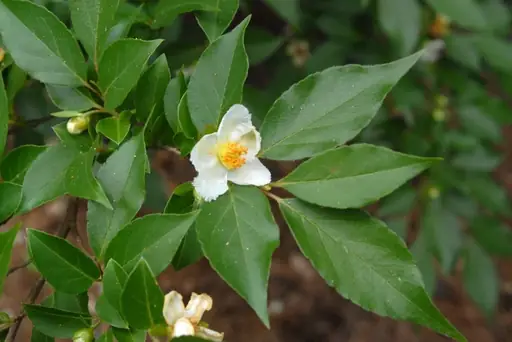
This small tree of Chinese origin has showy white flowers and fall foliage that is red or reddish, and the smooth whitish trunks with exfoliating bark are an important ornamental feature. In truth the bark is the reason most people plant one. Old stems shed in thin plates to leave a polished,.
Fordern Sie ein individuelles Angebot an
Preise, Packungsgrößen und Verfügbarkeit werden in Ihrem persönlichen Angebot bestätigt. Mit dem Absenden einer Anfrage wird noch keine Bestellung aufgegeben.
Erkundigen Sie sich nach Eignung, Aussaat- und Anbaubedingungen.
Bitte prüfen Sie die Lieferoptionen und die benötigten Dokumente in Ihrem Angebot.
Über diese Sorte
This small tree of Chinese origin has showy white flowers and fall foliage that is red or reddish, and the smooth whitish trunks with exfoliating bark are an important ornamental feature. In truth the bark is the reason most people plant one. Old stems shed in thin plates to leave a polished, mottled surface in cream, buff, and cinnamon that looks best in winter when nothing distracts from it, and improves every year for decades. The flowers arrive in early summer, white and cupped, about two inches across with a central boss of yellow stamens, unmistakably the work of a relative of Camellia. Then autumn brings a clean red. Very few small trees do three distinct things this well.
The tea family connection is not incidental. Stewartia sits in Theaceae alongside Camellia and Franklinia, and the family resemblance runs right through the flower. The genus name honors John Stuart, third Earl of Bute, a patron of botany whose name Linnaeus rendered with a w, and nomenclatural rules have preserved that spelling ever since. Sinensis places this species in China, where it grows in mountain forests, and it is one of a group of Asian stewartias that have proven considerably easier in cultivation than the two American species.
Our propagation stock comes from cuttings taken at Hopelands Gardens, a few minutes from the nursery here in Aiken. Local provenance of that kind is worth more than it sounds: these are cuttings off a tree that has already proven it will grow in this soil and this heat, rather than material shipped in from a cooler climate and hoped for.
Dirr, in his Manual of Woody Landscape Plants, says: "....a delightful small landscape plant that should be more widely used." and: "Hardy to Boston and should be pursued by discriminating gardeners." That second remark is worth attending to, because the cold hardiness surprises people. This is a tree that will grow well north of where the American silky camellia gives up, and it asks less of a gardener in every respect.
A plant for moist but well-drained acidic soil in sun or half shade, reaching fifteen to twenty-five feet. Like the whole genus, this species dislikes root disturbance, so plant young into a permanent position and mulch rather than cultivate around the base. Steady moisture matters, particularly while establishing; a droughty site produces a stunted tree that never develops the bark. Site where the winter trunk will actually be seen, near a path, a drive, or a window, since bark this good is wasted at the back of a border. Underplant with hellebores, epimedium, ferns, or low evergreens that will not compete hard at the surface, and resist the urge to limb up too early. Growth is unhurried and the tree rewards patience.
Es gibt noch mehr zu entdecken



Fragen und Diskussion