

Diese Seite wird in ihrer Originalsprache angezeigt. Eine Übersetzung ist noch nicht verfügbar.
Die Seedsun-Auswahl
Vitis rotundifolia ‘Triumph'
Artikelnummer: VITI-ROTU-TRIU-01G
The muscadine is the South's own grape, and 'Triumph' is one of the finest for the home garden. Vitis rotundifolia is a vigorous native vine of the southeastern United States, the first North American grape brought into cultivation, long grown for thick-skinned, intensely flavored fruit and the.
Fordern Sie ein individuelles Angebot an
Preise, Packungsgrößen und Verfügbarkeit werden in Ihrem persönlichen Angebot bestätigt. Mit dem Absenden einer Anfrage wird noch keine Bestellung aufgegeben.
Erkundigen Sie sich nach Eignung, Aussaat- und Anbaubedingungen.
Bitte prüfen Sie die Lieferoptionen und die benötigten Dokumente in Ihrem Angebot.
Über diese Sorte
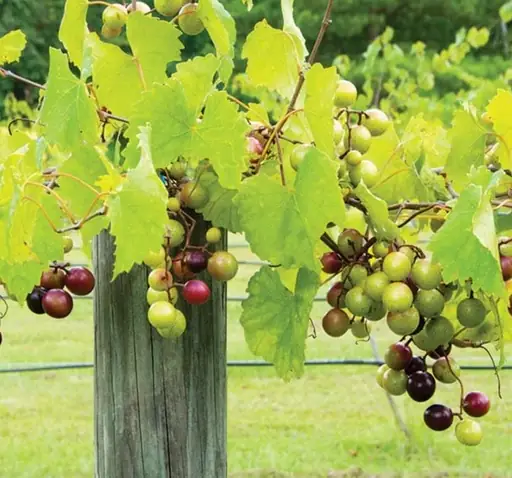
The muscadine is the South's own grape, and 'Triumph' is one of the finest for the home garden. Vitis rotundifolia is a vigorous native vine of the southeastern United States, the first North American grape brought into cultivation, long grown for thick-skinned, intensely flavored fruit and the honeyed wines of Scuppernong fame. 'Triumph', a bronze-fruited selection, carries that heritage forward with unusual quality and ease.
The berries of 'Triumph' are large, sweet, and bronze-green, thick-skinned in the muscadine way, with a rich, musky flavor prized for fresh eating, juice, jelly, and wine. The vine is vigorous and notably resistant to the mildew and rot that trouble bunch grapes, and, unlike many older muscadines that carry only female flowers, 'Triumph' is self-fertile, so a single vine sets a full crop, with even heavier yields where a second muscadine grows nearby.
Broad, rounded, glossy leaves with toothed edges clothe the sprawling vine and turn soft gold in fall. Small greenish-white flowers open in late spring, quiet but fragrant and worked by bees, and the fruit ripens over a long window from late summer into early autumn, feeding people and wildlife alike.
Give 'Triumph' a sturdy arbor, a trellis, or a strong fence in full sun, and room for a vigorous climber to run. The vine thrives across the warm South in well-drained soil, asks little once established, and rewards a hard annual pruning with a heavy crop. A handsome, productive backbone for an edible landscape, and a living piece of Southern agricultural history.
Es gibt noch mehr zu entdecken



Fragen und Diskussion