
How to Grow Single Late Cottage Tulips
Tulipa hybrids Tulips are among the most beautiful harbingers of spring but they seem to be in bloom for such a brief period. So when I first discovered the magic of late-season or May-flowering tulips, I knew I had found a way to keep the floral show going just a little bit longer. Cottage tulips,.
Tulipa hybrids
Tulips are among the most beautiful harbingers of spring but they seem to be in bloom for such a brief period.
So when I first discovered the magic of late-season or May-flowering tulips, I knew I had found a way to keep the floral show going just a little bit longer.
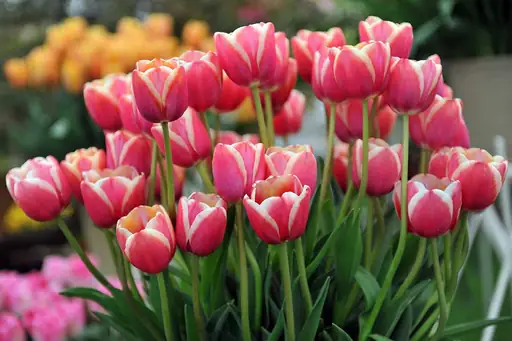
Cottage tulips, also known as single late tulips, feature elongated, cup-shaped blooms that open gradually to reveal lush, rounded faces.
Available in the same range of colors as other types of tulip, including pure white, near-black, bicolors, and everything in between.
These flowers also feature patterns like flames, stripes, feathers, solid hues, and contrasting edges.
They bloom from midspring to the beginning of summer on plants that are much larger than the early spring tulips, with stalks that can extend nearly three feet tall.
In our guide to growing tulips we cover how to cultivate these spring staples.
This guide focuses on single lates, aka single cottage or May-flowering tulips. The ones that keep the display going almost into early summer.
So, ready to give these a home? Awesome! Here’s what I’ll cover:
What You’ll Learn
Quick Look
How to Sow
How to Grow
Cultivars to Select
Pests and Disease
Tulips are commonly classified into 15 groups known as Divisions.
Single late types are classified in Division 5. So-called “cottage” tulips were once in a category of their own, but have been grouped together with single late types for several decades.
There are also double late types, in Division 11, that bloom at a similar time but these have fuller, denser flowers with more petals.
Most single lates have the classic tulip silhouette, though some sport pointed, egg-shaped, or reflexed petals, which means they curve back toward the stem.
Cottage types are sometimes referred to as Scheepers, while a subset of newer hybrids bred in France may be labeled “French single late.”
Quick Look
Common name(s): Single late, cottage, May-flowering tulip
Plant type: Perennial bulb
Hardiness (USDA Zone): 4-7
Native to: Turkey
Bloom time / season: Late spring to early summer
Exposure: Full sun
Soil type: Loose, humus-rich, well-draining
Soil pH: 6.0-7.0, slightly acidic to neutral
Time to maturity: 9 months
Mature size: 18-30 inches tall, 4-6 inches wide
Best uses: Borders, containers, formal gardens, mass planting, wildlife gardens
Taxonomy
Order: Liliales
Family: Liliaceae
Genus: Tulipa
Species: Hybrids
These tend to be sturdier and longer-lived than the older cultivars, which makes them excellent for cutting gardens.
In large drifts, single late tulips put on a performance that’s hard to beat. Their tall, nodding blooms swaying in the breeze makes for a pretty impressive statement.
They’re ideal as a stately backdrop in borders or mass-planted for a formal burst of color.
Let them naturalize in a wildlife garden, or show them off in tall containers where they bring both structure and beauty.
Of course, they also shine in cut flower gardens.
Pair them with peonies, irises, and ornamental alliums to add color after the tulip flowers have faded.
You can also plant some early tulips like single or double early, Fosteriana, Greigii, and Kaufmanniana, along with some mid-season bloomers like Darwin hybrids.
That way, you’ll have color from March and lasting through June.
How to Sow
Because single late types are hybrids, you can’t grow them from seed.
If you come across “seeds” labeled as single late, they’re either mislabeled or won’t produce plants that match the parent.
To grow true single late varieties, you’ll need to start with bulbs.
If you live in a warm region in Zones 6 and up, you might need to buy pre-chilled bulbs.
When you bring your bulbs home, you need to get them in the ground before the ground freezes in fall.
If your soil is particularly heavy or sandy, work in lots of well-rotted compost. Then, dig holes three times the length of the bulbs about six inches apart and plant one bulb per hole.
The pointed end should be facing up.
Cover them with soil and water in well. You can add a few inches of mulch such as straw or shredded leaves to insulate against temperature extremes.
Leave them alone through the winter months.
How to Grow
Though they bloom later in the season, single late tulips don’t require any special treatment compared to more familiar types.
Light
Plant single lates in a spot that receives full sun, at least six hours of direct sunlight per day. These varieties are a bit more tolerant of heat than early spring bloomers.
Soil
The soil should be well-draining with a pH between 6.0 and 7.0.
If you’re working with heavy clay or poorly draining areas, amend the planting site to a depth of at least a foot with well-rotted compost.
You can also grow these in raised beds or containers if drainage is a concern.
Water
Depending on where you live, the bulbs might not need any supplemental watering since spring tends to bring plenty of rain.
When they first emerge, the soil should remain evenly moist. As the plants grow and start to fade, it’s fine to let the soil dry out a bit.
Learn more about the water needs of tulips here.
Fertilizing
Fertilize in both fall and spring. Apply in the fall when daytime temperatures drop below 65°F and again in spring after the foliage emerges.
Ideally, you should test your soil to guide your fertilizer choice and application rate. If you skip the test, a mild liquid fertilizer formulated for flowering plants will do.
I like AgroThrive’s Fruit & Flower mix as it has an NPK ratio of 3-3-5. The extra potassium helps to support the large blooms.
AgroThrive Fruit & Flower
Cultivars to Select
Whether you want something tall and bold or soft and subtle, there are oodles of stunning options out there. Here are just a few of our favorites:
Avignon
Two- to three-inch blooms in raspberry, fuchsia, and coral tones appear on statuesque 26-inch stems, capturing the very essence of spring.
A classic Scheepers hybrid, ‘Avignon’ features apricot-tinted edges and raspberry flames at the center of each petal, making for a stunning display.
Dreamland
‘Dreamland’ belongs in a magical fairytale. The rose pink petals have a creamy white base that looks like a cloud.
As the two- to three-inch flowers dance at the end of the two-foot stalks, it looks like a dream.
This beauty is reliable and beautiful enough that it won the Royal Horticultural Society’s Award of Garden Merit in 1995.
Maureen
If you love the elegant serenity of white tulips, ‘Maureen’ is one of the finest. Bred in 1950, the four- to five-inch, oval flowers are creamy white, held on 24-inch stems.
As a French single late, it’s ideal for cutting and adding to bouquets or arrangements.
‘Maureen’
The Royal Horticultural Society honored ‘Maureen’ with the Award of Garden Merit in 1993.
You can find packets of 10 bulbs available at .
Menton
‘Menton’ is a real charmer. The petals of the three- to four-inch flowers are soft ballerina pink with peach edges, held atop two-foot-tall stalks.
Another standout Scheepers hybrid, it blooms even later than most single lates – you could practically call it a summer tulip!
The Royal Horticultural Society gave it the Award of Garden Merit in 2008.
Queen of the Night
Fans of dark or black flowers are going to fall in love with this tulip royalty.
One of the deepest, darkest types available, ‘Queen of the Night’ looks nearly black, with hints of burgundy and purple depending on the light.
‘Queen of the Night’
It can rocket up to 30 inches tall with extremely sturdy stems that are just right for vases and bouquets.
You can pick up ‘Queen of the Night’ bulbs at .
Pests and Disease
Late-season tulips face all the same challenges as their early-blooming cousins.
That includes herbivores like deer and rabbits, which tend to munch on the foliage and flowers.
Voles, mice, gophers, and groundhogs are even more destructive, going straight for the bulbs.
Common pests include aphids, bulb mites, slugs, snails, spider mites, and wireworms. All of which can damage the plants either above or below ground.
I find that single lates are less prone to rotting issues than earlier varieties, possibly because they are growing during the drier end of spring.
They can be susceptible to basal rot (Fusarium), botrytis blight, tulip breaking virus, and crown rot.
Keep the Party Going
If you find yourself eyeing your fading tulips with a hint of regret as spring marches on, adding a few late-blooming types will keep the color going long after the classic hybrids have come and gone.
Are you growing single late cottage types? Do you have a favorite cultivar that we missed? Let us know in the comments section below!
And for more information about growing tulips in your landscape, check out these guides next:
- How to Grow and Care for Rembrandt Tulips
- How to Grow and Care for Parrot Tulips in the Spring Garden
- How to Grow Peony Tulips in Your Garden
- X




Preguntas y debate