

Esta página se muestra en su idioma original. La traducción aún no está disponible.
La selección de Seedsun
Elaeagnus pungens 'Variegata'
SKU: ELAE-PUNG-VARI-01G
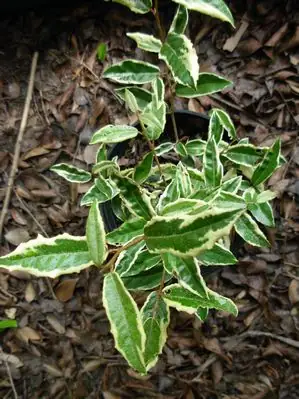
The gold-edged form of silverthorn, and a genuinely useful evergreen for hard places. Leaves are leathery and wavy-margined, three inches or so long, glossy green through the middle with a broad creamy-gold border, and silvered underneath with a dusting of tiny brown scales that catches light when.
Solicita un presupuesto personalizado
Los precios, tamaños de los paquetes y disponibilidad se confirman en su presupuesto personalizado. Enviar una consulta no implica realizar un pedido pagado.
Pregunte sobre la idoneidad, la siembra y los requisitos de cultivo.
Confirme las opciones de entrega y los documentos necesarios en su presupuesto.
Acerca de esta variedad
The gold-edged form of silverthorn, and a genuinely useful evergreen for hard places. Leaves are leathery and wavy-margined, three inches or so long, glossy green through the middle with a broad creamy-gold border, and silvered underneath with a dusting of tiny brown scales that catches light when the wind turns them. In October and November the shrub produces small creamy-white bells, apetalous and easy to overlook entirely, which is a joke the plant plays every autumn: the flowers are nearly invisible and the scent is extraordinary, closer to gardenia than to anything else, and strong enough to stop people on a path while they work out where it is coming from. Small reddish-brown drupes follow in spring and are technically edible, though the birds are welcome to them.
A correction is owed here, because our own catalog carried it for years. This plant is not autumn olive. Autumn olive is Elaeagnus umbellata, a deciduous and notoriously aggressive relative. Elaeagnus pungens is thorny olive or silverthorn, evergreen, native to China and Japan, and named for the hooked thorns along the branchlets. Elaeagnus comes from the Greek elaia, olive, and agnos, the chaste tree, for a plant that resembles both and is closely related to neither. All the Elaeagnaceae fix nitrogen through root nodules, which is exactly why the whole family thrives on ground too poor to interest anything else.
In China the leaves are hu tui zi ye, and the use is specific and old. Li Shizhen recorded the leaf in the Bencao Gangmu in the sixteenth century as a remedy for severe asthma, cough, and bronchitis, classified among the herbs that moisten the lung and settle a dissipated lung qi. That tradition has held modern attention: published work has tested leaf extracts for antiasthmatic, antitussive, and expectorant activity in animal models, and reports lengthened latency before coughing and increased tracheal secretion. The chemistry is dominated by flavonoids and triterpenes.
Site in full sun with drainage and then leave the shrub alone; this is a plant for a dry bank, a hot corner, a wind-scoured boundary, or a coastal garden, and it is unbothered by salt, drought, poor soil, or neglect. Left unpruned, long whip-like shoots will scramble up into whatever is nearby and the whole thing turns vine-like, so cut those back through the season for a tight twelve to fifteen foot shrub or a dense screening hedge. Watch for reversion: shoots that come back plain green are more vigorous than the variegated growth and will take over if you let them, so cut them out at the base as they appear. One honest caution before you plant. Elaeagnus pungens has escaped cultivation across the Southeast and is assessed as invasive throughout Florida and listed in Texas, spread by birds carrying the fruit into woodland. A variegated clone is less vigorous than the plain species, but in the lower Southeast this is a shrub to keep pruned, watched, and away from a woodland edge.
Hay mucho más por descubrir



Preguntas y debate