

Esta página se muestra en su idioma original. La traducción aún no está disponible.
La selección de Seedsun
Muhlenbergia capillaris
SKU: MUHL-CAPI-01G
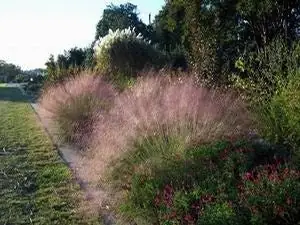
Few native grasses put on a show like Muhlenbergia capillaris. For most of the year pink muhly is a modest, upright tuft of fine, wiry, dark green blades, easy to overlook. Then, in the shortening days of autumn, the whole clump erupts into a haze of tiny flowers, an airy cloud of pink to rose-red.
Solicita un presupuesto personalizado
Los precios, tamaños de los paquetes y disponibilidad se confirman en su presupuesto personalizado. Enviar una consulta no implica realizar un pedido pagado.
Pregunte sobre la idoneidad, la siembra y los requisitos de cultivo.
Confirme las opciones de entrega y los documentos necesarios en su presupuesto.
Acerca de esta variedad
Few native grasses put on a show like Muhlenbergia capillaris. For most of the year pink muhly is a modest, upright tuft of fine, wiry, dark green blades, easy to overlook. Then, in the shortening days of autumn, the whole clump erupts into a haze of tiny flowers, an airy cloud of pink to rose-red that seems to hover a foot above the foliage and glows when backlit by low sun. Massed in a drift, the effect is one of the most spectacular in the fall garden.
Pink muhly belongs to a large American genus named for Gotthilf Henry Ernest Muhlenberg, the Pennsylvania botanist and Lutheran minister who did much of the early work on North American grasses. The species has a famously tangled relationship with the coastal sweetgrass long known as Muhlenbergia filipes, a grass so close to pink muhly that botanists once folded the two together, treating sweetgrass as a variety of M. capillaris itself. It is that coastal sweetgrass, rather than pink muhly, whose wiry leaves the Gullah basketmakers of the South Carolina Lowcountry coil into the celebrated sweetgrass baskets, a craft carried from West Africa and kept alive for generations along the coast.
For all the delicacy of the bloom, pink muhly is a tough, adaptable native of the eastern and central United States, at home on sandy pinelands, rocky glades, and coastal flats. The grass shrugs off heat, humidity, drought, and poor soil once established, asks for nothing in the way of feeding, and stays neatly clump-forming rather than running. Deer pass the wiry foliage by, and the seed heads shelter small birds and insects through the colder months.
Pink muhly earns a place wherever the autumn display can be seen to advantage, and above all where low morning or evening light can pass through the pink cloud. Mass the grass in a sweep at the front or middle of a sunny border, repeat a rhythm of clumps along a path or drive, or set a drift against a dark backdrop of evergreens or a wall so the color reads. The plant pairs beautifully with little bluestem, asters, goldenrod, and other fall natives, thrives in gravel gardens and coastal plantings, and asks only full sun and sharp drainage. Cut the old foliage to the ground in late winter before new growth begins.
Hay mucho más por descubrir



Preguntas y debate