
23 of the Most Fabulous Types of Epiphyllums to Grow at Home
Epiphyllums, also known as orchid cacti, are large, succulent plants with long, flat, leafless stems that produce breathtaking blooms. There are many different species that go by the name “epiphyllum,” as well as thousands of colorful hybrids to tempt the houseplant lover or orchid cactus.
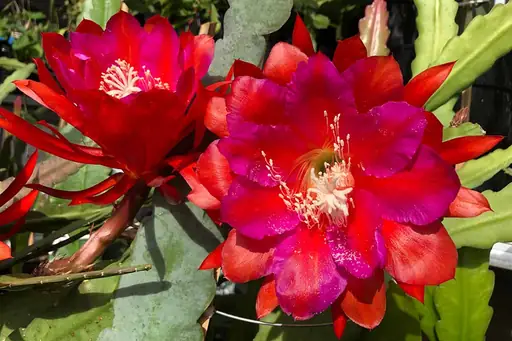
Epiphyllums, also known as orchid cacti, are large, succulent plants with long, flat, leafless stems that produce breathtaking blooms.
There are many different species that go by the name “epiphyllum,” as well as thousands of colorful hybrids to tempt the houseplant lover or orchid cactus collector.
I’ve cultivated a list of 23 different selections to give you a feel for these fascinating leaf cacti and introduce you to some you might want to consider growing yourself!
Here’s a peek at our list:
23 of the Best Epiphyllums for Home Gardeners
1. Ackermannii
2. American Sweetheart
3. Anguliger
4. Anthonyanus
5. Apache Magic
6. Chrysocardium
7. Clown
8. Connie Mayer
9. Crenatus
10. George French
11. Guatemalense
12. Hookeri
13. King Midas
14. Kiwi Razzle Dazzle
15. Laui
16. Madras Ribbon
17. Oxypetalum
18. Pegasus
19. Phyllanthoides
20. Phyllanthus
21. Pumilum
22. Punchbowl
23. Unforgettable
We’re going to interpret the term “epiphyllum” broadly for the purposes of this roundup, including three different types: members of the Epiphyllum genus, some species that were formerly classified in the genus, and epiphyllum hybrids.
I’ll let you know what type of epiphyllum we’re dealing with for each selection. But first, a little more on these distinctions so that you can understand what to expect from each:
Epiphyllum is a genus that currently includes nine or 10 different species, depending on who you ask.
However, several species that were once included within this genus have since been reclassified and placed in other genera such as Selenicereus or Disocactus.
Despite their new scientific names, these members of the Cactaceae family and the Hylocereeae tribe are still widely referred to as epiphyllums.
Hybrid epiphyllum cultivars are bred for big, showy, colorful blooms.
Various members of the Hylocereeae tribe. Photo by Kristina Hicks-Hamblin.Some of these hybrids have Epiphyllum ancestry, but others may be crosses of Selenicereus or Disocactus species, or species of different genera.
Collectors and fans of these cacti call them “epiphyllums” or “epis,” for short, nonetheless.
What we’re not going to include in our selection today is plants that were formerly classified in a totally different Epiphyllum genus.
The short story on this other use of this botanical name is this: two botanists had the same great idea for a name, but they weren’t talking about the same plants – or to each other – when they separately came up with that name.
Those plants are members of the Schlumbergera genus, whose most famous representative you’ll recognize by the common name “Christmas cactus.”
If you’d like to learn more about growing and caring for Christmas cacti, read our complete guide.
Let’s also cover a little flower anatomy before we dig into our epiphyllum selections so you can fully appreciate the big blooms on these plants – the lesson will be short, I promise!
Epiphyllums tend to produce exceptionally large blooms, and that means all the distinct parts of the flower are much more readily visible than what you might see in other types of blossoms.
E. hookeri flower.In the photo above, which depicts an Epiphyllum bloom with narrow white petals, you can see a yellow stigma and pink style surrounded by delicate white stamens.
Now you’ll know what I’m talking about when I use those terms moving forward.
That’s it! Lesson over.
For each of our selections, I’ll let you know what to expect in terms of the color, shape, and arrangement of the flower petals, as well as the color of stigma, style, and stamens.
You’ll also learn about foliage and growth habit, though in general, epiphyllum hybrids tend to be compact in size, while the mature sizes of species plants varies from one to the next.
And just a reminder, we’re not going to cover care needs in this article, so be sure to check out our complete guide to growing epiphyllums.
And now begins our excursion into the realm of the orchid cacti!
1. Ackermannii
Our first selection is commonly known as “red orchid cactus.”
Although this species used to be classified in the Epiphyllum genus, E. ackermannii has since been reclassified to the closely related Disocactus genus, and is now known botanically as D. ackermannii.
D. ackermannii.Red orchid cactus blooms in the springtime, bearing scarlet red, funnel-shaped flowers that reach five inches across or more.
These are delicately scented and last for a few days before fading.
The stems of red orchid cactus reach seven inches to three feet long, and have prominent veins and undulating to toothed margins. These stems display upright growth before trailing down.
In 2012, this species received the Royal Horticultural Society’s Award of Garden Merit.
Interested in purchasing a specimen of your own?
2. American Sweetheart
‘American Sweetheart’ is an epiphyllum hybrid with gorgeous pink and golden-pink blooms.
Flowers are extra-large, reaching nine inches wide or more, and have a cup and saucer form, with pink inner petals, golden-pink outer petals, and cream colored stigma and stamens.
‘American Sweetheart’ has flat stems and grows well in a hanging basket.
3. Anguliger
Commonly called “zigzag cactus” or “fishbone cactus,” Disocactus anguliger is another species that has been ousted from the Epiphyllum genus.
Also previously classified as Cereus mexicanus, which is considered a synonym, fans of forest cacti will frequently see this species referred to as E. anguliger.
Its flat, wide stems are deeply lobed, making one think of the skeleton of a fish – or of rickrack ribbon, which gives rise to another common name, “ric rac cactus.”
This species bears medium-sized flowers that measure five to seven inches across.
D. anguliger. Photo by Zapyon, Wikimedia Commons, via CC BY-SA.Inner petals are white to cream colored, broad and overlapping, surrounded by golden to golden brown, narrow outer petals. Stigma, stamens, and style are all white.
These flowers bloom at night and are short lived, remaining open for 12 to 24 hours.
D. anguliger grows well in a hanging basket and has prolific foliage, which can grow several feet long.
Learn more about growing fishbone cactus here.
4. Anthonyanus
Our next selection is commonly called “fishbone cactus.”
Are you getting a feeling of déjà vu?
Glad to know you’re paying attention – yes, that common name should sound very familiar! I suppose the world is big enough for two fishbone cacti, isn’t it?
Along with bearing a remarkably close resemblance to the previous selection, this species (Selenicereus anthonyanus) shares additional common names with that other fishbone cactus – “ric rac cactus” as well as “zigzag cactus.”
While S. anthonyanus was never classified botanically as an Epiphyllum, it is often confused with its lookalike and is frequently referred to as an epiphyllum.
S. anthonyanus has long, flat stems that are deeply lobed, with a fishbone shape. Compared to D. anguliger, the lobes are sharper and less rounded – but only on more mature stems!
Younger specimens of these two species can be extremely hard to distinguish from each other based on their foliage.
The fragrant blooms are medium-sized, reaching five to seven inches across and are short lived, opening for one night a year.
They have narrow petals, with cream and yellow inner petals and outer petals that are reddish purple.
The yellow stamens are shorter than those of our other selections, and the style and stigma are white.
This species will thrive with more direct sun than the other epiphyllums described here, and is considered a shy bloomer.
5. Apache Magic
‘Apache Magic’ is an attractive, orange- and pink-flowered epiphyllum hybrid.
Flowers have a cup and saucer form and are large, with broad, overlapping petals.
Petals are orange with hot pink margins, surrounding cascading stamens, a creamy pink style, and a white stigma.
The foliage of ‘Apache Magic’ has both flat and triangular growth.
6. Chrysocardium
Commonly known as “fern leaf cactus” or “shark tooth cactus,” this species suffers from a bit of an identity crisis – or at least, botanists have bestowed it with one.
According to the Royal Horticultural Society, the official classification of this species is unresolved.
Perhaps it’s an Epiphyllum species. Or perhaps it’s more closely related to S. anthonyanus, the purple-flowered fishbone cactus we encountered above.
Shark tooth fern (S. chrysocardium). Photo by Max Ronnersjö, Wikimedia Commons, via CC BY-SA.Call it Selenicereus chrysocardium or E. chrysocardium; either way, this cactus is commonly referred to as an epiphyllum.
This species has long, flat stems that are deeply lobed and look like the foliage of ferns.
Its flowers are eight inches wide, with broad, overlapping, white inner petals and narrow white and pink outer petals.
The white to pale yellow stigma is surrounded by golden stamens, which give this plant another common name, “golden heart epiphyllum.”
Plants have a trailing growth habit, with stems reaching up to six feet long. This species is well suited for hanging baskets, and is considered a shy bloomer.
7. Clown
‘Clown’ is a colorful epiphyllum hybrid with tricolored blooms.
Flowers have a cup and saucer form and are large, reaching seven to nine inches wide.
Photo via Alamy.The red outer petals are narrow, forming spokes around broad, overlapping inner petals that are white with raspberry veining and midstripes. The stigma, style, and stamens are white.
This hybrid is prone to spotting, a primarily cosmetic issue that affects epi foliage, and especially certain hybrids.
8. Connie Mayer
‘Connie Mayer’ is an epiphyllum hybrid whose extra-large, purple blooms are short lived but make a long-lasting impact.
The purple petals are narrow but abundant, resembling the purple streaks of fireworks as they explode. The inner petals are magenta to purple, surrounded by slightly darker outer petals.
The style is purple, stigma is white to yellow, and stamens are yellow.
The flowers of this night-blooming epiphyllum last one night only, but they are huge, ranging in size from nine to 14 inches wide.
Stems are three-sided on plants that grow to be very large.
‘Connie Mayer’ is a cross of Selenicereus undatus and S. stenopterus.
9. Crenatus
Known as the “crenate orchid cactus,” this former member of the Epiphyllum genus is now classified as Disocactus crenatus.
Bearing delicately scented white flowers, blooms are funnel shaped with broad white petals, and can reach eight inches wide.
Crenate orchid cactus. (D. crenatus). Photo by Aqiao HQ, Wikimedia Commons, via CC BY-SA.In spring or summer, D. crenatus bears day-blooming flowers, which remain open for a few days.
Foliage grows upright then weeps, growing up to 10 feet long, with flattened stems that are two inches wide.
This species has been widely used by epiphyllum hybridizers.
10. George French
‘George French’ is a cheery hybrid named after a world-renowned epiphyllum breeder.
‘George French.’ Photo by Andre Abrahami, Wikimedia Commons, via CC BY-SA.The fragrant blooms have pale yellow inner petals transitioning to darker yellow outer petals.
Flowers have an open shape and are medium-sized, measuring four to six inches wide.
These plants have an upright growth habit.
11. Guatemalense
Guatemalan orchid cactus is an Epiphyllum subspecies, classified as E. hookeri ssp. guatemalense, that is grown more for its unusual foliage than for its flowers.
Also known as “curly locks epiphyllum” or “curly sue,” this species has wavy stems that look like thick locks of hair, particularly in more mature specimens with long stems that twist and turn as they trail.
Curly locks orchid cactus (E. hookeri subsp. guatemalense). Photo by Kristina Hicks-Hamblin.This subspecies was formerly classified as E. guatemalense, which is considered a synonym. Some sources also refer to it as E. guatemalense ‘Monstrose.’
The wavy stems have prominent midveins and bear blooms that are three inches wide and white, which open at night. Flowers give way to rounded, pink fruit.
12. Hookeri
Known by the common name “Hooker’s orchid cactus,” E. hookeri is a species in the Epiphyllum genus.
It was formerly classified as Cereus hookeri and E. phyllanthus ssp. hookeri, which are considered synonyms.
White flowers are large, reaching seven to nine inches across, and are unscented or have a very delicate fragrance.
Hooker’s orchid cactus. (E. hookeri).Blooms are wheel shaped, with narrow, spoke-like petals, surrounding white stamens and a bright pink style with a yellow stigma.
Hooker’s orchid cactus blooms for one night a year in spring, summer, or fall, and produces bright pink fruits.
The wavy-margined stems can reach six to 10 feet long – or sometimes more – and can be both flat and triangle shaped.
13. King Midas
‘King Midas’ is an epiphyllum hybrid with dazzling golden-orange blooms.
The large flowers have a cup and saucer form, measure seven to nine inches wide, and remain on the plant for three to four days.
‘King Midas.’ Photo by Andre Abrahami, Wikimedia Commons, via CC BY-SA.Petals are salmon to orange with a darker orange midstripe, surrounding a creamy stigma and stamens, and pink style.
Plants have an upright growth habit and are spiny.
14. Kiwi Razzle Dazzle
With blooms so full of petals, you might mistake the flowers of orchid cactus hybrid ‘Kiwi Razzle Dazzle’ for those of a dahlia.
Large flowers have multiple rows of overlapping petals. Inner petals are purple with light pink edges, and outer rows are orange with purple-pink edges. The stigma and stamens are white.
Plants have an upright growth habit, with both flat and triangular stems.
15. Laui
E. laui is a member of the Epiphyllum genus that has funnel-shaped flowers.
Blooms have broad, overlapping, white inner petals with golden brown outer petals, and appear in spring or summer.
Flowers open in the evening and are short lived, remaining open for approximately two days.
E. laui. Photo by Alfred Lau, Wikimedia Commons, Public Domain.E. laui can take a very long time – sometimes many years – to flower. When it does, this species then produces fruits that are red to pink.
Plants are quite compact, reaching 12 inches tall and 20 inches wide, and can be spiny.
The stems of E. laui are glossy and tinged with red. These have prominent midribs, and scalloped or wavy margins.
16. Madras Ribbon
‘Madras Ribbon’ is an eye-catching orchid cactus hybrid with bicolored blooms.
‘Madras Ribbon.’ Photo by Prenn, Wikimedia Commons, via CC BY-SA.Broad, wavy inner petals are bright pink with a darker pink midstripe, while outer petals are dark pink with feathery orange midstripes.
The foliage is flat and broad, with wavy margins.
17. Oxypetalum
Queen of the night, E. oxypetalum, is the most well-known member of the Epiphyllum genus.
E. oxypetalum blooms in spring or summer, bearing large, short-lived flowers that last only one night, fading by morning.
Inner petals are white, broad, and overlapping, while outer petals are narrow and range in color from cream to golden brown to pink.
Also known as “Dutchman’s pipe,” this species is a prodigious grower, with stems up to five inches wide that can grow to be over 10 feet in length.
Stems grow upright before trailing down, and produce secondary branches.
Queen of the night will be perfectly content in a hanging basket, and makes an excellent houseplant. Plants will require staking for an upright display
Also known as “night-blooming cereus” and “lady of the night,” this species shares these common names with another “queen of the night” from a different genus and tribe – Cereus peruvianus, a desert species that has different care needs than our forest species.
Looking for an epiphyllum queen of the night?
18. Pegasus
With multicolored blooms, ‘Pegasus’ is an enchanting epiphyllum hybrid.
Flowers have broad inner petals that are purple with an orangish-red midstripe and outer petals that are bronze violet.
‘Pegasus.’ Photo by Andre Abrahami, Wikimedia Commons, via CC BY-SA.The blooms are extra large, measuring nine inches wide or more, and have a funnel form, opening wide around cream-colored stigma, style, and stamens. Flowers last one to two days.
The weeping growth habit of ‘Pegasus’ makes it well suited for hanging baskets.
19. Phyllanthoides
Disocactus phyllanthoides is a species plant known by the common name “German empress.”
This former member of the Epiphyllum genus was previously classified as E. phyllanthoides, as well as Nopalxochia phyllanthoides and Cereus phyllanthoides, which are now considered synonyms.
It is also known as “pond lily cactus” and “empress.”
German Empress (D. phyllanthoides). Photo by Archibald Tuttle, Wikimedia Commons, via CC BY-SA.German empress bears unscented flowers that are bell- to funnel-shaped, with mid- and outer petals in bright pink, and paler pink inner petals.
Flowers bloom during the daytime, primarily in spring, with some specimens flowering three times a year.
This species has pendulous, flattened stems that typically grow to three feet long, sometimes more. Stems have pointed tips and serrated margins.
These plants will grow beautifully in a hanging basket.
20. Phyllanthus
Epiphyllum phyllanthus is also known as “climbing cactus.” This species bears small, scented flowers that are white and two inches wide, opening at night.
The petals of E. phyllanthus are narrow and short. The outer petals are greenish white and inner petals are cream to white, surrounding a pink or white style, and white stigma and stamens.
E. phyllanthus. Photo by Pierre Braun, Wikimedia Commons, via CC BY-SA.The fruits of this species are ribbed, oblong, and bright red or purple.
With a climbing habit in the wild, the branching stems of E. phyllanthus can reach up to 10 feet long, have blunt tips, and sometimes show purple margins.
21. Pumilum
Also known as “white Christmas,” Epiphyllum pumilum produces white, night-blooming flowers, measuring two to five inches wide.
The inner petals are broad, forming a funnel shape, while outer petals stand out like spokes.
The blooms last for one to two days and appear in summer or early fall, on branching stems that can reach 18 feet long.
The stems start off upright but then take on a pendulous growth habit, making this plant suitable for a hanging basket.
22. Punchbowl
With its enthralling tricolored blooms, ‘Punchbowl’ is an epiphyllum hybrid that may make you feel giddy.
‘Punchbowl.’ Photo by Andre Abrahami, Wikimedia Commons, via CC BY-SA.Broad overlapping mid-petals are purple, with white inner petals and red outer petals.
Each petal has a lighter colored midstripe. The stigma, style, and cascading stamens of this hybrid are white.
23. Unforgettable
‘Unforgettable’ is an epiphyllum hybrid with sumptuously hued, double, tricolored blooms.
Broad, overlapping petals are dark red to purple, with inner petals tinged with white.
Photo by Jim Evans, Wikimedia Commons, via CC BY-SA.The flowers of this orchid cactus are large, with a cup and saucer form. They have a white stigma and stamens, and pink styles.
Plants reach one to two feet tall and are suitable for hanging baskets.
Stamens and Petals and Stems, Oh My!
With their luxuriant, succulent foliage and their extravagant blooms, whichever epiphyllum you favor, you’re sure to delight in these species and hybrids.
Which epiphyllums are you growing? Do you have a favorite that wasn’t included in this list? Or are you trying to identify an orchid cactus and hoping for some help? Let us know in the comments section below!
If learning about cacti and succulents takes you to your happy place, you’re in luck! We have more reading for you right here:
- 35 of the Best Hanging and Trailing Succulents and Cacti
- 11 Easy-Care Exotic Succulents to Grow at Home
- Propagating Succulents in 5 Easy Steps
- Facebook296
- X




Questions et discussion