
How to Grow and Care for Creeping Phlox
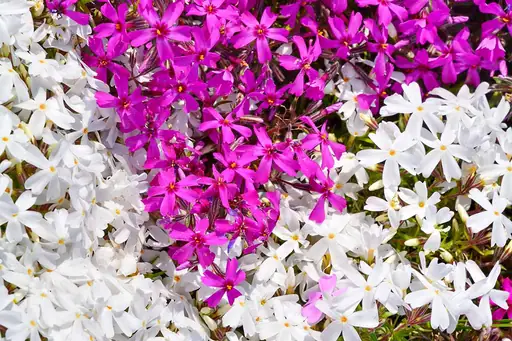
Phlox stolonifera, P. subulata A name like “creeping phlox” might not sound particularly inspiring, but as soon as you see the bright purple, pink, white, and blue star-shaped flowers you’ll be enchanted. When you see the pretty blooms set against the vibrant green foliage, it’ll be clear that the.
Phlox stolonifera, P. subulata
A name like “creeping phlox” might not sound particularly inspiring, but as soon as you see the bright purple, pink, white, and blue star-shaped flowers you’ll be enchanted.
When you see the pretty blooms set against the vibrant green foliage, it’ll be clear that the name doesn’t do justice to this delightful candy-colored plant.
And the good news doesn’t stop there.
A low-growing, evergreen perennial that thrives in tough places, creeping phlox is the perfect option to bring a splash of color to a rock garden or for a cascading cover over stone walls.
There are actually two different species that go by this common name and both are hardy in Zones 3 to 9.
So if you’re looking for a flowering ground cover that is both beautiful and easy to grow, look no further than creeping phlox!
Here’s what’s ahead:
What You’ll Learn
Quick Look
How to Grow
Cultivars to Select
Maintenance
Propagation
Pests and Disease
Creeping phlox, P. stolonifera, and moss phlox, P. subulata, are both perennials native to North America, and are firm favorites among gardeners.
And clearly, gardeners aren’t the only fans of this plant.
Native Americans even named April’s full moon – the “Full Pink Moon” – after the flower, heralding the arrival of the swathes of purple and pink which signify the start of spring.
The vibrancy of this plant is even reflected in its name – the genus name Phlox is derived from the Greek word meaning “flame,” referring to the intense color of its flowers.
Quick Look
Common name(s): Creeping phlox
Plant type: Herbaceous perennial
Hardiness (USDA Zone): 3-9
Native to: Eastern/central North America
Bloom time / season: Spring
Exposure: Full to part sun
Soil type: Sandy, organically-rich, well-draining
Soil pH: 6.0-8.0, slightly acidic to slightly alkaline
Time to maturity: 2 years
Mature size: Up to 12 inches tall by 24 inches wide
Best uses: Ground cover, rock gardens, xeriscapes
Taxonomy
Order: Ericales
Family: Polemoniaceae
Genus: Phlox
Species: Stolonifera, subulata
Technically speaking, P. stolonifera is a “creeping phlox” and P. subulata is a “moss phlox.”
But both species are remarkably similar, both in appearance and in biology, so the two common names are often used interchangeably.
Both are semi-evergreen ground cover plants that bloom with beautiful flowers in spring. That being said, there are a few notable differences between the two.
For instance, P. subulata only reaches a height of around six inches, whereas P. stolonifera can grow to around double that.
P. subulata also has almost needle-like leaves, whereas P. stolonifera has softer, broader foliage.
The main difference between the two is that P. stolonifera tolerates partial shade but P. subulata is very much a sun-seeker and so only thrives in full sunlight.
Both are such similar plants that they are often confused.
If I really had to choose between the two, I’d say P. subulata might just about win out as a ground cover, as it stays shorter and tends to bloom more densely.
But both options can bring beauty to the garden, when planted under the right conditions.
Growing only three to eight inches tall, but spreading as wide as nine to 24 inches, creeping phlox is an ideal ground cover and companion plant.
Although it is perfectly at home on flat land, to appreciate this plant in all its colorful glory, it might be best to place it on a slope, where the blooms can be properly seen and enjoyed.
Slopes also provide an ideal home for creeping phlox for two other reasons:
- The soil typically drains well on slopes.
- The roots can help to prevent erosion.
Both species are also tolerant of black walnuts and other trees containing juglone.
As the name suggests, these plants have a tendency to spread. For some gardeners, this is ideal – spreading perennials that cover every inch of empty space.
But if you prefer well behaved and orderly plants, creeping phlox might not be right for you.
How to Grow
P. stolonifera and P. subulata are adaptable and versatile and when situated in the right place with the right amount of sun exposure, will thrive without any special care.
Neither species is particularly fussy, although they prefer well drained, humus-rich soil.
Creeping phlox doesn’t like soggy soil, so generally speaking, it’s best to keep watering to a minimum.
Even when well established, phlox benefits from watering during especially hot summers or if you live somewhere that gets an average of less than one inch of rain per week.
Both P. stolonifera and P. subulata take kindly to either a late winter or early spring feeding with a slow release fertilizer or organic plant food, which helps promote strong and vigorous growth.
Cultivars to Select
With so many varieties to choose from, there’s no doubt that you can find the right kind to suit your tastes and your garden plans.
Generally very hardy and adaptable plants, the most important consideration is probably color.
With a variety of vibrant shades of pink, purple, and blue to choose from, this can be a tough decision.
Here are a few of my favorites:
Candy Stripe
P. subulata ‘Candy Stripe’ is named for its distinctive pink-and-white striped blooms, which resemble candy cane markings on the star-shaped spring flowers.
‘Candy Stripe’
It grows four to six inches tall and spreads up to 24 inches wide, forming a dense, evergreen mat that puts on a colorful show for three to four weeks in mid to late spring.
You can find ‘Candy Stripe’ available at .
Drummond’s Pink
‘Drummond’s Pink’ is a P. subulata cultivar that produces solid bubble-gum pink, fragrant blooms from early to late spring over a dense, evergreen mat.
‘Drummond’s Pink’
It grows to around 12 inches tall and spreads 12 to 24 inches wide.
Emerald Blue
Masses of lavender-blue, star-shaped flowers over needle-like evergreen foliage adorn ‘Emerald Blue’ in mid to late spring, blooming for three to four weeks.
‘Emerald Blue’
This P. subulata cultivar grows four to six inches tall and spreads 12 to 24 inches.
You can find ‘Emerald Blue’ plants available at .
Scarlet Flame
In mid to late spring, ‘Scarlet Flame’ produces vivid scarlet-red, star-shaped flowers.
‘Scarlet Flame’
Growing four to six inches tall with a spread of 12 to 24 inches, this P. subulata cultivar is one of the more boldly colored varieties available.
Snowflake
For something a bit more delicate, P. subulata ‘Snowflake’ produces pure white, fragrant blooms in early to late spring, with a potential fall rebloom if deadheaded.
‘Snowflake’
It grows to around 12 inches tall and wide.
Maintenance
Although not strictly necessary, a bit of trimming from time to time does this plant some good.
Stems can be cut back at a couple of different times throughout the year.
Once after flowering to encourage a second bloom, with an occasional winter cut-back to keep the plant happy, healthy, and raring to go, ready for the following spring.
Cutting the stems back like this also encourages their naturally long growth to become shorter and woodier, creating more dense flowering.
Propagation
It’s easy to grow P. stolonifera and P. subulata from seed, cuttings, and transplants.
From Seed
From seed, the main thing to remember is to use a potting medium with good drainage, preferably comprised of perlite and coarse sand granules.
It’s best to seed them about two months before the last frost date. Once the plants start to emerge, it’s important to give them enough sunlight – around 12 hours a day.
From Cuttings
However, it is probably easier to grow from cuttings than it is from seeds.
Cuttings, if done right, are a particularly easy option to propagate, as they root easily after a few months.
All you need to do is cut a roughly six-inch-long section, either from a rooted stem or a lateral shoot near the tip.
Make sure there’s at least one leaf and no flowers on the cutting. Always make cuttings with a clean, sharp tool to prevent infection.
Creeping phlox roots so well that it doesn’t even require rooting hormone, although this product will help speed along the process if you’re keen to ensure success.
Just place the cuttings in a potting mixture with good drainage, using perlite and/or coarse sand, and you’re good to go.
One thing to bear in mind is timing, which is everything with this plant.
It’s recommended to take cuttings in spring or autumn, although it seems to take root particularly well in fall after it has flowered.
By Division
You can also propagate P. stolonifera and P. subulata easily through division.
It is best to divide in early fall when temperatures are cool. It’s recommended to divide this plant once every few years to keep it healthy, especially if it seems to be blooming less than usual.
Root Cuttings
Root cuttings should be taken just before the arrival of new spring shoots.
Root cuttings of around one and a half inches should do the trick, and they should be fully inserted into firmed compost, taking care that the end furthest from the root tip is facing up.
Top tip: when taking root cuttings, you can nick the top of the cuttings to indicate which end is which, to make sure you don’t get mixed up.
Transplanting
Luckily, this plant can be found easily in nurseries and will happily take to the soil if transplanted in spring or fall.
The main thing to keep in mind is the planting distance, with a recommended spacing of around 15 to 18 inches between each.
Creeping phlox, as the name suggests, creeps along the ground and spreads with long, leggy runners.
It’s best to plant in staggered rows, allowing enough room for each plant to occupy the space around it.
There’s nothing too complicated or technical about planting – just try to keep the top of the root ball level with the ground, be sure to give each plant a good first soaking to settle it into its new home, and you should be good to go.
Pests and Disease
This beautiful bloomer can be a bit susceptible to mites. To stop any problems from “creeping” up on you, it is important to act fast, as soon as you spot signs of trouble.
This can usually be easily achieved by using an organic insecticidal soap.
In moist conditions, P. stolonifera and P. subulata can also suffer from powdery mildew.
The best way to ensure that this isn’t a problem is to keep watering to a minimum, although this can also be quite effectively prevented via occasional pruning to promote good air circulation.
Time to Get Growing!
With its vibrant flowers and easygoing nature, there is no doubt that this beautiful perennial will quickly creep its way into both your garden and your heart, whichever species you choose!
Whether you’re planting it to cover a slope, attract pollinators to your yard, or to add a splash of vibrant color to a partly shady corner, that’s a cultivar that’s up to the task.
And with little maintenance required, you’ll be glad you chose these beautiful blooms.
What’s your favorite variety? Do you have any questions that we didn’t cover here? Feel free to reach out in the comments section below – we’d love to hear from you!
And for more information about growing ground covers in your landscape, check out these guides next:
- Learn How to Grow Creeping Jenny (Moneywort)
- How to Grow and Care for Creeping Avens (Geum Reptans)
- Creeping Thyme: Plant and Grow this Aromatic Ground Cover
- Facebook244
- X




Questions et discussion