
How to Grow False Indigo (Baptisia)
Baptisia spp. False indigo (Baptisia spp.) is an attractive flowering perennial in the Fabaceae or legume family. The flowers resemble those of peas or lupines – upright and spiked, bilaterally symmetrical, and are blue, yellow, white, or purplish in hue, depending on the species. These plants grow.
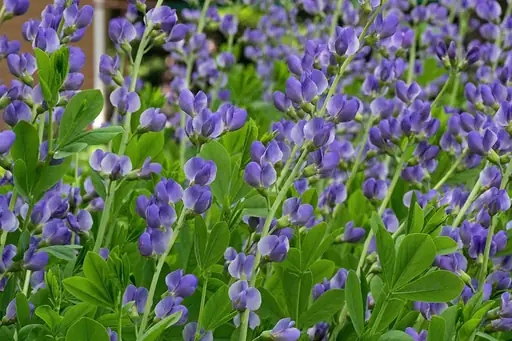
Baptisia spp.
False indigo (Baptisia spp.) is an attractive flowering perennial in the Fabaceae or legume family.
The flowers resemble those of peas or lupines – upright and spiked, bilaterally symmetrical, and are blue, yellow, white, or purplish in hue, depending on the species.
These plants grow naturally in open woods, fields, and prairies across the central and eastern United States, where they’ve evolved to withstand extreme temperatures, grazing herbivores, wildfires, and poor soils.
Within this genus, there are three species common to horticulture, all known as false or wild indigo.
B. australis, the blue-flowered species, might be the best known, but golden B. sphaerocarpa, creamy B. alba, and hybrids bring even more versatility to gardens.
They top out at about two to three feet tall by two to five feet wide and adopt an upright, mounding habit.
Read on to learn how to cultivate this drought-tolerant pollinator magnet in your own garden.
Here’s what I’ll cover:
What You’ll Learn
Quick Look
How to Grow
Cultivars to Select
Maintenance
Propagation
Pests and Disease
Baptisia is wonderfully easy to grow and blooms in spring to early summer.
These low-maintenance perennials tolerate heat and summer drought in Zones 3 to 9 and can grow in clay or rocky soils that may challenge other species.
Their deep roots also help prevent erosion, making them well-suited to slopes and restoration projects.
Plants from this genus are slow to mature but require little maintenance once they’ve settled in.
The roots are deep and woody, making them difficult to move after establishment. They’re best planted where they can remain undisturbed for years.
Quick Look
Common name(s): False indigo, wild indigo, baptisia
Plant type: Herbaceous flowering perennial
Hardiness (USDA Zone): 3-9
Native to: North America
Bloom time / season: Late spring
Exposure: Full sun to partial afternoon shade
Soil type: Loose, loamy, moist, well-draining
Soil pH: 6.0-7.0, slightly acidic to neutral
Time to maturity: 2-3 years
Mature size: 2-3 feet high by up to 5 feet wide
Best uses: Perennial border, native plant garden, wildlife garden
Taxonomy
Order: Fabales
Family: Fabaceae
Genus: Baptisia
Species: Alba, australis, sphaerocarpa
While they may look like shrubs, Baptisia plants are entirely herbaceous and die back to the ground each winter, before returning in spring to provide an early-season food source for pollinators.
After flowering finishes, the blue-green foliage remains attractive and tidy, providing an appealing backdrop for later-blooming plants.
As native legumes, Baptisia also contribute nitrogen to the soil, supporting a healthy garden over time.
The name “false indigo” derives from the historical use of Baptisia as a substitute for true indigo (Indigofera tinctoria), a tropical species used for dye production.
Early settlers used the flowers and stems of Baptisia to create a blue dye, though it was less intense and less colorfast than that produced by Indigofera.
While they share similar flower structures as both are legumes, the two genera differ significantly in habitat, growth habit, and dye quality.
How to Grow
Hardy in USDA Zones 3 to 9, false indigo is incredibly tolerant of a wide range of temperature and humidity levels.
However, if grown in high humidity combined with lack of airflow, these drought-tolerant plants may be susceptible to leaf spot, powdery mildew, and other fungal diseases.
It’s ideal for low-maintenance landscapes, native and pollinator gardens, and once established the plants largely take care of themselves.
Light
False indigo prefers full sun, but can tolerate a little afternoon shade. As with any sun-loving flowering perennial, planting in shade may decrease bloom production.
Aim for at least six hours of direct sunlight per day to promote strong stems, dense foliage, and abundant blooms.
Soil
These deep rooted perennials require freely draining soil, but will tolerate clay, loam, or sandy substrate as long as drainage is sufficient and there is no standing water.
While it doesn’t require high fertility, false indigo will grow faster and bloom more abundantly in soil that contains some organic matter.
Water
During the first year, keep the soil moderately moist to help the root system become established.
After that, these plants are highly drought tolerant and typically require no supplemental water unless conditions are extremely dry.
Fertilizer
Resist the urge to fertilize false indigo. Unless you’re growing in very poor, sandy soils, these plants will not need any additional feeding.
If you notice poor growth, you can top dress with several inches of well-rotted manure or compost in spring and fall.
Cultivars to Select
Blue false indigo (B. australis) is the species most commonly found at nurseries and garden centers.
Blue False Indigo
This species is a reliable bloomer with deep blue spires and tops out at four feet tall and wide.
There are a few cultivated varieties worth seeking out, including:
Lemon Meringue
‘Lemon Meringue’ is a yellow-flowering Baptisia hybrid that’s part of the Decadence® series. The lemon-colored blooms are held on three-feet-tall, charcoal colored stems.
‘Lemon Meringue’
This dense and compact cultivar is especially vigorous and floriferous.
Twilite Prairieblues
Twilite Prairieblues™ is a B. australis cultivar, bred by the Chicago Botanic Garden. It’s more dense and bushy than the species and grows up to five feet tall and wide.
Twilite Prairieblues
In season, it’s covered with purple and yellow bicolored flowers. You will sometimes see this one listed as ‘Twilight Prairieblues’ or ‘Twilight Prairie Blues.’
You can find plants available at .
Maintenance
Once established, false indigo requires absolutely no maintenance except for occasional watering during dry spells.
After flowering, allow the spent blooms to turn into beautiful, dark seed pods and don’t be tempted to prune dead stems back until new growth emerges in spring.
Many beneficial insects, including native bees use dead stems as shelter through winter, and the charcoal colored pods add texture to the off-season garden.
Propagation
There are two primary ways to get false indigo started in your home garden, one harder than the other.
You can either start from seed, which takes time and isn’t always very easy or reliable, or you can purchase nursery starts for transplanting.
Let’s discuss each:
From Seed
Seed can be harvested in the summer when the seed pods are dark, firm, and starting to split open.
If you collect seed, you’ll need to cold-stratify it for at least eight weeks before sowing.
You can do this either by sowing in flats and leaving them outside for the winter or putting them in the fridge in a zip-top bag with some moist vermiculite.
To let nature do the cold stratification for you, fill a flat with moistened potting soil and sow the seeds just below the surface. Place the flat outside in a brightly lit, sheltered location.
Ideally, the seeds will stay consistently cold all winter long, so keep them away from any south-facing walls that may raise the temperature too much on sunny days.
Ensure the soil stays moist, but not soaking wet. If it freezes, that’s fine, when warmth and longer days arrive, the seeds will germinate.
If you opt to stratify your seeds in the fridge, retrieve them after at least eight weeks and follow the sowing instructions above.
When the seedlings are about three inches high, transplant the largest and most robust into individual four-inch pots filled with regular potting soil.
Transplanting
The easiest and quickest way to establish false indigo in your landscape is to buy a transplant.
To plant directly in the ground, dig a hole a little wider than the root ball and the same depth. I like to drench the root ball before setting into the hole at the same height it was in the growing container.
Backfill with soil, tamping it down as you go, and water in well.
Water deeply once a week for the first summer to ensure the roots become established.
Pests and Disease
Baptisia is rarely bothered by pests or disease, and even deer tend to pass them by in favor of more appealing options.
Problems typically arise only when conditions are overly wet or if plants are growing too close together, limiting airflow.
These hardy North American perennials are about as tough as they come but there are a couple of fungal diseases worth knowing about.
Leaf Spot
Leaf spot is a general term for blemishes on foliage caused by a variety of pathogens. Spots may be tan, brown, or black and are usually just a cosmetic problem.
To minimize leaf spot, remove and discard any affected or fallen leaves. Avoid wetting the foliage when watering to help reduce the spread of any fungal spores.
Powdery Mildew
Powdery mildew often starts in dry weather as small, pale dots that gradually spread into a white, powdery coating.
While unsightly, it rarely causes long-term damage. If caught early, remove and trash affected leaves.
In more advanced cases, water deeply at the base, thin out nearby plants to improve airflow, and clean up any diseased debris to prevent further spread.
Learn more about how to deal with powdery mildew here.
Darlings of Dry Ground
From their lofty, colorful blossoms to their low maintenance requirements, these deep rooted, lovers of dry ground are reliable, easygoing, and beloved by springtime pollinators.
Give false indigo a try in your rock garden or sunny well-draining border. You won’t be disappointed!
Do you grow false indigo in your garden? Let us know how it’s going in the comments section below and if you have any questions, we always love to hear from you!
To learn more about native plants and how to grow them at home, check out these guides next:
- How to Plant and Grow Bee Balm
- How to Grow and Care for Coneflowers, A Native American Favorite
- 15 of the Best Native Wildflowers for the US and Canada
- X




Questions et discussion