

Cette page est affichée dans sa langue d'origine. La traduction n'est pas encore disponible.
La sélection Seedsun
Xanthocyparis vietnamensis
UGS: CUPR-VIET-01G
Few garden plants have a discovery story this recent. In the autumn of 1999, Vietnamese foresters surveying timber on the karst limestone mountains of Ha Giang province, close to the Chinese border, came upon a conifer nobody could name. Specimens collected in 2001 reached Aljos Farjon at the Royal.
Demandez un devis personnalisé
Les prix, les conditionnements et la disponibilité sont confirmés dans votre devis personnalisé. L'envoi d'une demande de renseignements ne constitue pas une commande.
Renseignez-vous sur l'adéquation, les conditions de semis et de culture.
Veuillez confirmer les options de livraison et les documents requis dans votre devis.
À propos de cette variété
Few garden plants have a discovery story this recent. In the autumn of 1999, Vietnamese foresters surveying timber on the karst limestone mountains of Ha Giang province, close to the Chinese border, came upon a conifer nobody could name. Specimens collected in 2001 reached Aljos Farjon at the Royal Botanic Gardens, Kew, and in 2002 Farjon and his Vietnamese, American and Russian colleagues, among them Nguyen Tien Hiep, Phan Ke Loc, Daniel Harder and Leonid Averyanov, published the tree as a new genus and species, Xanthocyparis vietnamensis. The discovery of a whole new conifer genus made headlines around the world.
The name means golden cypress of Vietnam, from the Greek xanthos, yellow, for the fine-grained, fragrant golden wood. In the same paper the authors moved the Nootka cypress of the Pacific Northwest into the new genus as the tree's closest relative, a startling link between a Vietnamese mountaintop and the coast of Alaska. Botanists have argued over the placement ever since. Some, including the American Conifer Society, fold the tree into a broad Cupressus as Cupressus vietnamensis, while Kew and most nurseries keep the original Xanthocyparis, the name we use here.
In the wild the golden cypress clings to the narrow, knife-edged summits of limestone ridges at about 3,300 to 5,200 feet, in cloud forest where rain is abundant but the karst rock drains instantly. The prized wood has been cut for houses and for altar and worship objects, and the trees regenerate poorly. The IUCN lists the species as Endangered, with perhaps 500 to 1,000 mature trees in northern Vietnam and a few dozen more discovered in Guangxi, China, in 2013. In Vietnam all felling and trade are banned. Cuttings brought to the Royal Botanic Garden Edinburgh in 2002 began a conservation program that placed plants in safe gardens, and every plant in cultivation today, ours included, helps keep the species going.
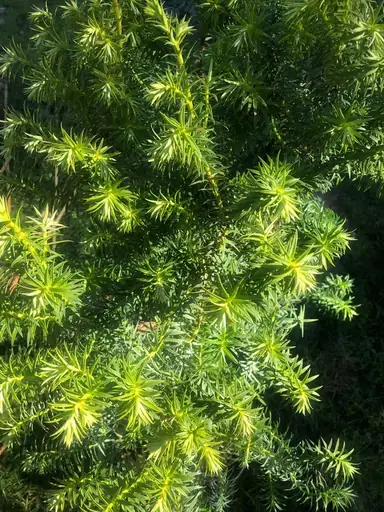
The tree is a botanical curiosity as well as a rarity. Most members of the cypress family drop their soft juvenile needles as they mature; this one keeps both kinds, carrying needle-like juvenile leaves and flat adult scales, often with transitional shoots between, on the same mature tree. The bark is reddish brown and peels in thin strips, and the small round cones ripen from green to dark brown.
Grow the Vietnamese golden cypress as a collector's specimen at eye level, where visitors can see the two kinds of foliage and the peeling bark up close, or as the centerpiece of a group of living fossils and recent discoveries such as dawn redwood, Wollemi pine, Taiwania and China fir. Give the tree excellent drainage, a sheltered spot out of drying winter winds, and steady moisture in dry spells. Cultivated plants are barely twenty years old, so hardiness and ultimate size are still being learned; zone 8 gardens, including ours in Aiken, are well within the expected range.
Plus à découvrir



Questions et discussion