
How to Encourage Branching in Rubber Tree Plants
Rubber trees, Ficus elastica, are appreciated for their big, dramatic, leathery leaves. But they have a reputation for becoming a bit leggy when they’re grown indoors. When we keep the trees inside, they generally remain in their juvenile form, which can mean reduced branching and more upward.
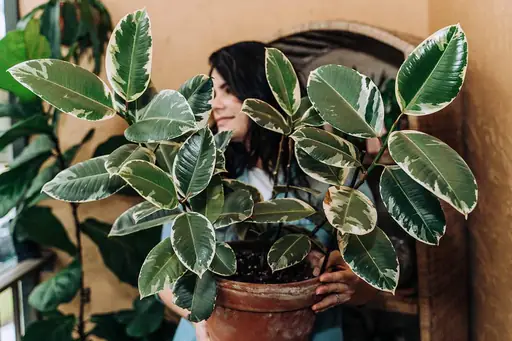
Rubber trees, Ficus elastica, are appreciated for their big, dramatic, leathery leaves. But they have a reputation for becoming a bit leggy when they’re grown indoors.
When we keep the trees inside, they generally remain in their juvenile form, which can mean reduced branching and more upward growth.
This can be disappointing, especially as the plant grows taller and taller instead of filling out with branches and foliage.
However, it’s possible to change this growth habit and encourage your rubber tree to branch out.
If you need an overview of how to grow and care for rubber tree plants, read our guide.
Then, come back here and we’ll discuss how to encourage branching in rubber trees.
Here’s what I’ll cover:
What You’ll Learn
Rubber Tree Growth Habit
Environmental Changes
Pruning
Notching
Rubber Tree Growth Habit
If you look at a rubber tree in the wild, you can see that mature specimens will be well branched with big, dense canopies.
But when we grow F. elastica indoors as houseplants, they can look decidedly different since they remain in a juvenile form. How many rubber trees have you seen that have a single stem? Probably a lot.
A lot of “bushy” rubber trees that you see at the store are often a bunch of individual specimens clustered into one pot to give a bushier, fuller appearance.
There are several reasons that rubber trees fail to branch. Those growing indoors generally don’t receive enough light, or at least not enough light to grow big and bushy.
This causes them to have slow, stunted growth and stay in an immature form.
Because they tolerate low light, many people take the opportunity to use rubber plants in dark areas of the home. I know I’ve done it. F. elastica will grow perfectly well in this kind of exposure, but they tend to grow leggy and won’t branch.
As they age, they might drop lower leaves, making them look even more sparse.
So how do we fix this and encourage the rubber tree to branch? Firstly, it’s a good idea to change the environment to ensure the plant is receiving what it needs, and secondly, careful pruning.
There’s also a third method, known as notching which can help branching.
Environmental Changes
Whether you decide to also do some pruning or not, which we’ll discuss below, you can encourage branching by changing the plant’s environment.
The most important factor is to provide additional light. While rubber trees can thrive in low light conditions, if you want to encourage branching, more light is important.
Set the plant near a window where it will receive direct sunlight for at least four hours per day.
Preferably, you’ll give it morning light as afternoon light can be too harsh for a plant that isn’t used to it.
If you want to place your specimen somewhere that it will receive afternoon light, make sure you introduce it to the stronger light gradually.
Move it into the new area a half hour at a time. That means you’ll take it into the new spot for a half hour and then move it back to its original spot. The next day, add another half hour and so on until it can live in its new area.
While these plants prefer to be a bit root bound in a relatively small container, you might want to change out the soil if you haven’t repotted or refreshed the soil for a while.
As soil gets older, it becomes compacted and the nutrients leach out.
Remove the plant from its container and gently brush away all the soil from around the roots. While you’re in there, prune off any broken or dead roots. Clean out the old pot and repot the plant in fresh, new soil.
If your plant is in quite a small container, it’s definitely worth upgrading to a pot one size larger. If you see roots circling the interior of the pot or popping out of the soil or through the drainage holes, it’s definitely time to move up a size.
With extra nutrients from refreshed potting soil and the addition of lots of sunlight, your plant should start to put out plenty of new growth.
Pruning
In addition to providing more sun, you can encourage the plant to branch out using some careful pruning cuts.
When you’re pruning for this purpose, you don’t want to wait for the dormant season, you want to do the trimming during the growing season instead.
If you want to prune during the semi-dormant season, that’s fine, it won’t hurt anything, but it will take longer for the new growth to develop.
Look at the spot where you want the branching to start and identify a leaf node. That’s where the leaf emerges from the branch. If the leaves have fallen off, look for the little lumps where the leaves were growing previously.
Take a clean pair of pruners and snip the stem off about a quarter of an inch above the leaf node at a slight angle. That’s it!
Now, instead of producing a single stem in that area, the plant will produce two, three, and sometimes four new stems right there.
Learn more about pruning rubber trees in our guide.
Don’t forget you can also use the pruned stems to propagate more plants. As long as the cutting is six inches or longer, you can plant it.
Rubber trees take extremely well this way, though they’re a bit slow to start producing growth, and you can have new plants to enjoy or give away.
Now, all you need to do is wait. The plant should start sending out new growth in the area within a few months.
Notching
Ficus species have the ability to send out new growth when they are wounded.
You can take advantage of this by using a technique called notching to encourage branching.
Essentially, you will make a cut in the bark of the stem or trunk that will cause the plant to send healing growth hormones to the area.
With enough time, that wounded spot will start branching out.
To do this, put on some gloves and grab a sanitized knife. Look for a bare area of stem between two leaf nodes.
Make a horizontal cut about an inch above the node, deep enough that it cuts just through the bark into the light colored material underneath. The cut should extend across half of the branch. Make a second cut about a quarter of an inch above that.
Scrape the bark away between the two cuts so the cambium layer underneath is exposed.
This is best done in the spring or summer when the plant is actively growing, but you can do it any time of year. Worst case scenario is that the notch won’t form any new growth.
After you’ve made your notches, you just need to wait. Keep caring for the plant as you would normally, and new growth will emerge below the notches.
Branch Out a Bit!
Rubber trees can be a bit leggy, especially when they are grown indoors. But we can fix it with pruning, a change of environment, or notching.
Before you know it, you’ll be enjoying your big, bushy plant.
Do you need any additional tips on how to handle a particularly tricky situation? Let us know what’s up in the comments section below and we’ll do our best to help you out.
And for more information about growing rubber trees, check out these guides next:
- Why Is My Rubber Tree Dropping Leaves?
- Common Causes and Solutions for Yellow Leaves on Rubber Trees
- Why Is There a Red Sheath on My Ficus Elastica? Do Rubber Trees Flower?
- X




Domande e discussione