

Questa pagina viene visualizzata nella sua lingua originale. La traduzione non è ancora disponibile.
La selezione Seedsun
Emmenopterys henryi
SKU: EMME-HENR-01G
Rare in cultivation and rarer still in bloom, Emmenopterys henryi is a Chinese tree of the coffee family, Rubiaceae, and a close relative of the native fever tree, Pinckneya. was the first nursery to offer the species in the United States, and one of our own trees was the first to display the.
Richiedi un preventivo personalizzato
Prezzi, formati e disponibilità saranno confermati nel preventivo personalizzato. L'invio di una richiesta non costituisce un ordine a pagamento.
Informatevi sull'idoneità, le modalità di semina e le esigenze di coltivazione.
Conferma le opzioni di consegna e i documenti necessari nel tuo preventivo.
Informazioni su questa varietà
Rare in cultivation and rarer still in bloom, Emmenopterys henryi is a Chinese tree of the coffee family, Rubiaceae, and a close relative of the native fever tree, Pinckneya. was the first nursery to offer the species in the United States, and one of our own trees was the first to display the showy, pink-bracted flowers in the Western Hemisphere, a small piece of horticultural history rooted in South Carolina soil.
The tree carries the name of Augustine Henry, the Irish botanist and physician who found the tree in 1887 in the remote forests of Hubei Province while serving as a medical officer in China. Two decades later, in 1907, the great plant hunter Ernest Henry Wilson collected seed for the Veitch Nurseries, and from those introductions Emmenopterys henryi made a slow way into the arboretums and botanic gardens of Europe and North America, always as a coveted rarity rather than a common tree.
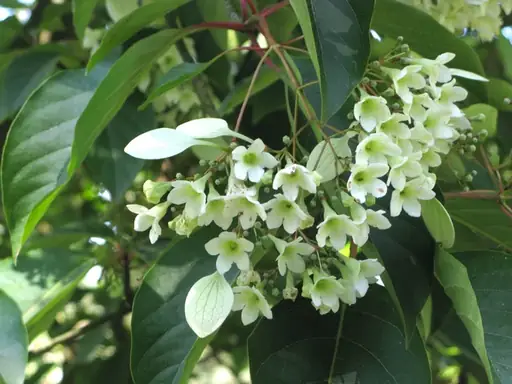
Part of the legend is the tree's famous reluctance to flower. A young Emmenopterys may grow vigorously for years, even decades, before offering a first bloom, which is exactly what has made each flowering an event reported in the horticultural press. When the tree finally performs, usually in late summer, the reward is a spectacular display of large, creamy-white flowers, sweetly fragrant, some cradled by an enlarged, leaf-like white bract that flushes pink to rose as the season turns, so a flowering tree can look, from a distance, dusted with giant snowflakes.
Given time and space, Emmenopterys henryi makes a large, handsome, deciduous shade tree, upright and vigorous, with bold, glossy foliage that earns a place long before the first flowers arrive. Hardy in USDA zones 6 through 9, the tree wants full sun to part shade, deep, fertile, well-drained soil, and steady moisture while young. This is a specimen for the patient collector, an heirloom planted as much for the gardeners who will one day see the tree bloom as for the one who sets it in the ground. Photos courtesy of Julian Sutton and Abraham Rammeloo.
C'è ancora molto da scoprire



Domande e discussione