

Questa pagina viene visualizzata nella sua lingua originale. La traduzione non è ancora disponibile.
La selezione Seedsun
Kalmia latifolia 'Croft Carpet'
SKU: KALM-LATI-CROF-CARP-01G
Most mountain laurels are shrubs with presence, upright and woody and faintly aristocratic. 'Croft Carpet' flips the script. This rare, prostrate selection of Kalmia latifolia stays low and spreads into a dense evergreen mat, delivering the understory finish that designers chase in shade gardens:.
Richiedi un preventivo personalizzato
Prezzi, formati e disponibilità saranno confermati nel preventivo personalizzato. L'invio di una richiesta non costituisce un ordine a pagamento.
Informatevi sull'idoneità, le modalità di semina e le esigenze di coltivazione.
Conferma le opzioni di consegna e i documenti necessari nel tuo preventivo.
Informazioni su questa varietà
Most mountain laurels are shrubs with presence, upright and woody and faintly aristocratic. 'Croft Carpet' flips the script. This rare, prostrate selection of Kalmia latifolia stays low and spreads into a dense evergreen mat, delivering the understory finish that designers chase in shade gardens: lush, deliberate, and quietly polished. A specimen at the JC Raulston Arboretum measured only about one foot tall while spreading many times as wide.
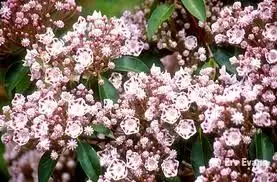
In late spring and early summer, 'Croft Carpet' scatters the ground-hugging canopy with rounded clusters of soft, cup-shaped flowers, white to pink and freckled with rose inside, exactly the intricate blooms that make mountain laurel a native icon. Like every Kalmia, the flowers hide a bit of botanical theater: ten stamens sit under tension in small pockets of the corolla and spring forward to dust visiting insects with pollen the moment a bee trips them.
The genus Kalmia was named by Linnaeus for the botanist Pehr Kalm, one of the early plant explorers of eastern North America, and latifolia means broad-leaved. In the wild, mountain laurel forms evergreen thickets along woodland slopes and edges wherever soils run naturally acidic. 'Croft Carpet' takes that woodland heritage and turns the habit sideways, offering a way to bring year-round structure to places where turf fails and most shrubs feel too bulky. You can read more in the Guide to Kalmias.
One caution belongs with all this charm. Every green part of mountain laurel, along with the pollen and any honey from the flowers, contains grayanotoxins and is poisonous to livestock, wildlife, and people, so 'Croft Carpet' is grown as an ornamental and pollinator groundcover, never a medicinal or edible plant. In the garden, use this low laurel as a carpet layer beneath high pines and oaks, as a ribbon stitching together boulders and paths, or as an evergreen slope stabilizer, a modern native alternative to pachysandra or ivy with far more character. The toxic foliage keeps deer at bay as a welcome bonus.
C'è ancora molto da scoprire



Domande e discussione