

Questa pagina viene visualizzata nella sua lingua originale. La traduzione non è ancora disponibile.
La selezione Seedsun
Morus rubra
SKU: MORU-RUBR-01G
The red mulberry, Morus rubra, is the eastern woodlands' own mulberry, a medium to large deciduous tree native across the eastern United States from New England to Texas. The genus name Morus is simply the old Latin word for mulberry, and rubra, red, points less to the ripe fruit, which darkens to.
Richiedi un preventivo personalizzato
Prezzi, formati e disponibilità saranno confermati nel preventivo personalizzato. L'invio di una richiesta non costituisce un ordine a pagamento.
Informatevi sull'idoneità, le modalità di semina e le esigenze di coltivazione.
Conferma le opzioni di consegna e i documenti necessari nel tuo preventivo.
Informazioni su questa varietà
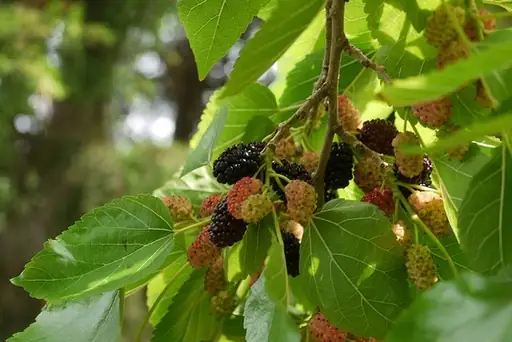
The red mulberry, Morus rubra, is the eastern woodlands' own mulberry, a medium to large deciduous tree native across the eastern United States from New England to Texas. The genus name Morus is simply the old Latin word for mulberry, and rubra, red, points less to the ripe fruit, which darkens to near black, than to the reddish cast of the young growth. Broad, heart-shaped, sandpaper-rough leaves clothe a wide, rounded crown, and where a female tree grows the summer branches hang heavy with blackberry-like fruit.
Mulberries carry a curious chapter of American history. When the early colonists dreamed of a homegrown silk industry, mulberry trees were the linchpin, since silkworms feed on mulberry leaves, and the native red mulberry was pressed into service before the Asian white mulberry (Morus alba) largely took over the role. The silk venture never flourished in the way its backers hoped, but the trees remained, and the red mulberry has stayed a fixture of southern dooryards and fencerows, valued less for silk than for the fruit that children have always gathered straight from the branch.
The fruit has fed people for a very long time. The De Soto expedition recorded Muskogee people drying mulberries as early as the 1500s, and the tree held a place in Native medicine as well: the Cherokee steeped the bark into an infusion taken as a laxative and to clear intestinal worms, and dabbed the milky sap on the skin to treat ringworm, while other nations turned the root to weakness and urinary complaints. The ripe berries, sweet and juicy, still make fine jams, jellies, pies, and fresh eating, and what the household does not gather feeds an astonishing traffic of birds, squirrels, and other wildlife.
In the garden the red mulberry makes a fast, generous shade tree for a large lawn, a woodland edge, or an edible and wildlife planting, in full sun to part shade and moist, well-drained soil. Site the tree with a little forethought, since the ripe fruit drops freely and stains what lies beneath, so a spot away from patios, walks, and parked cars is kindest. Plant where the summer harvest can be reached and the birds watched, give room for the broad crown, and the tree repays with shade, fruit, and decades of easy company. These are seed-grown trees, so no two are quite alike, and a given plant may prove male or female.
C'è ancora molto da scoprire



Domande e discussione