

Questa pagina viene visualizzata nella sua lingua originale. La traduzione non è ancora disponibile.
La selezione Seedsun
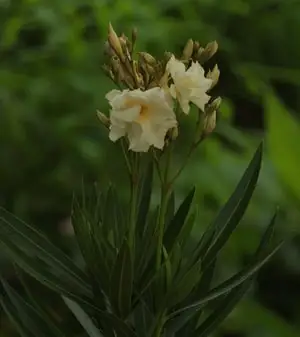
Nerium oleander 'Double Yellow'
SKU: NERI-OLEA-DOUB-YELL-01G
The hardiest yellow oleander in cultivation, and one of the very few oleanders that come in yellow at all. Of the four hundred and more named cultivars of Nerium oleander, the genus runs naturally to white, pink, and red; yellow is the aberration, and a fully double yellow rarer still. 'Double.
Richiedi un preventivo personalizzato
Prezzi, formati e disponibilità saranno confermati nel preventivo personalizzato. L'invio di una richiesta non costituisce un ordine a pagamento.
Informatevi sull'idoneità, le modalità di semina e le esigenze di coltivazione.
Conferma le opzioni di consegna e i documenti necessari nel tuo preventivo.
Informazioni su questa varietà
The hardiest yellow oleander in cultivation, and one of the very few oleanders that come in yellow at all. Of the four hundred and more named cultivars of Nerium oleander, the genus runs naturally to white, pink, and red; yellow is the aberration, and a fully double yellow rarer still. 'Double Yellow' is the old French selection that fixed the color.
The cold-hardiness is no idle claim. After the 1984 freeze that drove temperatures to nine below zero Fahrenheit across much of the Southeast, the nursery Plant Delights surveyed which oleanders had come through. Most had not. This selection had, burned hard but back the following spring in full vigor, and the reputation has held ever since. 'Double Yellow' is reliable through zone 8 in the open and root-hardy through zone 7b with shelter, where the top dies back and resprouts to bloom on new wood the same season. Plants at Aiken reach eight feet and stay evergreen.
The flowers are soft primrose to buttery yellow, fully double and rose-like, lightly fragrant, borne in clusters at the branch tips from late June through September, over glossy dark green leathery leaves in whorls of three. Heat-tolerant, drought-tolerant, salt-tolerant, deer- and rabbit-proof, and indifferent to lean soil, this is the classic Mediterranean coastal plant doing exactly what a Mediterranean coastal plant does.
A toxicity note belongs in every oleander listing: all parts contain cardiac glycosides and are poisonous if eaten. The practical garden risk is low, since the bitterness keeps animals off and human cases are rare, and as the old catalog has always put it, oleander is poisonous but not likely to be ingested except by beach goers who choose oleander sticks to cook wieners. In short, do not grill on an oleander stick.
One for the southern coastal gardener, the heat-and-drought designer, the container gardener north of zone 8 willing to overwinter a tub indoors, or anyone who has ever been told that yellow oleanders do not really exist. Give full sun and sharp drainage, cut back hard in late winter to renew, and site away from where children or livestock might nibble.
C'è ancora molto da scoprire



Domande e discussione