

Questa pagina viene visualizzata nella sua lingua originale. La traduzione non è ancora disponibile.
La selezione Seedsun
Parrotia subaequalis
SKU: PARR-SUBA-01G
For most of botanical history the genus Parrotia was thought to hold a single species, the Persian ironwood (Parrotia persica) of the Caspian forests. Then came a small Chinese tree with a long and tangled paper trail. A fruiting specimen gathered in Jiangsu Province in 1935 sat in a herbarium.
Richiedi un preventivo personalizzato
Prezzi, formati e disponibilità saranno confermati nel preventivo personalizzato. L'invio di una richiesta non costituisce un ordine a pagamento.
Informatevi sull'idoneità, le modalità di semina e le esigenze di coltivazione.
Conferma le opzioni di consegna e i documenti necessari nel tuo preventivo.
Informazioni su questa varietà
For most of botanical history the genus Parrotia was thought to hold a single species, the Persian ironwood (Parrotia persica) of the Caspian forests. Then came a small Chinese tree with a long and tangled paper trail. A fruiting specimen gathered in Jiangsu Province in 1935 sat in a herbarium drawer until 1960, when the botanist H.T. Chang described the specimen as a witch-hazel under the name Hamamelis subaequalis. The living tree, meanwhile, had vanished. The species was presumed extinct for half a century, until a 1988 expedition found the tree again, and only in the late 1990s did DNA settle the question once and for all: no witch-hazel at all, but a second Parrotia, sibling to the Persian across some 3,500 miles of Asia.
They are genuinely rare in the wild, scattered across a handful of mountain sites in eastern China where barely a hundred mature trees still stand. A Tertiary relict, in other words, an old soul that outlasted the ice ages and very nearly did not outlast us. We may have been the first to offer them in the United States, and even now they pass through remarkably few hands.
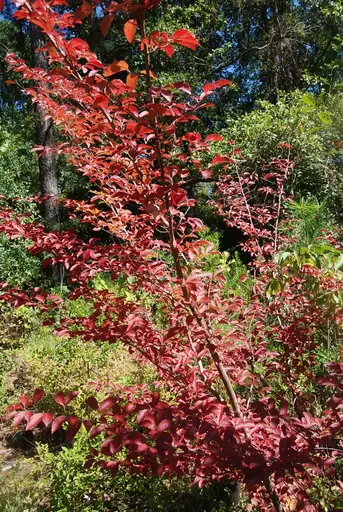
In the garden Parrotia subaequalis reads as a refined medium tree or generous shrub in the witch-hazel family, smaller in leaf than persica and finer in proportion. The toothed, oval leaves carry a dark burgundy margin all summer that hints at what is coming: a long, unhurried autumn turn through burgundy, scarlet, orange and gold, often holding for weeks. As the leaves let go the bark takes over, exfoliating into a mosaic of gray, green, cream and brown that carries the tree through winter. In late winter, before the foliage returns, the bare branches flush with small crimson-stamened flowers, modest at arm's length and quietly luminous up close.
Hardy and forgiving for all their rarity, they have come through brutal cold at the Arnold Arboretum in Boston and ask little beyond sun to light shade and a soil that drains. Site them where low winter light can find the bark.
To grow them is to keep company with a living fossil, one of only two Parrotias on earth and very nearly none, a tree most botanists will only ever meet as a pressed sheet in a drawer.
C'è ancora molto da scoprire



Domande e discussione