

Questa pagina viene visualizzata nella sua lingua originale. La traduzione non è ancora disponibile.
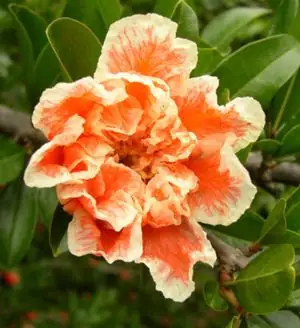
La selezione Seedsun
Punica granatum 'California Sunset'
SKU: PUNI-GRAN-CALI-SUNS-01G
Punica granatum 'California Sunset' turns the pomegranate into something closer to a florist's confection. The flowers arrive fully double, coral to salmon-red and streaked with creamy white, each one fluted and ruffled like an old boutonniere carnation rather than the tidy scarlet trumpet of the.
Richiedi un preventivo personalizzato
Prezzi, formati e disponibilità saranno confermati nel preventivo personalizzato. L'invio di una richiesta non costituisce un ordine a pagamento.
Informatevi sull'idoneità, le modalità di semina e le esigenze di coltivazione.
Conferma le opzioni di consegna e i documenti necessari nel tuo preventivo.
Informazioni su questa varietà
Punica granatum 'California Sunset' turns the pomegranate into something closer to a florist's confection. The flowers arrive fully double, coral to salmon-red and streaked with creamy white, each one fluted and ruffled like an old boutonniere carnation rather than the tidy scarlet trumpet of the wild species. Because the petals are packed so tightly, the flowers rarely set fruit, which is precisely the point: this is a pomegranate grown for the long parade of bloom from early summer into fall, not for the leathery globes at the end of the season.
The plant carries two names and a small tangle of history. In Europe the shrub is still Punica granatum 'Madame Legrelle', or 'Legrellei', after Madame Legrelle d'Hanis of Belgium, who introduced the cultivar to horticulture shortly before 1858 after receiving the plant from her friend Madame Parmentier, a Belgian gardener then living in Illinois. American nurseries later rechristened the same shrub 'California Sunset', a nod to the Mediterranean-style gardens of the West Coast where the heat-loving pomegranate felt at home. One plant, two continents, and a name for each.
Behind the ornamental lies one of the oldest cultivated plants on earth. The species has been grown across Persia, the Levant, and the Mediterranean since antiquity, valued for fruit, dye, medicine, and a thick freight of myth, from Persephone's stolen seeds to the many-chambered fruit as an emblem of fertility and abundance. The botanical name tells a geographic story of its own: granatum means seeded or grainy, the root of the word grenade, while Punica points to Carthage and the Punic peoples through whom Rome first came to know the fruit. 'California Sunset' keeps the lineage and trades the harvest for spectacle.
In the garden, treat the shrub as a long-blooming ornamental for a hot, sunny, well-drained spot: a mixed border, a cottage planting, a courtyard, or a large container where the ruffled flowers can be studied at close range. Give full sun for the heaviest bloom, sharp drainage, and room for the deciduous, twiggy frame to reach eight to ten feet. Pair 'California Sunset' with other sun-and-drought lovers such as rosemary, salvias, and ornamental grasses, and site the plant where the summer-long flush of coral and cream can carry a bed through the hottest months, when many shrubs have long since finished.
C'è ancora molto da scoprire



Domande e discussione