

Questa pagina viene visualizzata nella sua lingua originale. La traduzione non è ancora disponibile.
La selezione Seedsun
Rhododendron 'Great Balls of Fire'
SKU: RHOD-GREA-BALL-OF-01G
'Great Balls of Fire' belongs to the celebrated line of Aromi azaleas, the life's work of Dr. Eugene Aromi, a University of South Alabama education professor who set out in the late 1960s simply to help the azaleas in his Mobile front yard survive the Gulf Coast's brutal heat and humidity. What.
Richiedi un preventivo personalizzato
Prezzi, formati e disponibilità saranno confermati nel preventivo personalizzato. L'invio di una richiesta non costituisce un ordine a pagamento.
Informatevi sull'idoneità, le modalità di semina e le esigenze di coltivazione.
Conferma le opzioni di consegna e i documenti necessari nel tuo preventivo.
Informazioni su questa varietà
'Great Balls of Fire' belongs to the celebrated line of Aromi azaleas, the life's work of Dr. Eugene Aromi, a University of South Alabama education professor who set out in the late 1960s simply to help the azaleas in his Mobile front yard survive the Gulf Coast's brutal heat and humidity. What began as a backyard experiment grew into one of the great American breeding programs. From 1971 onward Aromi crossed cold-hardy Exbury and Knap Hill azaleas with tough southern native species, chief among them the Florida azalea, Rhododendron austrinum, chasing large, fragrant, heat-proof deciduous flowers. He made more than a thousand crosses and raised over fifty thousand seedlings before his death in 2004, and roughly a hundred of the best were named. This is counted among them.
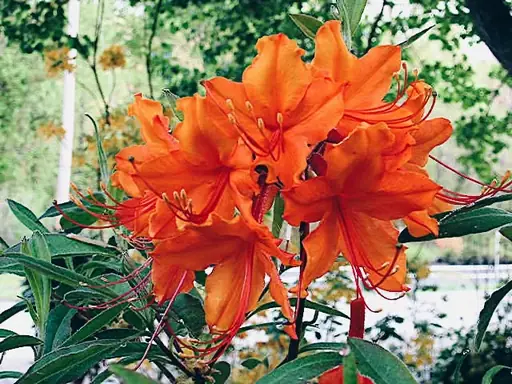
A deciduous azalea rather than the evergreen sort, 'Great Balls of Fire' erupts in spring with rounded trusses of two-inch blooms in tones that run from molten orange to deep, glowing tangerine, each flaring flower carrying a slim red tube and long, arching stamens that give the whole cluster a fiery, honeysuckle-like poise. A soft sweetness rides the air around the shrub, and the color reads from clear across the garden. The genus name Rhododendron comes from the Greek for rose tree, while azalea traces to azaleos, meaning dry, an old reference to the open ground where some kinds were found; neither name prepares a visitor for how incandescent these flowers can be.
The name is pure showmanship. Christened for Jerry Lee Lewis's 1957 barn-burner "Great Balls of Fire," the shrub practically demands a soundtrack, and we stand by the original advice to blast the song through the speakers while you coronate this beauty in the ground. Difficult to propagate and slow to bulk up, the plant reaches very few nurseries, which makes each one something of a collector's prize. A word of caution familiar to every azalea grower: like all Rhododendron, the leaves and nectar carry grayanotoxins and should never be eaten by people or pets.
Give 'Great Balls of Fire' the classic deciduous-azalea situation, dappled light or morning sun with shelter from the hottest afternoon, in moist, sharply drained, acidic soil enriched with pine bark or leaf mold. Standing four to six feet tall and nearly as wide with an open, informal frame, the shrub shines at the woodland edge, among high-branched pines and oaks, or threaded through a naturalistic border where the spring fireworks can blaze against fresh green. Underplant with ferns, native phlox, or foamflower, and site the shrub where low morning light can set the trusses aglow. Photo courtesy of Merri Oxley.
C'è ancora molto da scoprire



Domande e discussione