
Dahlia Flower Types: A Guide to Groups and Classification
Dahlias are beloved by gardeners and florists for their large array of glorious colors and delightful flowers that range from miniature pompoms to giant dinnerplates! Flowering from midsummer until the arrival of frost, they add fresh beauty to beds, borders, containers, and window boxes through.
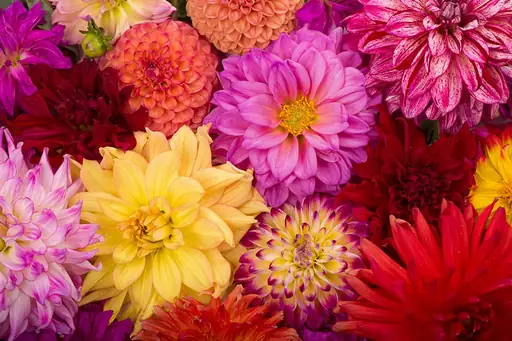
Dahlias are beloved by gardeners and florists for their large array of glorious colors and delightful flowers that range from miniature pompoms to giant dinnerplates!
Flowering from midsummer until the arrival of frost, they add fresh beauty to beds, borders, containers, and window boxes through the dog days of summer – just when other plants start to wear out from summer’s heat.
But with over 57,000 registered cultivars worldwide, choosing a selection for your garden can be a challenge.
The American Dahlia Society (ADS) categorizes dahlias into three groups on the basis of color, form (or flower type), and size.
In our guide to growing dahlias, we cover how to cultivate these beauties. In this guide, we’ll take a look at the different classifications to help you choose the type that’s right for your garden.
Here’s what I’ll cover:
Dahlia Groups and Classification
Color
Form
Size
1. Anemone
2. Ball and Miniature Ball
3. Cactus, Incurve, and Semi
4. Collarette
5. Decorative
6. Laciniated
7. Mignon Single
8. Novelty
9. Orchid
10. Orchette
11. Peony
12. Pompom
13. Single
14. Stellar
15. Waterlily
Color
The ADS Color group lists 15 distinct shades or color combinations.
- Bicolor
- Bronze
- Dark blend
- Dark pink
- Dark red
- Flame
- Lavender
- Light blend
- Orange
- Pink
- Purple and Black
- Red
- Variegated
- White
- Yellow
With every color available except true blue, you’re sure to find just the right shade for your garden palette.
Want Some Beginner Cultivar Suggestions?
Take a look at our guide, 27 of the Best Dahlia Varieties for Your Garden.
Form
There are multiple flower types in the Form group, with different petal structures and bloom shapes.
1. Anemone
Anemone (AE) types are distinguished by at least one row of evenly spaced, flat ray petals surrounding a vivid, and often contrasting, pincushion center made of long, tubular florets.
They may also be bicolored, as in the case of ‘Polka Dot’ which features cream colored petals edged in dark pink surrounding a bright yellow center.
Blooms are four to six inches wide, and plants grow to a mature height of three to four feet.
‘Polka Dot’
You can find bags of two, four, or eight tubers available at .
2. Ball and Miniature Ball
Ball (BA) types are fully double flowers with a slightly flattened globe shape featuring furled, involute (incurved) petals in a gorgeous, spiral arrangement.
Petal tips can be blunt, flat, or indented.
Miniature Ball (MB) types have identical flower forms but in smaller sizes.
‘Cornel’ features deep red, cherry-colored, three- to four-inch blooms atop four-foot sturdy stems.
The globe-shaped flowers make a dramatic impact in the garden and in cut flower arrangements.
‘Cornel’
You can find bags of two, four, or eight tubers available at .
3. Cactus, Incurved Cactus, and Semi Cactus
Cactus (C) types have long, pointed ray florets with petal edges that are involute (IC), revolute (edges rolled back), or straight (SC), radiating out from an open center in a somewhat spiky look.
‘Black Narcissus’ is a dramatic, moody semi-cactus cultivar with deep red petals that look almost black from a distance.
Adding texture, color, and interest to beds and borders, plants top out at two to three feet tall with large, six- to eight-inch blooms.
‘Black Narcissus’
Find bags of two, four, or eight tubers available at .
4. Collarette
Collarette (CO) flowers have a flat, open face with a single outer row of regularly spaced ray florets, an inner collar of shorter petals (petaloids), and a fringed or tight center disk.
The inner collar and center disk are often contrasting.
‘Kelsey Anne Joy’ is a superb example of a Collarette dahlia, featuring apricot outer petals, with yellowish-reddish-gold inner petals surrounding a yellow center.
Two- to four-inch flowers bloom on stems that grow up to three feet tall.
‘Kelsey Anne Joy’
carries bags of two, four, or eight tubers.
5. Decorative, Formal and Informal
Decorative cultivars are double petaled and open centered, with flat florets that may have a roll at the edges or tips.
Formal Decoratives (FD) have evenly spaced petals and a symmetrical flowerhead while informal Decoratives (ID) have twisted or wavy petals in a more irregular arrangement.
With five-inch flowers in blushed with soft pink, ‘Sweet Nathalie’ is an Formal Decorative type.
Plants grow three to four feet tall, and may require staking.
‘Sweet Nathalie’
Find ‘Sweet Nathalie’ tubers available at .
6. Laciniated
Laciniated (LC) types have uniformly arranged florets radiating from a disk or open center with involute or revolute edges.
A lengthwise split at the tips of the petals gives a fringed or “pinked” appearance like that of a carnation.
7. Mignon Single
Mignon Single (MS) is an open faced flower with a single row of uniform, slightly overlapping ray florets, in a flat plane surrounding a center disk that can be tightly furled or unfurled into a pincushion.
The delicate four-inch flowers are stunning when mass planted in beds and borders, and are available in a variety of colors. Compact plants top out at one- to two-feet tall.
Mixed Mignon
You can find seeds for D. variabilis in a mixed packet of pinks, reds, yellows, and whites available at .
8. Novelty, Open and Fully Double
Novelty flowers have characteristics that fall outside of the other classifications.
Novelty Open (NO) varieties have a disc center. Fully Double (NX) types have an open center surrounded by double petals.
9. Orchid
Orchid (O) types feature open flowers with a single row of uniform ray florets surrounding a tight disk center.
The florets are involute for at least two thirds of their length, giving a narrow, rolled effect.
Four-inch-wide flowers are light and stand erect atop three-foot stems.
10. Orchette
Orchette (OT) types are intricate blooms that combine the involute petal characteristics of the Orchid dahlia with an inner fringe of short petals (petaloids) surrounding a center disk typical of the Collarette form.
The petaloids may be flat or slightly curved towards the center of the bloom.
11. Peony
Peony (PE) types feature an open flower with two or more rows of flat or slightly cupped ray florets surrounding a center disk of open anthers on short filaments.
‘Bishop of Canterbury’ is a compact Peony type featuring deep magenta-pink petals that surround a dark golden center.
Flowers are five to six inches across on three-feet-tall sturdy stems.
‘Bishop of Canterbury’
Find bags of two, four, or eight tubers available at .
12. Pompom
Pompom (aka pompon) types (P) feature an open-centered, fully double flower in a rounded globe shape with rolled, involute florets that are blunt or round tipped.
Flowers are beautifully symmetrical with an appealing geometry.
‘Burlesca’ is a coral-pink cultivar with dainty four-inch flowers that look perfectly symmetrical.
Flower stalks can be up to three feet tall and may require staking.
‘Burlesca’
You can find ‘Burlesca’ tubers available at .
13. Single
Single (S), is an open faced flower with a single row of regular, overlapping ray florets in a flat plane surrounding a center disk.
The petals are flat or slightly cupped with blunt or pointed tips, and the center disk opens to reveal frilly anthers.
14. Stellar
Stellar (ST) types are fully double flowers with long and pointed cupped florets that recurve back towards the stem, giving the appearance of a shooting star.
Like the Ball types, there is no center disc.
15. Waterlily
Waterlily (WL) has fully double, symmetrical blooms with slightly cupped florets that open from a domed center to a saucer-shaped face.
Petals are broader and sparser than the Stellar types.
Size
The third group is Size, classified according to letter values.
- AA – Giant flowers, measuring over 10 inches in diameter (also known as Dinnerplate)
- A – Large flowers of 8 to 10 inches (also known as Dinnerplate)
- B – Medium flowers of 6 to 8 inches
- BB – Small flowers that measure 4 to 6 inches
- M – Miniature flowers up to 4 inches
- BA – Ball types measuring over 3.5 inches
- MB – Miniature Balls of 2 to 3.5 inches
- P – Pompoms up to 2 inches
- MS – Mignon Single, up to 2 inches
Like the Color and Form groups, the large selection of sizes offers a good variety of flowers suitable for multiple environments.
From small patio or courtyard spaces to large garden beds, there’s ample selection for any setting.
Best for Your Garden
Now that you’re familiar with the different classifications and have learned how to identify dahlia flower types, have you decided which will be best for your garden?
From anemone to waterlily forms, you’re sure to find a few new favorites to brighten up your late season landscape – tell us about your selection in the comments section below!
And for more information about growing dahlias in your garden, be sure to add these articles to your reading list:
- How to Lift Dahlias for Winter Storage
- 19 of the Best Flowering Companion Plants for Dahlias
- How and When to Divide Dahlias
- Facebook166
- X

質問とディスカッション