
How to Grow and Care for Stokes’ Asters
Stokesia laevis Stokes’ asters, Stokesia laevis syn. Carthamus laevis, are perennials in the Asteraceae or daisy family. They’re native to the southeastern United States and grow well in USDA Hardiness Zones 5 to 9. Botanical species and cultivated varieties are available in shades of blue, pink,.
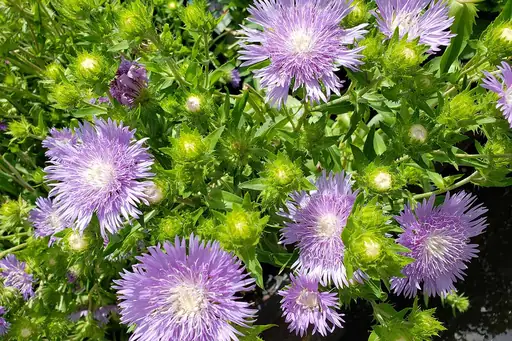
Stokesia laevis
Stokes’ asters, Stokesia laevis syn. Carthamus laevis, are perennials in the Asteraceae or daisy family.
They’re native to the southeastern United States and grow well in USDA Hardiness Zones 5 to 9.
Botanical species and cultivated varieties are available in shades of blue, pink, purple, white, and yellow. The size and composition of the flower heads make them some of the showiest asters.
Our guide to growing asters discuss cultivation, maintenance, troubleshooting for species and cultivated varieties.
This article zeroes in on growing and caring for Stokes’ asters.
Here’s what we’ll cover:
What You’ll Learn
- What Are Stokes’ Asters?
- Cultivation and History
- Propagation
- How to Grow
- Growing Tips
- Pruning and Maintenance
- Cultivars to Select
- Managing Pests and Disease
- Best Uses
- Quick Reference Growing Guide
Let’s begin!
What Are Stokes’ Asters?
Unlike many native asters with blossoms measuring an inch or less across, Stokes’ offer generous two- to four-inch flowers with deeply divided rays with a shredded tissue paper, fringe-and-frills quality.
They generally begin blooming in mid to late summer and continue into the fall, but sometimes they delight with a few spring blossoms, a tantalizing promise of more to come.
Plants have an upright, clumping growth habit. There is a basal mound of foliage.
The leaves are narrow, lance-like, and semi-evergreen, remaining green in the warmest regions and bronzing toward season’s end in cooler climes.
Mature dimensions are 12 to 24 inches tall and 12 to 18 inches wide.
Cultivation and History
In nature, S. laevis often grows in stream beds with sandy, well-draining soil. The blossoms resemble wild cornflowers, Centaurea cyanus, with similar finely cut rays.
Cultivated plants perform well with full sun and prefer consistent moisture. In the warmest zones, growing in filtered sunlight helps to foster a moist environment.
Once mature, plants exhibit above-average drought and heat tolerance.
Stokes’ asters were named to honor renowned British physician and botanist John Stokes, who studied the medicinal properties of foxglove, Digitalis, and was a member of the Linnean Society of London.
Propagation
To start plants of your own, you’ll need seeds, nursery plants, soft stem cuttings, or divisions of existing plants. Find instructions for each method in our aster propagation guide.
To direct-sow seeds, moisten the soil.
Scatter a few seeds on the surface every 18 to 24 inches.
Keep the soil moist, but not oversaturated.
When the seedlings have two sets of true leaves, thin them to one per interval.
To transplant seedlings started indoors, nursery plants, soft stem cuttings, or divisions, take note of their depth in the original setting and replicate it when you place them in the garden soil.
Tamp the soil firmly around the stems, water, and tamp again.
How to Grow
After the danger of frost has passed in the spring, choose a location with full sun or filtered sun/part shade in the warmest regions.
The soil should be loose, sandy, and well-draining, with a pH of 5.2 to 6.7. Poorly draining soil may result in root rot, especially during the winter.
Work the soil to a depth of eight to 10 inches until it is crumbly. Remove rocks and debris.
Apply a well-balanced, slow-release, granular fertilizer to plants ranging in size from seedlings to nursery specimens.
Sprinkle the granules on the moist soil around, but not touching, the stems.
Maintain an inch of water per week, rain included.
Growing Tips
It’s easy to grow S. laevis when you remember the following:
- A sunny location is best except in the warmest zones, where filtered sunlight helps to retain soil moisture.
- Moist soil is essential, but it must be loose and well-draining to avoid rotting.
- Sow seeds on the soil surface and transplants at the same depth as in their original settings.
- Fertilize plants with a well-balanced granular product.
- Maintain even moisture, an inch per week.
With planting done, it’s time to discuss ongoing care.
Pruning and Maintenance
You’ll find S. laevis is one of the lower maintenance garden flowers. However, there are a few chores that support their best performance.
Deadhead spent flowers to prolong blooming. Remove entire stems at their points of origin to encourage new growth.
Divide large clumps every two to three years in early spring or early fall to prevent overcrowding, stimulate new root formation, and promote optimal blooming.
Fertilize each spring with a well-balanced, slow-release, granular product.
Cut the stems down to the basal mound of foliage at season’s end and discard the remains to inhibit wintering over pests and diseases.
In cooler climes, a three-inch layer of mulch helps to insulate and facilitate drainage during the winter.
Cultivars to Select
When shopping, you may find botanical species S. laevis and cultivated varieties.
Here are some cultivars to whet your appetite:
Honeysong
S. laevis ‘Honeysong’ boasts four-inch pinkish-purple blossoms with white, frilly eyes and fringed rays.
‘Honeysong’
Enjoy flowers from late summer to fall. Plants mature to a height and width of 12 to 15 inches.
Peachie’s Pick
S. laevis ‘Peachie’s Pick’ offers lavender-blue blossoms up to three inches across with white eyes and all the frills and fringe one would expect from a top-performing Stokes’ cultivar.
‘Peachie’s Pick’
Bloom time is from midsummer to fall. Mature dimensions are 12 to 18 inches tall and 15 to 18 inches wide.
White Star
S. laevis ‘White Star’ displays bright white, generously proportioned three- to four-inch frilly, fringed blossoms with a hint of pink at the center.
‘White Star’
Flowers bloom from late summer to early fall. Overall dimensions are 12 to 16 inches in height and spread.
You’ll find a varied color palette awaits when you shop.
Managing Pests and Disease
S. laevis and its cultivars are not typically prone to pests or disease.
However, when conditions are too wet, they may be more prone to slugs and snails, as well as fungal conditions like Fusarium wilt and powdery mildew.
To avoid pests and disease, purchase high-quality plants or seeds, space generously for ample air circulation, grow in well-draining soil with full to filtered sun, and maintain even moisture without oversaturation.
Best Uses
A showy native flower like Stokes’ aster is an excellent choice for mass-planting in butterfly, cottage, and cutting gardens, where it can spread and attract bees and butterflies.
It also performs well en masse in moist areas like stream banks.
While you may read that plants are deer and rabbit resistant, I have seen the damage to confirm the contrary regarding deer, so take this information with a grain of salt.
Quick Reference Growing Guide
| Plant Type: | Herbaceous flowering perennial | Flower / Foliage Color: | Blue, pink, purple, white, yellow/green |
| Native to: | Southeastern United States | Tolerance: | Drought, heat, light shade |
| Hardiness (USDA Zone): | 5-9 | Maintenance: | Low |
| Bloom Time/Season: | Late spring-summer | Soil Type: | Sandy, loose |
| Exposure: | Full sun | Soil pH: | 5.2-6.7 |
| Spacing: | 18-24 inches | Soil Drainage: | Well-draining |
| Planting Depth: | Surface sow (seeds); same depth as originally planted (transplants) | Attracts: | Bees, butterflies |
| Height: | 12-24 inches | Uses: | Beds, borders, butterfly gardens, cottage gardens, cutting gardens, mass plantings, pond banks |
| Spread: | 12-18 inches | Family: | Asteraceae |
| Water Needs: | Moderate | Genus: | Stokesia |
| Common Pests and Diseases: | Slugs, snails; fusarium wilt, powdery mildew | Species: | Laevis |
Transition with Showy Stokes’
Stokes’ asters are showier than many of their native perennial cousins, with their two- to four-inch flowers in shades of blue, pink, purple, white, and yellow.
And unlike their shade-loving relatives, Stokes’ grow in full sun but appreciate a little shade in the warmest zones.
Also unique are their preferences for sandy soil that drains well, and a perpetual need for moisture, especially when growing in full sun.
And finally, sporadic spring blooms may precede the summer-to-fall flowering they have in common with their late-season counterparts.
For a showy flower that commands attention and attracts beneficial pollinators, add the Stokes’ species, S. laevis, to your garden planner and feature it in your latest garden design.
Are you growing these flowers? Let us know in the comments section below.
If you enjoyed reading about Stokes’ asters and want to learn about more bold and bright perennial aster species, we recommend the following guides next:
- Grow New England Aster for Sensational Summer and Fall Color
- How to Grow and Care for Sky Blue Aster
- How to Grow Tatarian Aster: a Dynamic Late-Season Bloomer
- Facebook2
- X




質問とディスカッション