
When and How to Thin Fruit on Plum Trees
I remember the first time someone told me I should be thinning my plum trees. I thought they’d gone off their rocker. You want me to prune off of some of the marvelous fruit that is forming? Why? I spent all this time planting and nurturing the darn thing, and now I’m just going to throw the fruits.
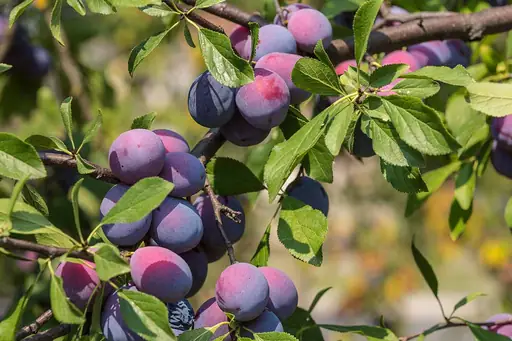
I remember the first time someone told me I should be thinning my plum trees. I thought they’d gone off their rocker.
You want me to prune off of some of the marvelous fruit that is forming? Why? I spent all this time planting and nurturing the darn thing, and now I’m just going to throw the fruits of my labors away, quite literally?
Turns out there are really good reasons for thinning and now I’m the one convincing new growers to give their orchards the snip.
While many gardeners are diligent about thinning their apples and peaches, plums, with their more easygoing nature and abundant fruits, tend to be forgotten.
Don’t make this mistake! You need to include thinning in your yearly maintenance chores. We’ll talk about why that is and how you can do it, coming up.
Here’s what we’ll discuss:
What You’ll Learn
Why You Should Thin Your Plums
When to Thin
The Process
Modern cultivated varieties produce a vast amount of fruit, but it can be too much of a good thing.
Japanese types, for example, are known for growing an abundance of fruits, many of them held in clusters. The trees usually drop quite a few in the late spring as a result. European types tend to be less likely to overbear, but that doesn’t mean you can ignore them.
When our trees become out of balance by producing more fruits than the leaves can handle, we need to somewhat restore the balance, and we can do that through thinning.
Why You Should Thin Your Plums
There are four reasons that we gardeners need to thin our plum trees:
1. First, the remaining fruits will grow larger than they would if you left all the ones that are developing in place.
This isn’t as essential on smaller cultivars like ‘Satsuma’ when the size isn’t as important. But on larger cultivars such as ‘Santa Rosa’ or ‘Elephant Heart,’ it’s a vital step to help the tree produce the big plums they’re renowned for.
When there are too many fruits developing on a tree, they’re all competing for energy, and when this happens, they’ll all be smaller than they would be otherwise.
2. Second, overloaded branches tend to break easily. A strong wind comes along, and suddenly, you have cracked branches dangling all over the place.
Not only does this reduce your yield, but it can expose the tree to pathogens and pests, and you don’t want that.
3. The third reason is that plum trees can bear heavily one year and hardly at all the next year, known as biennial bearing. Most of us don’t want all our harvest one year and only a few the following year.
Every fruiting plant needs to balance the energy required by the yields with the amount of leaf surface it has to photosynthesize.
But because we have bred trees to produce larger and more fruits than they do in nature, they become imbalanced. A plant that is devoting all its energy to producing fruit won’t have enough left to create the buds that will turn into plums the following year.
4. Finally, we want to discourage the tree from dropping fruits on its own. We want to be the ones to choose which to keep and which to remove.
When to Thin
Timing is everything when it comes to thinning. If you do it too early in the year, it won’t have much impact, plus at this time it’s really hard to see the fruits.
Conversely, if you wait too long, the plant will already have been drained of nutrients and energy, compromising next year’s harvest.
The right timing is between three and four weeks after the blossoms fade.
At this point, the fruits should be developing nicely so you can determine what you’re doing, but they won’t have grown to the point where they are costing the plant too much in terms of energy.
Don’t thin a tree that is producing for the first time. Give it a year to establish itself.
The Process
Plums grow on small spurs on one-year-old wood. A spur is a short little branch that only grows a few inches long.
Grab some scissors or secateurs, or just plan to use your fingers. For those that are really high up, you might opt to use a pole saw or pruner.
If you decide to use a tool, make sure it’s clean and sanitized. You can wipe it down with isopropyl alcohol or a 10 percent bleach solution.
Remove the fruit so there’s only one plum every six inches or so, though the distance between them depends on how large they will eventually grow.
For trees with larger fruits or in the case of plumcots and pluots, go with eight inches in between, and maybe four inches for those with smaller fruits.
Since it can be hard to determine distance when you’re out in the field working, measure your hand. I know that my fist is about four inches and my outstretched hand is about ten inches from the tip of my pinky to the top of my thumb.
It’s not an exact science, of course, so don’t stress about finding the precise distance.
Sometimes, you can see that the tree is favoring certain fruits over others because they’ll be larger and further along in the development process. Leave these and remove the smaller, less well-developed ones.
To remove the fruit, just cut it or pull it off right at the spur.
Don’t forget to lift up leaves and look underneath, you never know what’s hiding under there. There could be a ton of plums just out of sight.
In late spring, many types of plums, but especially Japanese ones, will drop some fruits on their own if there are too many for the tree to support. They’re smart like that. So you can leave more fruits on the tree than you need in anticipation of this event.
If at any point you see a branch that is bending or stressed enough that it’s close to breaking, go ahead and thin it even more than the guidelines above.
You can also do a bit more thinning after the fruit drop occurs if there still seem to be too many. Be aware that at this point, any impact from thinning will be minimal.
Thin Things Out for Better Results
Young fruits can be eaten, which makes me feel better about the whole process. Waste not want not and all that!
They’re incredibly bitter, however, so you’ll want to cook them down with some sugar – they’ll still be tart but not unpleasantly so.
What kind of plums are you growing? Do you thin them? Let us know in the comments section below!
Now that you have the thinning process sorted out, you might have questions about other elements of plum tree care. We can help! Here are a few guides that might be useful for you:
- How to Grow and Care for Plum Trees
- When and How to Spray Plum Trees for Pests
- When and How to Prune Plum Trees
- X




質問とディスカッション