

このページは原文のまま表示されています。翻訳はまだご利用いただけません。
Seedsunセレクション
Callicarpa americana
SKU: CALL-AMER-01G
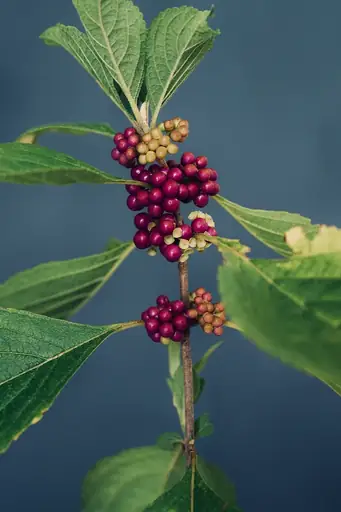
The genus name says it: Callicarpa, from the Greek kallos, beauty, and karpos, fruit, beautiful fruit, a genus named for exactly what it does. Callicarpa americana, the American beautyberry, is the southeastern native that gives the genus a calling card. From late August into November, the plant.
個別の見積もりをご依頼ください
価格、梱包サイズ、在庫状況は、お客様専用の見積書にてご確認いただけます。お問い合わせを送信しても、お支払い済みの注文は確定されません。
適性、播種方法、栽培条件について尋ねてください。
お見積書に記載されている配送オプションと必要書類をご確認ください。
この品種について
The genus name says it: Callicarpa, from the Greek kallos, beauty, and karpos, fruit, beautiful fruit, a genus named for exactly what it does. Callicarpa americana, the American beautyberry, is the southeastern native that gives the genus a calling card. From late August into November, the plant sets dense clusters of small drupes in a luminous magenta-purple, a color that registers as almost unreal in the late-summer landscape, somewhere between fuchsia and amethyst, with no real precedent among native fruits. The berries gather in tight whorls around the stem at every leaf node, all the way down the arching branches, so that a mature shrub in October looks less like a shrub bearing fruit than a ribbon of purple glass beads strung along the branches.
The species ranges across the southeastern coastal plain and Piedmont, west into Texas and northern Mexico, with outlier populations in Bermuda, the Bahamas, and Cuba, growing along forest edges, in pine flatwoods, on old-field margins, and in the dappled understory of mixed hardwood-pine canopies. So much a part of the southern landscape that to many southerners the beautyberry feels native to memory itself, the shrub has only really been embraced as a garden plant in recent decades. William Bartram, the eighteenth-century Quaker naturalist whose Travels (1791) remains the foundational botanical document of the American South, described Callicarpa in the Carolina and Georgia woods he walked, and the southern poet Kathryn Stripling Byer used the beautyberry in her poem Beautyberry as a figure for endurance, beauty in the face of adversity, a fair description of how the plant actually lives.
The other story is more recent. In the rural Mississippi of his grandfather's generation, the USDA botanist Charles Bryson had been told that crushed beautyberry leaves, rubbed on the skin or stuffed under a farm animal's harness, kept biting insects away. Bryson passed the tip to Charles Cantrell, a chemist at the USDA Agricultural Research Service in Oxford, Mississippi, and Cantrell and colleagues isolated three terpenoid compounds from the leaves: callicarpenal, intermedeol, and spathulenol. In peer-reviewed testing against the mosquitoes that carry yellow fever and malaria, callicarpenal worked at roughly 79 percent the strength of DEET; against the blacklegged ticks that carry Lyme disease, and lone star ticks, callicarpenal was statistically equal to DEET; against fire ants, also effective. The USDA patented the compounds. The grandfather was right.
In the garden, the American beautyberry is a forgiving, durable, slightly unruly deciduous shrub, four to six feet tall and as wide, with an open, arching frame that takes a light pruning in late winter to stay compact and fruit heavily. The shrub blooms and fruits on new wood, so cutting back to twelve or eighteen inches each spring sharply increases the show. The early-summer flowers are small and pale lavender-pink, pretty up close, easy to miss from a distance, and busy with native bees and small butterflies. But the fruit is the event: more than forty species of southeastern birds work the clusters in fall and winter, from bobwhite and cardinals to mockingbirds and thrashers, along with deer, raccoons, foxes, and opossums. The berries are mildly edible, long used for jelly, though the wildlife usually clears them faster than any cook could.
For the native gardener, the wildlife gardener, the ethnobotanist, or anyone who wants to plant a real piece of the flora of the American South: the plant Bartram saw, the plant Bryson's grandfather knew, the plant the USDA validated.
さらに多くの発見があります



質問とディスカッション