

このページは原文のまま表示されています。翻訳はまだご利用いただけません。
Seedsunセレクション
Holboellia coriacea
SKU: HOLB-CORI-01G
Holboellia coriacea is an evergreen twining vine from western China, glossy and leathery in the leaf, each one divided into three long leaflets held on a slender stalk so the whole plant hangs in layers rather than making a solid mat. In spring and early summer come clusters of small flowers,.
個別の見積もりをご依頼ください
価格、梱包サイズ、在庫状況は、お客様専用の見積書にてご確認いただけます。お問い合わせを送信しても、お支払い済みの注文は確定されません。
適性、播種方法、栽培条件について尋ねてください。
お見積書に記載されている配送オプションと必要書類をご確認ください。
この品種について
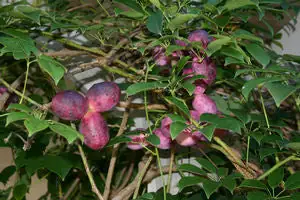
Holboellia coriacea is an evergreen twining vine from western China, glossy and leathery in the leaf, each one divided into three long leaflets held on a slender stalk so the whole plant hangs in layers rather than making a solid mat. In spring and early summer come clusters of small flowers, greenish white through to pale purple, and the scent is the surprise: intensely sweet and carrying, far out of proportion to flowers that most people walk straight past. Later, if the season and the siting are right, the vine produces the other trick, fat pinkish-purple pods shaped unmistakably like sausages, ripening into early winter.
Our plants were propagated from the Charlotte, North Carolina garden of the late Elizabeth Lawrence, the great Southern gardener and garden writer whose books taught two generations how to garden in this climate rather than pretending to be in England. That connection alone is reason enough to want the plant. Little-known in cultivation on either side of the Atlantic, the species was introduced to Britain by Ernest Wilson in 1907 and has never quite caught on, which is the usual fate of a vine whose best quality is a scent rather than a color.
The genus honors Frederik Ludvig Holbøll, a Danish botanist who ran the botanic garden at Copenhagen, and the epithet coriacea means leathery, for those thick evergreen leaflets. Holboellia sits in Lardizabalaceae, a small and rather exotic family of mostly Asian climbers that includes the chocolate vine, Akebia, and the resemblance is obvious once pointed out. The pods split open in late winter to show the seeds bedded in a mass of white jelly, and that jelly is edible, as Akebia pulp is in Japan. Whether the fruit is worth eating is another matter: accounts run from sweet but insipid to frankly bitter, the rind worse than the pulp, and nobody has ever grown this vine for the table. Treat the pods as a curiosity to try once rather than as a crop.
Male and female flowers are borne separately on the same plant, and fruit set is erratic: a vine in shade will flower and scent perfectly well and may never fruit, while the same vine given sun is far likelier to produce the sausages. Two plants of different origin improve the odds further. Grow the sausage vine on a shady or semi-shady arbor, pergola, or wall in the Southern garden, in moist, well-drained soil with organic matter, and give the twining stems something to wind around, since this plant climbs by twining rather than clinging and will not hold to bare masonry. Reckon on fifteen to twenty feet. Site the vine where people pass close in spring, because the scent is the whole point and is easy to miss from a distance. Hardy through USDA zones 7 to 9. Prune after flowering, and expect a vigorous grower that will want a firm hand on a small structure.
さらに多くの発見があります



質問とディスカッション