

このページは原文のまま表示されています。翻訳はまだご利用いただけません。
Seedsunセレクション
Stewartia rostrata
SKU: STEW-ROST-01G
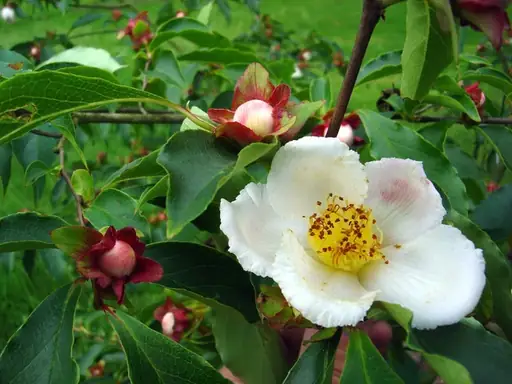
Beaked stewartia is one of the rarest plants in a genus that has no common members, and we are indebted to Roger Gossler of Oregon for our stock. He calls the species one of the rarest Stewartias, grown above all for the large maroon calyx that closes around the seed pods once the flowers have.
個別の見積もりをご依頼ください
価格、梱包サイズ、在庫状況は、お客様専用の見積書にてご確認いただけます。お問い合わせを送信しても、お支払い済みの注文は確定されません。
適性、播種方法、栽培条件について尋ねてください。
お見積書に記載されている配送オプションと必要書類をご確認ください。
この品種について
Beaked stewartia is one of the rarest plants in a genus that has no common members, and we are indebted to Roger Gossler of Oregon for our stock. He calls the species one of the rarest Stewartias, grown above all for the large maroon calyx that closes around the seed pods once the flowers have fallen. "Very beautiful," he says, and Gossler has grown more stewartias than most gardeners will ever see. In the garden the plant makes a deciduous, multi-stemmed shrub or small tree, pyramidal while young and rounding into an oval with age, reaching anywhere from thirteen to thirty-odd feet depending on how patient the gardener turns out to be.
The genus commemorates John Stuart, third Earl of Bute, an eighteenth-century patron of botany whose surname Linnaeus set down as Stewart when he coined the name. The misspelling is now permanent, fixed in place by the rules of botanical nomenclature, which is a small comedy the plant carries without complaint. The epithet rostrata means beaked, for the drawn-out point on the seed capsule. Stewartia sits in Theaceae, the tea family, in the company of Camellia and the lost Franklinia, and the family resemblance shows plainly the moment the flowers open.
This species spent decades in cultivation with no name of its own. Two different plants were growing at the Arnold Arboretum under the single label Stewartia sinensis, and in the early 1970s Stephen Spongberg worked out that one of them was a distinct species from southeastern China, describing the plant as Stewartia rostrata. The flowers open white and cupped in May and June, five petals around a boss of stamens, and the calyx behind them flushes deep beet red and holds that color long after the petals drop, staining the developing capsules through summer. Autumn brings red and orange to the leaves. There is no ethnobotany to speak of here, no old medicine or dye or timber tradition; this is a plant grown for looking at, and honest enough to admit as much.
Site the beaked stewartia as a specimen where the calyx and the smooth young trunk can be read at close range, in dappled shade or morning sun with shelter from hard afternoon light, in moist, acid, well-drained ground enriched with leaf mold. Stewartias resent root disturbance and hate hot dry soil, so plant once, mulch generously, and water through the first summers rather than moving the plant about looking for a better spot. Hardy through USDA zones 5 to 8, a good deal colder than the Southern reputation of the genus suggests. Growing a nursery-propagated plant of a species this scarce is a quiet way of keeping the species in cultivation, which for the rarer stewartias is not a small thing.
Image courtesy of Philip de Spoelberch
さらに多くの発見があります



質問とディスカッション