

このページは原文のまま表示されています。翻訳はまだご利用いただけません。
Seedsunセレクション
Verbena hastata
SKU: VERB-HAST-01Q
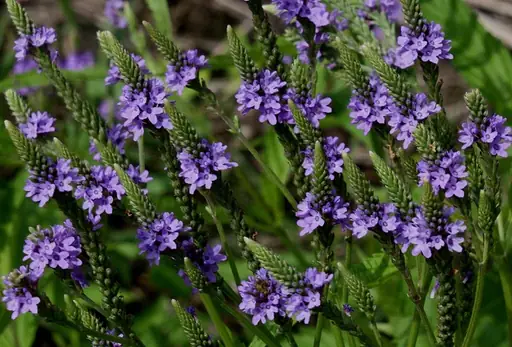
Blue vervain rises in summer as a candelabra of slender, pencil-thin spikes, each one lit from the base upward with tiny, five-lobed flowers in a saturated purplish blue that few native perennials can match. Verbena hastata is a clump-forming perennial of eastern North America, reaching two to four.
個別の見積もりをご依頼ください
価格、梱包サイズ、在庫状況は、お客様専用の見積書にてご確認いただけます。お問い合わせを送信しても、お支払い済みの注文は確定されません。
適性、播種方法、栽培条件について尋ねてください。
お見積書に記載されている配送オプションと必要書類をご確認ください。
この品種について
Blue vervain rises in summer as a candelabra of slender, pencil-thin spikes, each one lit from the base upward with tiny, five-lobed flowers in a saturated purplish blue that few native perennials can match. Verbena hastata is a clump-forming perennial of eastern North America, reaching two to four feet in good ground and occasionally stretching to six, on stiff, square, hairy stems that branch toward the top. The lance-shaped leaves are sharply toothed and rough to the touch, a coarse green foil for the refined flower spikes above. Bloom comes slowly and deliberately from July into September, only a few florets open on each spike at any moment, so the plant seems to smolder for weeks rather than flare all at once.
The names carry their own small histories. Verbena was a Latin word for the leafy branches and sacred herbs laid on altars and used in both ceremony and medicine, a lineage that marks this genus as one of the old holy plants. The epithet hastata means spear-shaped, a nod to the pointed leaves. English folk names lean into the same mix of reverence and use: simpler's joy, after the simplers who once gathered healing herbs from the countryside, and herb of grace, a name blue vervain shares with a long European tradition of vervain as a charm against ill will.
That reputation as a healing and protective herb runs deep in North America too. The Dakota and Omaha-Ponca names for the plant translate simply as medicine. The Iroquois are recorded using a cold infusion of the mashed leaves as a protective medicine, meant, memorably, to make obnoxious persons go away, while the Cherokee turned to the leaves, seeds, and roots for colds and coughs. Later Eclectic physicians and folk herbalists reached for blue vervain to settle frayed nerves and low spirits, and modern herbalists still regard the plant as a calming, bitter tonic. These are traditions worth knowing rather than prescriptions to follow, and the plant is potent enough that large doses upset the stomach; none of this is medical advice.
In the garden, blue vervain belongs wherever the ground stays damp: the low, wet middle of a rain garden, the margin of a pond, a moist meadow, or the soggy corner that defeats tidier plants. Give the plant full sun and medium to wet soil and they will form loose colonies by rhizome and self-sown seed, an asset in naturalistic plantings and something to edit in a formal bed. The vertical spikes read beautifully against the round umbels of Joe-Pye weed and swamp milkweed, the rusty spires of ironweed, and the airy white of Culver's root, and the flowers draw bees, butterflies, and the occasional hummingbird all summer. Leave the seedheads standing into winter and goldfinches, juncos, and sparrows will work them over on cold afternoons.
Photos courtesy of RW Smith and Sally & Andy Wasowski
さらに多くの発見があります



質問とディスカッション