
Why Is My Asparagus Ferning Out?
Growing asparagus can be a bit of a challenge if you’ve never done it before. These plants aren’t like squash or strawberries. You don’t plant them and then wait for the fruits to develop so you can pluck them off. With asparagus, you harvest the stems of the plant, and then you wait for more stems.
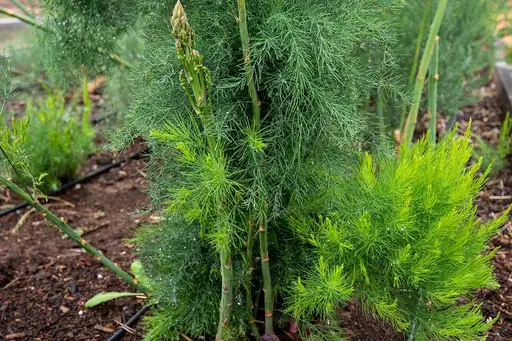
Growing asparagus can be a bit of a challenge if you’ve never done it before.
These plants aren’t like squash or strawberries. You don’t plant them and then wait for the fruits to develop so you can pluck them off.
With asparagus, you harvest the stems of the plant, and then you wait for more stems to return so you can do it again.
When all goes to plan, the process is pretty straightforward. But when funky stuff like ferning out early starts to happen, it can be perplexing.
In this guide, we’ll help you understand more about this process, what it is, and what – if anything – you should do about it.
Here’s what we’ll talk about, coming up:
What You’ll Learn
- What Is Ferning Out?
- Causes of Ferning Out
- How to Prevent Early Ferning
- What to Do With the Ferns
Ferning out isn’t always a bad thing. But when it happens at the wrong time, it can ruin your harvest.
So let’s figure out how to deal with it.
What Is Ferning Out?
First, we need to clarify our terms. Sending out foliage, aka the ferns, is a phase of growth that the asparagus plant needs to go through each year. It’s a healthy, normal part of the growing process.
At the end of the growing season, you allow the plant to form lots of fluffy foliage that emerges from the spears. Next, the female plants will form berries, and then the foliage of both male and female plants will eventually turn brown.
You don’t usually want to harvest asparagus in the first or second year, and sometimes even the third. So for the first few years, you’ll just let the plants do their thing, forming ferns and having a good old time.
Even once you do start harvesting the spears, you want what remains to start forming foliage at the end of the harvest season so they can gather and store nutrients in the crown for the coming winter.
If you keep pulling the spears, or stems, and never allow the plant to fern out, it won’t return next year. That foliage is necessary to provide nutrients to replenish the plant.
Once the ferns are completely brown, you can remove them. They’ve finished their job at that point.
Our guide to cutting back asparagus foliage at the end of the growing season has more tips on the process.
But ferning out is how people often refer to an asparagus plant that is flowering too early in the year.
Young plants form foliage first thing in the spring. This is nothing to worry about. But harvestable plants shouldn’t start doing so until you’ve had a chance to pull the stems and enjoy the harvest at least once.
Causes of Ferning Out
Remember, ferns on your plant aren’t a bad thing. Seeing these develop is part of the natural process of the plant.
But when it happens early in the year when the spears are still small, it’s usually caused by some sort of environmental condition that’s less than ideal.
Not enough nutrients, too little water, or too much heat early in the year are the most common causes. Too much water can also cause problems.
Essentially, adverse conditions convince the plant that it needs to hurry and try to reproduce before it dies. So out come the ferns and flowers.
If the spears are full-sized and it’s not super early in the year, or if the plants are in their first year, then the spears should be sending out foliage. Just let it happen and enjoy the beautiful display.
Depending on where you live and the weather in a given year, asparagus season usually ends sometime in June or July. Dry or hot weather can hasten this.
So if your spears are forming foliage and it’s already May or June, it’s nothing to be concerned about. But March or April is too early for foliage to form, and it probably means you experienced some really unusual weather for your region.
It could also mean you simply didn’t harvest the spears soon enough.
Left to its own devices, asparagus starts to fern out as soon as a stem has reached its full size. Removing these spears at peak harvest time, while they are still tender and immature, serves to delay this process.
How to Prevent Early Ferning
Once your asparagus starts this process early, you can’t stop it. But you can support the plant by making sure you do what you can to keep it healthy. That means providing water and perhaps some shade during the hottest days.
Shade cloth is a good option to keep a plant cool if you have unusually warm weather.
In the future, try to be sure to stay on top of watering and feeding your plant. This isn’t just an early spring job or something that’s only done attentively at planting time.
You need to do it year after year for these perennial vegetables, because a lack of nutrients and water one year can cause early ferning the following year.
For tips on caring for asparagus, read our comprehensive guide.
As long as you work to improve the conditions around your plant despite the early appearance of foliage, it should survive to produce a harvest the next year.
On the other hand, if the asparagus is starting to produce foliage because you haven’t harvested the stems and it’s past time, that’s easy to fix.
Just harvest the affected stems, and stay on top of the next harvest opportunity. Note that these might be tough – you can always toss them on the compost pile.
Alternatively, you can leave it in place and let the plant do its thing.
What to Do With the Ferns
If your plant is going through the healthy, normal process of ferning out, just let it. Once the foliage is completely brown, you can trim it away and dispose of it, or toss it in the compost.
Also remember, at some point, you need to allow the ferns to form on the remaining stalks.
Most gardeners harvest the largest spears two or three times before allowing the plant to mature and finish its life cycle for the season.
Learn more about how to harvest asparagus here.
Ferning Out Isn’t All Bad
It’s understandable that new asparagus growers often panic when they see all that frilly growth. But it’s not usually anything you need to stress over. It’s just part of the circle of life, as they say.
To avoid early ferning, keep an eye on the weather forecast and be prepared to do what you can to provide assistance to your plants in terms of watering and providing necessary shade.
You also need to ensure that you harvest the spears while they’re young – don’t wait for them to mature and start producing foliage.
Is this your first time growing asparagus? Or the first time you’ve run into early ferning out? Let us know about your experiences in the comments.
For more tips on troubleshooting asparagus issues, we’ve put together a few other guides that we hope you’ll find useful, including:
- How to Identify and Control Common Asparagus Diseases
- How to Identify and Treat Asparagus Crown and Root Rot
- What Is Purple Spot of Asparagus?
- When and How to Transplant Asparagus
- Facebook54
- X
질문 및 토론