
13 of the Best Companion Plants for Tall Late Season Asters
Late season asters are transitional flowers that bloom between summer and fall, bringing masses of small blossoms and rich texture to end of season gardens. In this article, we focus on 13 companion plants that share cultural requirements and stature with late season varieties. Here’s what’s in.
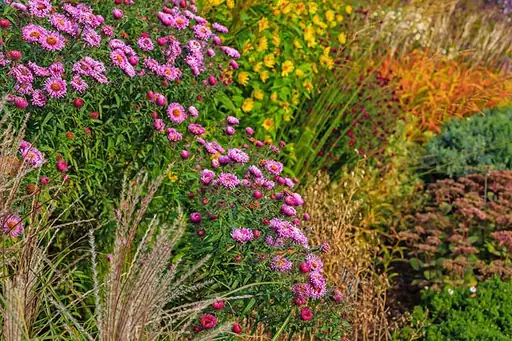
Late season asters are transitional flowers that bloom between summer and fall, bringing masses of small blossoms and rich texture to end of season gardens.
In this article, we focus on 13 companion plants that share cultural requirements and stature with late season varieties.
Here’s what’s in store:
13 of the Best Companion Plants for Late Season Asters
- Bachelor’s Button
- Black-Eyed Susan
- Coneflower
- Goldenrod
- Hydrangea
- Joe-Pye Weed
- Marigold
- Montauk Daisy
- Ornamental Grass
- Re-Blooming Azalea
- Red Valerian
- Strawflower
- Sunflower
Let’s start with some aster basics, and then meet our new friends.
Late season asters are perennials generally suited to gardens in USDA Hardiness Zones 3 to 8.
They thrive in full sun with organically-rich soil that is slightly acidic and drains well. Water needs are moderate, and plants usually exhibit above average drought tolerance once established.
Stokes’ aster.There are native and non-native species. Heights vary from one to four feet or more, and it’s not unusual for natives such as the New England aster, Symphyotrichum novae-angliae, to top out at six feet.
Plants have a shrubby, often unruly growth habit, and produce masses of small, daisy-like flowers. They consist of blue, pink, purple, or white rays surrounding a center disk that may be yellow, or yellow aging to reddish purple.
Blooming begins in mid to late summer, and often continues until the first frost.
Some noteworthy species are the calico aster (S. lateriflorum), New York (S. novi-belgii), sky blue (S. oolentangiense), Tatarian (Aster tataricus), and Stokes’ (Stokesia laevis). You can learn more about caring for various asters in our growing guide.
Companion plants for asters share similar growing conditions and water needs, and have colors and dimensions that complement one another.
Let’s meet our 13 favorite companions now!
1. Bachelor’s Button
Take it slow with the cool blue tones of perennial bachelor’s button, aka cornflower (Centaurea cyanus), as it sways lazily in the summer sun.
This is a reseeding annual that disperses so many seeds, it comes up reliably year after year, blooming profusely throughout the summer and into the fall.
And while corn farmers may consider it an invasive weed, those with room for meadows full of wildflowers beg to differ.
Cornflower, Mixed Colors
In addition to my favorite cobalt shade, there’s a lighter “cornflower” blue, as well as pink, purple, red, white, and bicolor combinations.
Mature heights are one to three feet tall.
Find bachelor’s button from .
Learn more in our guide to growing bachelor’s buttons.
2. Black-Eyed Susan
Turn the heat up for one last summer blast with mounds of orange-yellow biennial (or short-lived perennial) black-eyed Susan, Rudbeckia hirta.
The bold, black center eyes don’t miss a trick as they watch over the garden en masse.
Bloom time is from midsummer to early fall.
‘Goldilocks’ Black-Eyed Susan
Heights reach two to three feet at maturity.
Find black-eyed Susan from .
See our guide to growing black-eyed Susans to cultivate this classic.
3. Coneflower
Like shuttlecocks at the ready for a sporting round of badminton, perennial coneflower, Echinacea, has drooping petals and protruding flower heads.
Gear up with a palette of colors ranging from the palest pink to the brightest red.
And when the game is over, watch foraging songbirds wing their way to the seed-laden cones for a celebratory feast.
Echinacea ‘Warm Summer’ Mix
Heights range from two to five feet at maturity.
Find coneflower from .
Learn more in our guide to growing coneflowers.
4. Goldenrod
The cone-shaped clusters of perennial goldenrod, Solidago speciosa, resonate like emphatic drumbeats among melodious mounds of asters, as they reach toward the late summer sky.
They are especially attractive paired with purple asters, accenting the yellow disk centers like perky staccato notes.
Showy Goldenrod
Mature heights reach two to three feet.
Get tips on growing goldenrod here.
5. Hydrangea
The queen of the cottage garden, flouncy, big-blossomed perennial hydrangea (Hydrangea spp.) is quite at home surrounded by multitudes of aster ladies-in-waiting.
With a shared color scheme of blues, pinks, purples, and whites, harmony reigns supreme.
Choose fall-blooming varieties for late season flowers, such as Lavalamp Moonrock®.
Hydrangea paniculata Lavalamp Moonrock®
Heights range from a regal six to 10 feet.
Our hydrangea growing guide has everything you need to know.
6. Joe-Pye Weed
Tiny mauve blossoms cluster in domes atop the towering stems of perennial joe-pye weed, Eutrochium.
Like a canopy of fluffy clouds, they hover in the sultry air, offering a respite from the late season sun for understory plantings.
‘Gateway’ Joe-Pye Weed
Heights are between four and seven feet.
Learn more about joe-pye weed in our growing guide.
7. Marigold
Like your go-to guy/gal, the marigold, Tagetes spp., is an annual that’s always there when you need it.
When your asters are getting leggy and leaf-bare toward season’s end, marigolds are right out in front, blocking the view from gawkers just waiting to spread rumors at the popular table.
French Marigold Tagetes patula
Heights vary from six to 12 inches.
Find marigold from .
Cultivation is easy with our marigold growing guide.
8. Montauk Daisy
The cheerful perennial Montauk daisy, Nippoanthemum spp., has bold yellow centers surrounded by crisp white petals, like a starched dress at a summer picnic.
A neutral entr’acte, she plays well with all the other guests.
Plants reach 18 to 36 inches tall at maturity.
Read more about growing Montauk daisies in our guide.
9. Ornamental Grass
Wispy and windblown, decorative grasses add animal-like movement to gardens in big and small ways.
The tallest varieties have commanding forms that dwarf even the tallest asters.
Small ones draw the eye downward to rest for a while on spunky little tufts with wagging blades.
Choose from annual and perennial varieties to add texture to your landscape.
See our guide to landscaping with ornamental grasses for inspiration.
10. Re-Blooming Azalea
If you’re looking for a stalwart sentry for border perimeters that’s a permanent fixture, let azalea apply for the position.
A flowering shrub in the Rhododendron genus, it may be deciduous or evergreen.
Some bloom in the spring, and provide a green backdrop to summer plants.
Others, such as re-blooming azalea Encore® cultivars work overtime to give “encore” blooms in the spring, summer, and fall.
‘Autumn Twist’ Encore®
Choose from colors such as fuchsia, ivory, orange-red, pink, red, and bicolor pink/white, and mature heights ranging from two to five feet.
These are best suited to Zones 6 to 9.
Consult our guide to growing azaleas for more information.
11. Red Valerian
Cozy like a pair of bedroom slippers, fuzzy red valerian, Centranthus ruber, makes itself right at home in lush meadows and cottage gardens where it naturalizes with ease.
Tiny, star-shaped blossoms nestle in voluminous clusters atop stems that reach 18 to 36 inches tall at maturity.
Red Valerian
12. Strawflower
A floral designer’s dream, strawflower, Xerochrysum bracteatum, offers an ample supply of blooms for ready-made everlasting arrangements.
The secret is the crisp, straw-like bracts that give the daisy-like blooms a pre-dried quality.
Choose from an array of vivid colors including pink, purple, orange, red, yellow, and white.
Strawflower ‘Swiss Giant’ Mix
This annual (or tender perennial in Zones 8 to 10) blooms from summer to first frost.
Choose from low-profile plants of about 15 inches to tall types measuring over three feet.
Find strawflower from .
See our strawflower growing guide for more details.
13. Sunflower
This group of garden buddies wouldn’t be complete without the leader of the pack, the annual sunflower, Helianthus annuus.
From high-profile 12-foot giants to one-foot low-riders, you’ll find an iconic entourage that blooms anytime from midsummer to fall.
Rev things up with shades of brown, green, orange, red, white, and yellow.
Sunflower All Sorts Mix
At season’s end, the gang’s all here when flocks of larger bird species descend upon the bursting seed heads.
Our guide to growing sunflowers has everything you need to know.
A Friendly Garden
With similar cultural requirements, including water needs, plants that grow well together are user-friendly choices for the garden.
Now that you’re familiar with 13 plants that play well with late season asters, you’re ready to open your garden planner and head outside.
Select locations with full sun and organically-rich soil that drains well, and remember to allow plenty of room to achieve mature dimensions over time.
And for more information about growing asters in your garden, check out these guides next:
- 21 Tips for Managing Perennial Asters in the Garden
- How to Grow China Aster for Color in the Late Summer Garden
- 11 Perennial Aster Species for Summer’s Last Hurrah
- 7 Tips for Pruning Perennial Asters
- Facebook30
- X




질문 및 토론