
Learn About Bird’s-Nest Orchids
Neottia nidus-avis The world of orchids is always surprising. Every time I think I’ve seen it all, along comes another unexpected element. I remember the first time I saw a bird’s-nest orchid. It looked so bizarre, I thought it was some type of fungus or maybe a poor dead plant. But a living,.
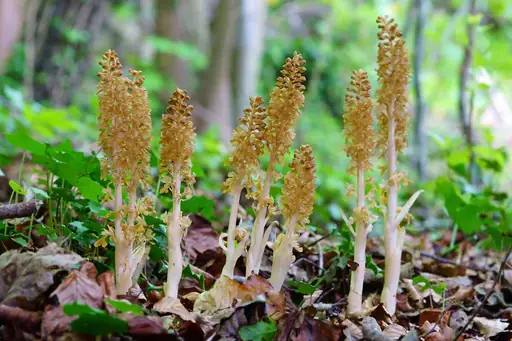
Neottia nidus-avis
The world of orchids is always surprising. Every time I think I’ve seen it all, along comes another unexpected element.
I remember the first time I saw a bird’s-nest orchid.
It looked so bizarre, I thought it was some type of fungus or maybe a poor dead plant. But a living, healthy orchid? I never would have guessed!
Named for their tangled roots that form a circular mass, bird’s-nest orchids are sometimes described as ghostly, sickly, bizarre, and strange.
I mean, those descriptions aren’t wrong, they certainly don’t look like your typical grocery store option, that’s for sure!
If you have an interest in the strange, funky flowers of this world, or maybe just a curiosity about plants in the Orchidaceae family, this guide will introduce you to these lesser known plants.
Here are the things we’ll discuss:
What You’ll Learn
What Are Bird’s-Nest Orchids?
How Do They Feed?
Where Do They Grow?
Can You Cultivate Bird’s-Nest Orchids?
Different Varieties
The most obvious place to start is, of course, a definition of terms.
What Are Bird’s-Nest Orchids?
The bird’s-nest orchid is a plant in the Orchidaceae family in the subfamily Epidendroideae. Its binomial nomenclature is Neottia nidus-avis.
When botanists named this plant, they apparently ran out of creativity. The genus name Neottia is Greek for bird’s nest, and the species name is nidus-avis, which is Latin for bird’s nest.
So we have the bird’s nest bird’s nest orchid, it would seem. A bit repetitive, but hey!
I’m sure you gathered that these plants are part of the same family as other species like slipper (Paphiopedilum parishii), cattleya (Cattleya spp.), and moth orchids (Phalaenopsis spp.).
They don’t look anything like these species, but they’re part of the same Orchidaceae family.
They’re monocarpic, which means they grow a flower stalk, pollinate, set seeds, and die. They won’t come back and grow a new flower stalk. It’s once and done.
These plants grow about one and a half feet tall and produce stalks of sweet-smelling flowers that are self-pollinated or pollinated by flies, thrips, or ants.
These inflorescences can have up to 100 flowers and appear in May or June and last only for a week or two.
If you look closely, the individual flowers have the same characteristic structure of other species in the Orchidaceae family, including five sepals, two petals, and a lip.
The underground roots are comprised of a rhizome and fleshy adventitious roots.
How Do They Feed?
But bird’s-nest orchids take unusual to the next level. They are known as micro-heterotrophs, which means they have a relationship with mycorrhizal fungi in the soil that helps them feed.
They work hand in hand with fungi in the Sebacinaceae family. Instead of using photosynthesis to produce food, they rely on their fungi friends to provide them with energy.
Scientists aren’t exactly sure if the relationship is symbiotic or if the plant receives all the benefits. We just know it works.
Because these plants don’t photosynthesize, their tissues don’t contain chlorophyll. A lack of chlorophyll means they aren’t green but instead are either entirely beige, white, yellow, or gray, with no leaves.
Interestingly, the plant still contains the enzymes to produce chlorophyll, so I guess if it ever got in a fight with its mycorrhizal pals, it could figure out a new way to survive.
Where Do They Grow?
These plants indigenous to Europe, Russia, the Middle East, western Asia, and North Africa where they grow in woodlands, usually under beech (Fagus spp.), hazel (Corylus spp.), and yew (Taxus spp.) in limestone, calcareous, chalky soil.
The fungi that feed them exist around tree roots, so that’s where these plants are found. As such, they’re part of the terrestrial group of orchids.
In Great Britain, they are relatively rare except in certain parts of southern England.
Elsewhere, deforestation and the shifting composition of the forests has reduced the range of the species considerably.
Can You Cultivate Bird’s-Nest Orchids?
While there are some dedicated orchid experts trying to cultivate these plants, they have a very delicate relationship with their environment which makes it impossible for home growers to replicate.
It’s not possible to transplant them from the wild, so if you see these plants, leave them be. They aren’t plants for home growers to cultivate.
Different Varieties
Within the species, there are only a few named varieties. To clarify, varieties are natural variations that occur in the wild, making the plants slightly different from the species.
They haven’t been cultivated or intentionally manipulated by humans.
N. nidus-avis var. pallida is cream, yellow, or white and is extremely rare, especially as its natural range in Europe and England has been dramatically reduced.
N. nidus-avis var. nivea is snow white and found in Europe.
N. nidus-avis var. sulphurea is also found in Europe and has a sulfur-yellow hue, hence the name.
Enjoy the Bizarre and Beautiful
There are some seriously strange plants in the Orchidaceae family, and N. nidus-avis are maybe some of the strangest.
Just knowing they’re out there is a reminder of our fascinating planet with all its mysteries and miraculous life.
Did we miss any facts about this unusual plant that you’d like to share? Or anything else you’d like to know that we missed? Drop a note in the comments section below and start a conversation.
If you’re looking for some more information about growing orchids, we have a few other guides that you might enjoy next:
- How to Grow and Care for Calanthe Orchids
- How to Grow and Care for Oncidium Orchids (Odontoglossum)
- 23 Types of Orchids to Grow as Houseplants
- Facebook2
- X




질문 및 토론